Kurt Niedenzu – författare
Visar alla böcker från författaren Kurt Niedenzu. Handla med fri frakt och snabb leverans.
15 produkter
15 produkter
E-bok
PDF, Engelska, 2013756 kr
Läs direkt efter köp
Annual Reports in Inorganic and General Syntheses-1972 presents an organized annual summary of synthetic developments in inorganic chemistry and its related areas. The book discusses alkali and alkaline earth elements, alloys, silver, gold, zinc, cadmium, mercury, boron, aluminum, gallium, indium, thallium, yttrium, scandium, lanthanides, actinides, titanium, zirconium, hafnium, Group V and VI transition elements, manganese, technetium, rhenium, iron, cobalt, nickel, ruthenium, osmium, rhodium, and iridium. The text also describes the chemistry of palladium, platinum, silicon, germanium, tin, lead, nitrogen, phosphorus, arsenic, antimony, bismuth, chalcogenides, fluorine, halogens, pseudohalogens, noble gases, and simple and complex metal hydrides of main groups I, I, and III. New techniques and reagents in synthetic coordination chemistry, as well as the stabilizing effects of large counter-ions are also encompassed. Chemists, chemistry students, and people working in chemical laboratories will find the book invaluable.
E-bok
PDF, Engelska, 2013763 kr
Läs direkt efter köp
Annual Reports in Inorganic and General Syntheses-1973 presents an organized annual summary of synthetic developments in inorganic chemistry and its related areas. The book covers the synthetic aspects and structural or mechanistic features of elements, including the main group hydrides, alkali and alkaline earth elements, boron, aluminium, gallium, indium, thallium, silicon, germanium, tin, and lead, nitrogen, phosphorus, arsenic, antimony, bismuth, chalcogens, halogens and pseudohalogens, and noble gases. The text also discusses the synthetic aspects and structural or mechanistic features of elements of yttrium, scandium, lanthanides, and actinides, titanium, zirconium, hafnium, vanadium, niobium, tantalum, chromium, molybdenum, tungsten, manganese, technetium, rhenium, iron, cobalt, and nickel. The chemistry of ruthenium, osmium, rhodium, iridium, palladium, platinum, copper, silver, gold, zinc, cadmium, and mercury is also encompassed. The book concludes by describing the synthesis and structures of metalloporphyrins. Chemists, chemistry students, and people working in chemical laboratories will find the book invaluable.
E-bok
PDF, Engelska, 2013756 kr
Läs direkt efter köp
Annual Reports in Inorganic and General Syntheses-1974 presents an organized annual summary of synthetic developments in inorganic chemistry and its related areas. The book discusses the chemistry of simple and complex metal hydrides of main groups I, II, and III, boron, aluminium, gallium, indium, thallium, silicon, germanium, tin, lead, phosphorus, arsenic, antimony, bismuth, chalcogens, halogens, and pseudohalogens. The text also describes the chemistry of scandium, yttrium, lanthanides, actinides, titanium, zirconium, hafnium, vanadium, niobium, tantalum, chromium, molybdenum, tungsten, manganese, technetium, rhenium, iron, cobalt, nickel, ruthenium, osmium, rhodium, and iridium. The chemistry of palladium, platinum, copper, silver, gold, zinc, cadmium, and mercury is also encompassed. The book concludes by demonstrating the photochemical syntheses of inorganic compounds. Chemists, chemistry students, and people working in chemical laboratories will find the book invaluable.
E-bok
PDF, Engelska, 2013756 kr
Läs direkt efter köp
Annual Reports in Inorganic and General Syntheses–1975 presents an annual review of synthetically useful information that would prove beneficial to nearly all organic chemists, both specialist and nonspecialist in synthesis. It should help relieve some of the information storage burden of the specialist and should aid the nonspecialist who is seeking help with a specific problem to become rapidly aware of recent synthetic advances. This is the fourth volume of "ARIGS" and is organized along the lines used for the last volume. The authors were encouraged to use synthetic aspects as their primary guideline for the arrangement and preservation of the information; however, an occasional deviation to include structural or mechanistic features seemed to be justified in order to reflect the particular features of a given element''s chemistry. Complex hydrides were dealt with under the particular elements. As a consequence there is no chapter on simple and complex metal hydrides of main groups I, II, and III in the present volume. As in previous issues of ARIGS, this volume presents an article of a timely subject of special interest. This year''s special feature is the "Synthesis of Radiopharmaceuticals by the Reduction of 99m TcO4-."
E-bok
PDF, Engelska, 2012693 kr
Läs direkt efter köp
Although the chemistry of boron is still relatively young, it is developing at a pace where even specific areas of research are difficult to compile into a monograph. Besides the boron hydrides, boron-nitrogen compounds are among the most fascinating derivatives of boron. Nitrogen compounds exist in a wide variety of molecular structures and display many interesting properties. The combination of nitrogen and boron, however, has some unusual features that are hard to match in any other combination of elements. This situation was first recognized by ALFRED STOCK and it seems proper to pay tribute to his outstanding work in the area of boron chemistry. One should realize that about forty years ago, STOCK and his coworkers had to develop completely new experimental techniq''\les and that no guidance for the interpreta tion of their rather unusual data had been advanced by theoretical chemists. In this monograph an attempt has been made to explore the general characteristics of structure and the principles involved in the preparation and reactions of boron-nitroge~ compounds. It was a somewhat difficult task to select that information which appears to be of the most interest to "inorganic and general chemistry" since the electronic relationship between a boron-nitrogen and a carbon-carbon grouping is reflected in the "organic" character of many of the reactions and compounds.
Del 6 - Anorganische und allgemeine Chemie in Einzeldarstellungen
Boron-Nitrogen Compounds
Häftad, Engelska, 2012
549 kr
Skickas inom 10-15 vardagar
Although the chemistry of boron is still relatively young, it is developing at a pace where even specific areas of research are difficult to compile into a monograph. Besides the boron hydrides, boron-nitrogen compounds are among the most fascinating derivatives of boron. Nitrogen compounds exist in a wide variety of molecular structures and display many interesting properties. The combination of nitrogen and boron, however, has some unusual features that are hard to match in any other combination of elements. This situation was first recognized by ALFRED STOCK and it seems proper to pay tribute to his outstanding work in the area of boron chemistry. One should realize that about forty years ago, STOCK and his coworkers had to develop completely new experimental techniq'\les and that no guidance for the interpreta tion of their rather unusual data had been advanced by theoretical chemists. In this monograph an attempt has been made to explore the general characteristics of structure and the principles involved in the preparation and reactions of boron-nitroge~ compounds. It was a somewhat difficult task to select that information which appears to be of the most interest to "inorganic and general chemistry" since the electronic relationship between a boron-nitrogen and a carbon-carbon grouping is reflected in the "organic" character of many of the reactions and compounds.
E-bok
PDF, Engelska, 20131 109 kr
Läs direkt efter köp
E-bok
PDF, Engelska, 2013687 kr
Läs direkt efter köp
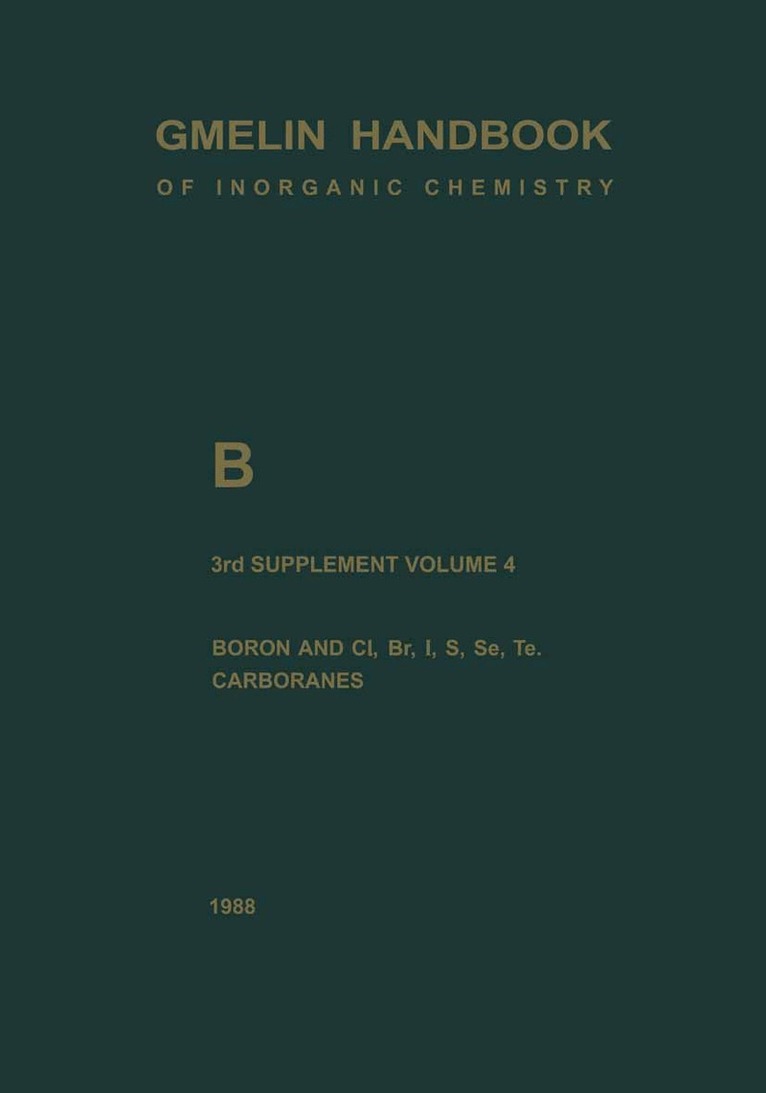
The 3rd supplement continues the updating of the original 20 volumes on boron compounds published between 1974 and 1979. The first supplement consisting of 3 volumes covered all the literature uniformly up to the end of 1977, whereas the two volumes of the 2nd supplement have extended the literature coverage of boron compounds to 1980 and the four volumes of the 3rd supplement to 1984. The present volume continues the description of boron compounds with halogens, presenting those with chlorine, bromine and iodine. The compounds with chalcogens are completed here along with those of boron with S, Se, Te and Po. The final chapter on carboranes contains the carboranes themselves, together with metallacarboranes, and in the last section a description of carborane-containing polymers, mostly derived from the three isomeric dicarbadodecarboranes. Volume 4 of the 3rd supplement brings this supplement series to an end. It will be supplemented by a separately appearing index volume, which contains all the boron compounds dealt with in volumes 1 - 4 of this supplement series.
Häftad, Engelska, 2013
788 kr
Skickas inom 5-8 vardagar
The 3rd supplement continues the updating of the original 20 volumes on boron compounds published between 1974 and 1979. The first supplement consisting of 3 volumes covered all the literature uniformly up to the end of 1977, whereas the two volumes of the 2nd supplement have extended the literature coverage of boron compounds to 1980 and the four volumes of the 3rd supplement to 1984. The present volume continues the description of boron compounds with halogens, presenting those with chlorine, bromine and iodine. The compounds with chalcogens are completed here along with those of boron with S, Se, Te and Po. The final chapter on carboranes contains the carboranes themselves, together with metallacarboranes, and in the last section a description of carborane-containing polymers, mostly derived from the three isomeric dicarbadodecarboranes. Volume 4 of the 3rd supplement brings this supplement series to an end. It will be supplemented by a separately appearing index volume, which contains all the boron compounds dealt with in volumes 1 - 4 of this supplement series.
E-bok
PDF, Engelska, 20131 100 kr
Läs direkt efter köp
The present issue, Volume 3a of "Boron Compounds" 4th Supplement of the Gmelin Hand book, presents the description of boron nitride and a part of other boron compounds containing nitrogen. Volume 3 b (to be published Later) will complete the presentation of the boron-nitrogen compounds and will also cover boron compounds containing fluorine. Due to technical circumstances, Volume 1 (systems with hydrogen) and Volume 2 (systems with oxygen) of this particular supplement will be published subsequently, whereas Volume 4 (boron compounds containing CL, Br, I, S, Se, and Te, as well as a section containing carboranes) has already been published. ALL volumes of the 4th Supplement will be augmented by a formula index. The IUPAC nomenclature is generally adhered to; occasional abbreviations for compounds are explained in the text. A positive sign for the chemical shifts of the NMR signals indicates a 1 13 downfield shift from the references, usually internal (CH ) Si for 6 H and 6 C and external 3 4 11 (C H h0-BF for 6 B, others being specified. 2 5 3 In contrast to more recent publications but remaining consistent with the previous volumes of the Boron Series, the iminoborane structure is written as B=N and not as B=N. In fact, the real electronic structure is more realistically symbolized by B=N, but it seems reasonable to avoid =NR in accordance with the commonly accepted "iminoborane" nomenclature.
E-bok
PDF, Engelska, 2013697 kr
Läs direkt efter köp
A broad coverage of boron topics is provided. Structural elucidations and convenient routes to useful hydroboration reagents are presented as well as boron compounds used for medical purposes. Special attention is devoted to theoretical studies and calculations on small boron-hydrogen and boron-noble gas species including molecules like BH, which are rather favorite subjects of theoreticians for testing various methods of calculation.
Häftad, Engelska, 2013
788 kr
Skickas inom 5-8 vardagar
A broad coverage of boron topics is provided. Structural elucidations and convenient routes to useful hydroboration reagents are presented as well as boron compounds used for medical purposes. Special attention is devoted to theoretical studies and calculations on small boron-hydrogen and boron-noble gas species including molecules like BH, which are rather favorite subjects of theoreticians for testing various methods of calculation.
E-bok
PDF, Engelska, 20131 100 kr
Läs direkt efter köp
The 3rd supplement continues the updating of the original 20 volumes on boron com pounds published between 1974 and 1979. The first supplement to this series brought the literature closing date uniformly to the end of 1977, whereas the two volumes of the 2nd supplement have extended the literature coverage of boron compounds to 1980. Selection and presentation of data parallel the style selected for the two previous supplement volumes, which appeared in 1980/1 and 1982/3, respectively. The Gmelin Principle of the Last Position is largely adhered to, excepting substituted polyboron species containing boron-boron bonds (all of which are found in Chapter 2 within the system boron-hydrogen). Examples of organic derivatives are included, especially in those cases where the carbon-free species are not known; and the carboranes are treated comprehensively. The literature is considered through 1984. Part 1 of the present 3rd supplement contains the systems boron-noble gases and boron hydrogen; Part 2 contains the system boron-oxygen. Part 3 will contain the systems boron nitrogen, boron-fluorine, and boron-chlorine; the remaining systems and a formula indexwill be included in the final 4th part of this supplement. The first chapter of the present volume on the compounds of boron and oxygen provides sections on the binary boron oxides, including some radicals, and the anhydrous berate ions. The following chapter describes boron-oxygen compounds with hydrogen or organyl groups.
E-bok
PDF, Engelska, 2013687 kr
Läs direkt efter köp
The present issue, Volume 2 of "Boron Compounds" 4th Supplement of the Gmelin Hand book, updates the previous issues by reporting the literature on boron-oxygen systems published up to 1988. For some important recent developments literature is covered through mid-1992; this concerns, for example, the compounds ~-Ba3[B306h and U[B305J which became of interest as materials with nonlinear optical properties. The volume directly com plements the earlier "Boron Compounds" 3rd Supplement Volume 2. In the original literature, alternative formulations are frequently used for the same com pound. This is especially true for many borates. Often, these species are neither completely heteropolar nor covalent, and an experimentally based decision has not been made. Hence, the use of brackets does not necessarily reflect a truly salt-like character. Volume 1 (systems with hydrogen and noble gases) of this particular supplement will be published subsequently, whereas Volume 3a (boron and nitrogen), Volume 3b (boron and nitrogen, boron and fluorine), and Volume 4 (boron compounds containing Cl, Br, I, S, Se, and Te, as well as a section containing carboranes) have already been published. All volumes of the 4th supplement will be augmented by a formula index. The IUPAC nomenclature is generally adhered to; thf means tetrahydrofuran; and occa sionally additional abbreviations for compounds are explained in the text. Positive signs for chemical shifts of the NMR signals indicates downfield shifts from the references, usually internal (CH3)4Si for olH and 013C with others being specified.
Häftad, Engelska, 2013
788 kr
Skickas inom 5-8 vardagar
The present issue, Volume 2 of "Boron Compounds" 4th Supplement of the Gmelin Hand book, updates the previous issues by reporting the literature on boron-oxygen systems published up to 1988. For some important recent developments literature is covered through mid-1992; this concerns, for example, the compounds ~-Ba3[B306h and U[B305J which became of interest as materials with nonlinear optical properties. The volume directly com plements the earlier "Boron Compounds" 3rd Supplement Volume 2. In the original literature, alternative formulations are frequently used for the same com pound. This is especially true for many borates. Often, these species are neither completely heteropolar nor covalent, and an experimentally based decision has not been made. Hence, the use of brackets does not necessarily reflect a truly salt-like character. Volume 1 (systems with hydrogen and noble gases) of this particular supplement will be published subsequently, whereas Volume 3a (boron and nitrogen), Volume 3b (boron and nitrogen, boron and fluorine), and Volume 4 (boron compounds containing Cl, Br, I, S, Se, and Te, as well as a section containing carboranes) have already been published. All volumes of the 4th supplement will be augmented by a formula index. The IUPAC nomenclature is generally adhered to; thf means tetrahydrofuran; and occa sionally additional abbreviations for compounds are explained in the text. Positive signs for chemical shifts of the NMR signals indicates downfield shifts from the references, usually internal (CH3)4Si for olH and 013C with others being specified.