L. Boeve – författare
Visar alla böcker från författaren . Handla med fri frakt och snabb leverans.
3 produkter
3 produkter
Del 38 - Annua Nuntia Lovaniensia
Naming God Today
Häftad, Engelska, 1994
275 kr
Skickas inom 3-6 vardagar
Del 53 - Annua Nuntia Lovaniensia
Encountering Transcendence
Contributions to a Theology of Christian Religious Experience
Häftad, Engelska, 2005
933 kr
Tillfälligt slut
This volume consists of several contributions to a refined understanding of religious experience in view of contemporary theological epistemology. Diverse sample studies taken from the extensive field of religion, theology and religious studies reveal that 'religious experience' is today clearly a pivotal issue. More specifically, this is made evident in modern theological hermeneutics and in the anti-modern and/or post-modern reactions thereto, the theology of world religions and inter-religious dialogue, the contemporary resurgence of religiosity in Western society and culture, and the so-called turn to religion in contemporary continental philosophy. It would appear from such studies that the category of 'religious experience' is frequently called upon to clarify or explain the phenomenon of religion and religiosity on the one hand and to support and legitimise religious positions or the critique thereof on the other.Because of the loss of plausibility of tradition-bound religiosity and of foundational, so-called onto-theological schemes, 'religious experience' has come to constitute, for many, the last (or latest) point of departure and anchor for religion and religious thinking. This is certainly the case with respect to tendencies within contemporary Christian traditions and theological reflection. In a multitude of ways and from a variety of different perspectives, 'religious experience' and 'experience of transcendence' or 'of the divine' have gained a prominent place in philosophical and fundamental-theological conceptual schemes. In reaction to this, other authors have denied the very primacy given to religious experience in reflecting upon faith, pointing to the constitutive role of tradition and narrative without which there is no religious experience. From all this follows that the category of religious experience is in great need of reconceptualisation, not least from a theological point of view. On the one hand, religious experience is all too easily called upon to legitimise religious claims (often against 'tradition') and on the other hand, the category has become misleading in so far as it is tainted by the modern scientific understanding of experience - in reaction to which 'tradition' is then easily invoked to protect the core of religion.Both young scholars at the preceding junior conference and senior scholars during the conference's paper sessions presented from diverse perspectives new ways to conceive of religious experience in view of today's challenges of secularisation, religious plurality, the aestheticisation of religion, etc. The selected contributions have been arranged in four thematically oriented parts: 'Approaching Religious Experience in a Postmodern Age', 'Modern (re)Thinking of Religious Experience', 'Liberating Religious Experience', and 'Challenges for Spirituality'.
Del 219 - Bibliotheca Ephemeridum Theologicarum Lovaniensium
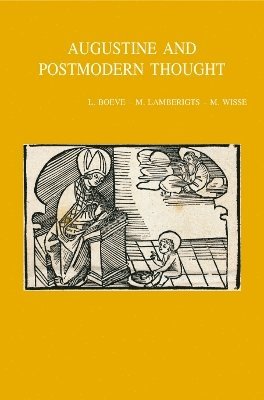
Augustine and Postmodern Thought
A New Alliance against Modernity?
Häftad, Engelska, 2009
1 576 kr
Tillfälligt slut
On November 9-11, 2006, the Research Group 'Theology in a Postmodern Context' (K.U.Leuven) organised an expert symposium on the return of Augustine in current postmodern philosophical-theological debates. The North-African Church Father, or at least the thinking patterns or intuitions borrowed from him, are often invoked in discussions on the relation between Christian faith and the contemporary postmodern context. On the one hand, one observes the retrieval of rather premodern approaches in order to remedy the so-called (post-)modern crisis, which is said to result in nihilism, relativism, etc. For what seems to attract some theologians in Augustinian thinking is the (apparent) marriage between Greek (neo-Platonic) philosophy and Christian faith. Such a combination of premodern metaphysics and Christian faith would serve as a necessary presupposition for every legitimate theological epistemology. On the other hand, there are theologians and philosophers who are increasingly trying to reread Augustine from a postmodern stance, stressing the role of particularity, narrativity, historicity, and the decentring of subjectivity, which they see present in Augustine's approach, or from which they deconstruct Augustine's thinking.Central questions discussed during the symposium were: Are the analyses, offered by authors who are re-introducing Augustine with respect to the contemporary context, correct? To what diagnosed problems, and on what basis, do they propose Augustine as a remedy? Are their presentations of other theological and philosophical responses to the present situation correct and which 'Augustine' do they claim to represent? More fundamentally: what would a genuine Augustinian epistemology look like, and what can we gain from it? In what way can it be normative for a theological epistemology in our day? In answering these questions, the symposium focused explicitly on contemporary philosophical and theological evaluations of both modernity and postmodernity, and theological responses to them.