Lachowicz Miroslaw Lachowicz – författare
Visar alla böcker från författaren Lachowicz Miroslaw Lachowicz. Handla med fri frakt och snabb leverans.
3 produkter
3 produkter
E-bok
PDF, Engelska, 1991475 kr
Läs direkt efter köp
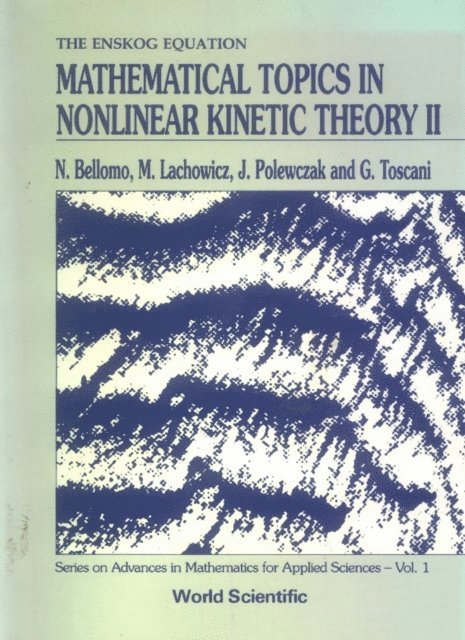
This book deals with the relevant mathematical aspects related to the kinetic equations for moderately dense gases with particular attention to the Enskog equation.
E-bok
PDF, Engelska, 2003342 kr
Läs direkt efter köp
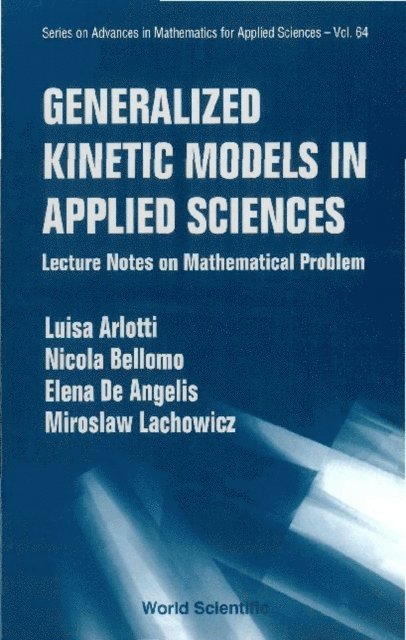
This book deals with analytic problems related to some developments and generalizations of the Boltzmann equation toward the modeling and qualitative analysis of large systems that are of interest in applied sciences. These generalizations are documented in the various surveys edited by Bellomo and Pulvirenti with reference to models of granular media, traffic flow, mathematical biology, communication networks, and coagulation models.The above literature motivates applied mathematicians to study the Cauchy problem and to develop an asymptotic analysis for models regarded as developments of the Boltzmann equation. This book aims to initiate the research plan by the analyzing afore mentioned analysis problems.The first generalization dealt with refers to the averaged Boltzmann equation, which is obtained by suitable averaging of the distribution function of the field particles into the action domain of the test particle. This model is further developed to describe equations with dissipative collisions and a class of models that are of interest in mathematical biology. In this latter case the state of the particles is defined not only by a mechanical variable but also by a biological microscopic state.The book is essentially devoted to analytic aspects and deals with the analysis of the Cauchy problem and with the development of an asymptotic theory to obtain the macroscopic description from the mesoscopic one.
E-bok
PDF, Engelska, 2009516 kr
Läs direkt efter köp
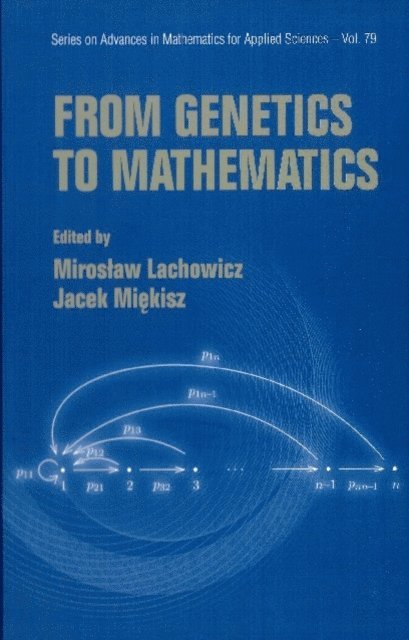
This volume contains pedagogical and elementary introductions to genetics for mathematicians and physicists as well as to mathematical models and techniques of population dynamics. It also offers a physicist''s perspective on modeling biological processes.Each chapter starts with an overview followed by the recent results obtained by authors. Lectures are self-contained and are devoted to various phenomena such as the evolution of the genetic code and genomes, age-structured populations, demography, sympatric speciation, the Penna model, Lotka-Volterra and other predator-prey models, evolutionary models of ecosystems, extinctions of species, and the origin and development of language. Authors analyze their models from the computational and mathematical points of view.