Lane A. Hemaspaandra - Böcker
Visar alla böcker från författaren Lane A. Hemaspaandra. Handla med fri frakt och snabb leverans.
7 produkter
7 produkter
552 kr
Skickas inom 10-15 vardagar
Complexity theory has been a flourishing area of research in the last ten years and currently provides one of the most active subjects for future research problems in computer science. This volume provides a survey of the subject in the form of a collection of articles written by experts that to- gether provide a comprehensive guide to research. The editors' aim has been to provide an accessible description of the current state of complexity theory,and to demonstrate the breadth of techniques and results that make the subject exciting. Thus, papers run the gamut from sublogarithmic space to exponential time and from new combinatorial techniques to interactive proof systems. As a result, researchers in computer science will find this an excellent starting point for study in the subject and a useful source of the key results known.
552 kr
Skickas inom 10-15 vardagar
Readers of Complexity Theory Retrospective (published by Springer-Verlag in 1990) will remember that the collection consisted primarily of articles that first ap peared in preliminary form at one of the meetings of the Annual IEEE Conference on Structure in Complexity Theory. In particular, Complexity Theory Retrospective contained final versions of high-quality technical expository presentations, includ ing talks that honored Juris Hartmanis on the occasion of his sixtieth birthday. We began planning for the current collection some months before the scheduled meeting in 1994 of the Tenth Annual IEEE Conference on Structure in Complexity Theory. As with the original volume, several of the papers in this book originated as presentations at one of the meetings of the Structure in Complexity Theory con ference. We are pleased to provide this forum for final, polished versions of these papers. As it turns out, 1994 was a watershed year for the Structures conference, for at this meeting the conference attendees voted to change the conference name to its current name, the Annual IEEE Conference on Computational Complex ity. In voting to remove the expression "Structure in," the conferees recognized the recent explosion of techniques and results in computational complexity, and expressed concern that the original conference name might not accurately reflect the current status. We approached this volume in the same spirit.
1 096 kr
Skickas inom 10-15 vardagar
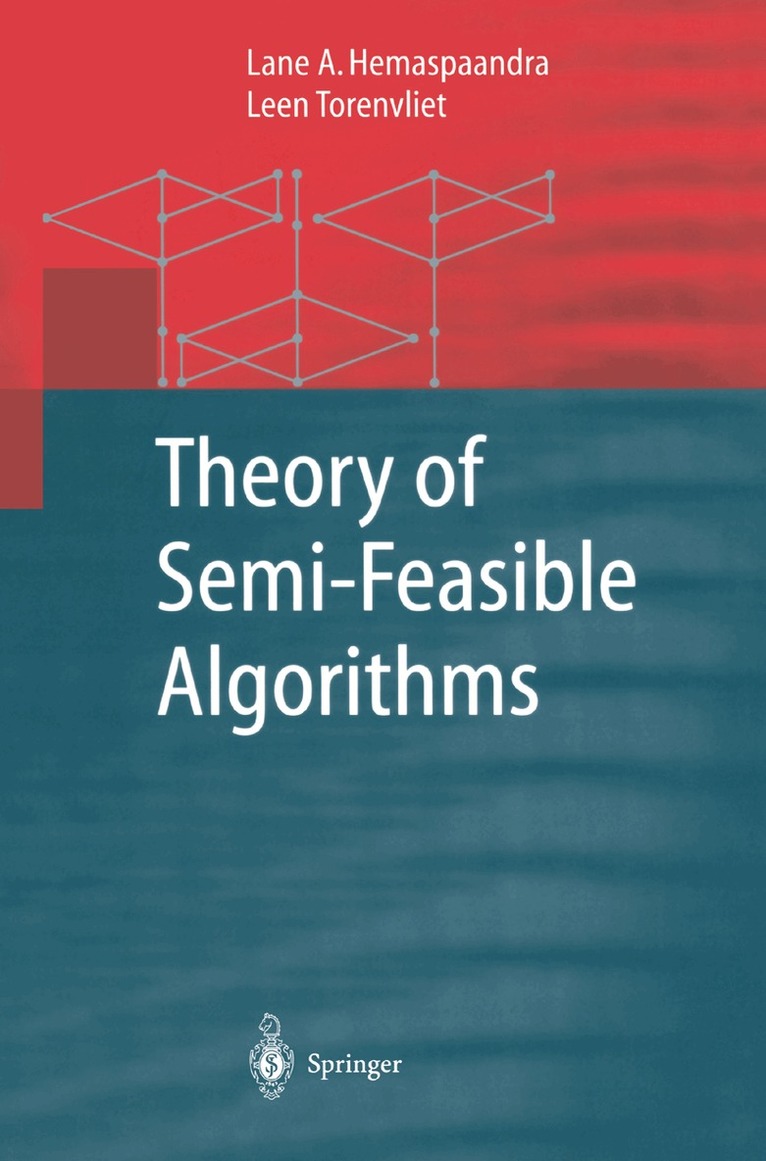
This book presents a consolidated survey of the vibrant field of research known as the theory of semi-feasible algorithms. This research stream perfectly showcases the richness of, and contrasts between, the central notions of complexity: running time, nonuniform complexity, lowness, and NP-hardness. Research into semi-feasible computation has already developed a rich set of tools, yet is young enough to have an abundance of fresh, open issues. Being essentially self-contained, the book requires neither great mathematical maturity nor an extensive background in computational complexity theory or in computer science in general. Newcomers are introduced to the field systematically and guided to the frontiers of current research. Researchers already active in the field will appreciate the book as a valuable source of reference.
853 kr
Skickas inom 7-10 vardagar
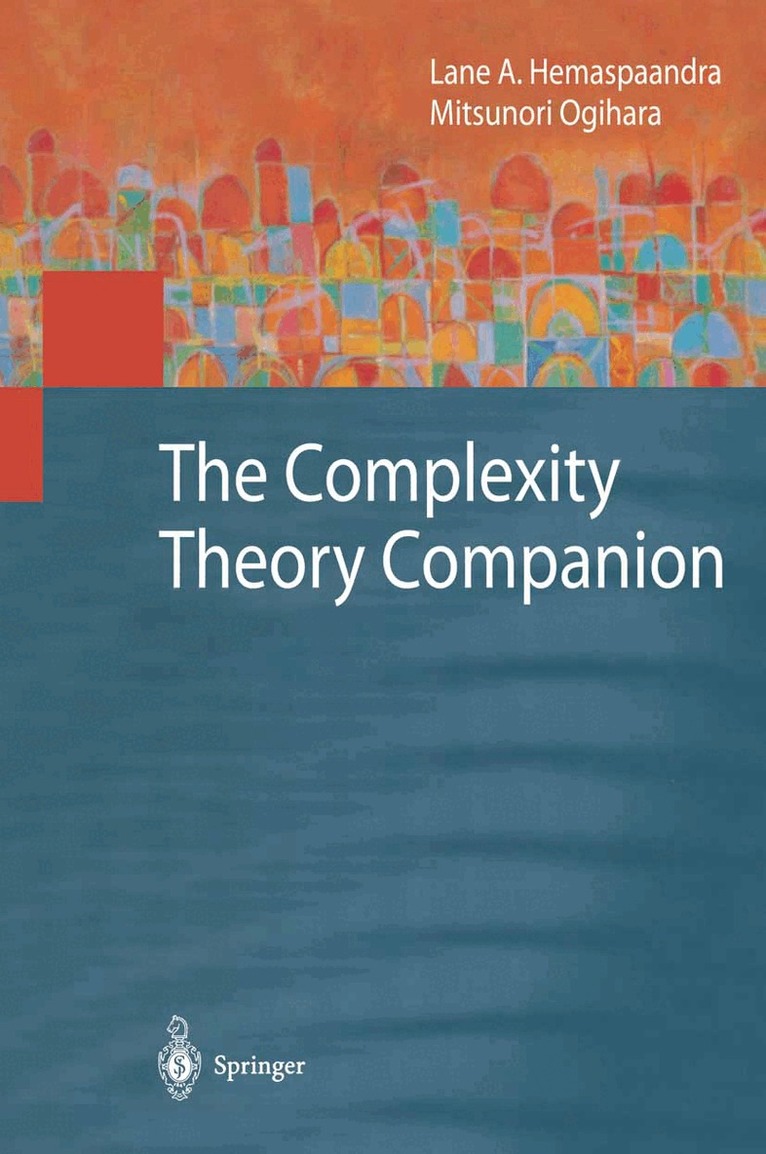
The Complexity Theory Companion is an accessible, algorithmically oriented, research-centered, up-to-date guide to some of the most interesting techniques of complexity theory.The book's thesis is that simple algorithms are at the heart of complexity theory. From the tree-pruning and interval-pruning algorithms that shape the first chapter to the query simulation procedures that dominate the last chapter, the central proof methods of the book are algorithmic. And to more clearly highlight the role of algorithmic techniques in complexity theory, the book is - unlike other texts on complexity - organized by technique rather than by topic. Each chapter of this book focuses on one technique: what it is, and what results and applications it yields.This textbook was developed at the University of Rochester in courses given to graduate students and advanced undergraduates. Researchers also will find this book a valuable source of reference due to the comprehensive bibliography of close to five hundred entries, the thirty-five page subject index, and the appendices giving overviews of complexity classes and reductions.
1 096 kr
Skickas inom 10-15 vardagar
An Invitation to the Dance It is an underappreciated fact that sets may have various types of complex ity, and not all types are in harmony with each other. The primary goal of this book is to unify and make more widely accessible a vibrant stream of research-the theory of semi-feasible computation-that perfectly showcases the richness of, and contrasts between, the central types of complexity. The semi-feasible sets, which are most commonly referred to as the P selective sets, are those sets L for which there is a deterministic polynornial time algorithm that, when given as input any two strings of which at least one belongs to L, will output one of them that is in L. The reason we saythat the semi-feasible sets showcase the contrasts among types of complexity is that it is well-known that many semi-feasible sets have no recursive algorithms (thus their time complexitycannot be upper-bounded by standard time-complexity classes), yet all semi-feasible sets are simple in a wide range of other natural senses. In particular, the semi-feasible sets have small circuits, they are in the extended low hierarchy, and they cannot be NP-complete unless P = NP. The semi-feasible sets are fascinating for many reasons. First, as men tioned above, they showcase the fact that mere deterministic time complex ity is not the only potential type of complexity in the world of computation.
610 kr
Skickas inom 10-15 vardagar
The Complexity Theory Companion is an accessible, algorithmically oriented, research-centered, up-to-date guide to some of the most interesting techniques of complexity theory.The book's thesis is that simple algorithms are at the heart of complexity theory. From the tree-pruning and interval-pruning algorithms that shape the first chapter to the query simulation procedures that dominate the last chapter, the central proof methods of the book are algorithmic. And to more clearly highlight the role of algorithmic techniques in complexity theory, the book is - unlike other texts on complexity - organized by technique rather than by topic. Each chapter of this book focuses on one technique: what it is, and what results and applications it yields.This textbook was developed at the University of Rochester in courses given to graduate students and advanced undergraduates. Researchers also will find this book a valuable source of reference due to the comprehensive bibliography of close to five hundred entries, the thirty-five page subject index, and the appendices giving overviews of complexity classes and reductions.
634 kr
Skickas inom 5-8 vardagar