Laura E. Grube – författare
Visar alla böcker från författaren Laura E. Grube. Handla med fri frakt och snabb leverans.
4 produkter
4 produkter
Inbunden, Engelska, 2015
2 674 kr
Skickas inom 5-8 vardagar
Culture has been a relatively understudied subject within economics. Economists who have studied it often conceive culture as a form of capital, treating it as a set of tools or a resource that certain groups possess and other groups do not. Austrian economics, in contrast, is a science of human behavior that is primarily concerned with making sense of meaningful human action. Because of this, Austrian economists are particularly well suited to inject cultural considerations into economic analysis.This edited volume, a collection of both theoretical essays and empirical studies, presents an Austrian economics perspective on the role of culture in economic action. The authors illustrate that culture cannot be separated from economic action, but that it is in fact part of all decision-making.Culture and Economic Action is an enlightening cross-disciplinary exploration that will appeal to all scholars in the social sciences, from anthropologists to economists.Contributors: P.D. Aligica, P.J. Boettke, E. Chamlee-Wright, B. Colon, C.J. Coyne, L.E. Grube, A. John, R. Langrill, D. Lavoie, P.T. Leeson, A. Matei, K.W. O'Donnell, P. Runst, S. Stein, V.H. Storr
Inbunden, Engelska, 2015
1 192 kr
Skickas inom 10-15 vardagar
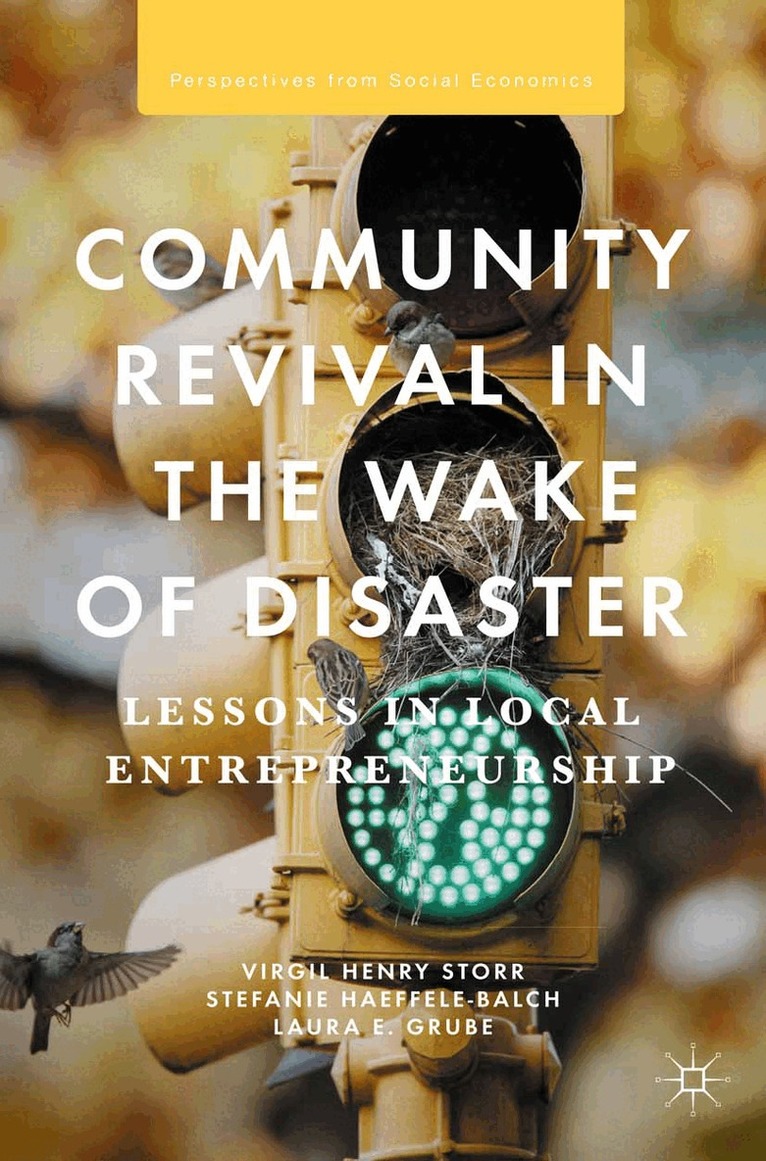
Rebounding after disasters like tsunamis, hurricanes, earthquakes, and floods can be daunting. Communities must have residents who can not only gain access to the resources that they need to rebuild but who can also overcome the collective action problem that characterizes post-disaster relief efforts. Community Revival in the Wake of Disaster argues that entrepreneurs, conceived broadly as individuals who recognize and act on opportunities to promote social change, fill this critical role. Using examples of recovery efforts following Hurricane Katrina in New Orleans, Louisiana, and Hurricane Sandy on the Rockaway Peninsula in New York, the authors demonstrate how entrepreneurs promote community recovery by providing necessary goods and services, restoring and replacing disrupted social networks, and signaling that community rebound is likely and, in fact, underway. They argue that creating space for entrepreneurs to act after disasters is essential for promoting recovery and fosteringresilient communities.
E-bok
PDF, Engelska, 20161 416 kr
Läs direkt efter köp
Rebounding after disasters like tsunamis, hurricanes, earthquakes, and floods can be daunting. Communities must have residents who can not only gain access to the resources that they need to rebuild but who can also overcome the collective action problem that characterizes post-disaster relief efforts. Community Revival in the Wake of Disaster argues that entrepreneurs, conceived broadly as individuals who recognize and act on opportunities to promote social change, fill this critical role. Using examples of recovery efforts following Hurricane Katrina in New Orleans, Louisiana, and Hurricane Sandy on the Rockaway Peninsula in New York, the authors demonstrate how entrepreneurs promote community recovery by providing necessary goods and services, restoring and replacing disrupted social networks, and signaling that community rebound is likely and, in fact, underway. They argue that creating space for entrepreneurs to act after disasters is essential for promoting recovery and fosteringresilient communities.
Häftad, Engelska, 2015
860 kr
Skickas inom 5-8 vardagar
Rebounding after disasters like tsunamis, hurricanes, earthquakes, and floods can be daunting. Communities must have residents who can not only gain access to the resources that they need to rebuild but who can also overcome the collective action problem that characterizes post-disaster relief efforts. Community Revival in the Wake of Disaster argues that entrepreneurs, conceived broadly as individuals who recognize and act on opportunities to promote social change, fill this critical role. Using examples of recovery efforts following Hurricane Katrina in New Orleans, Louisiana, and Hurricane Sandy on the Rockaway Peninsula in New York, the authors demonstrate how entrepreneurs promote community recovery by providing necessary goods and services, restoring and replacing disrupted social networks, and signaling that community rebound is likely and, in fact, underway. They argue that creating space for entrepreneurs to act after disasters is essential for promoting recovery and fosteringresilient communities.