Laura H. Kahn - Böcker
Visar alla böcker från författaren Laura H. Kahn. Handla med fri frakt och snabb leverans.
6 produkter
6 produkter
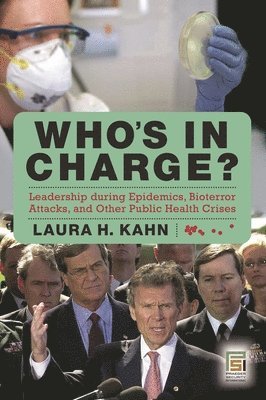
Who's in Charge?
Leadership during Epidemics, Bioterror Attacks, and Other Public Health Crises
Inbunden, Engelska, 2009
789 kr
Skickas inom 5-8 vardagar
A detailed exploration of leadership problems that can develop during public health crises such as the anthrax attacks, SARS, and Mad Cow disease.An imminent threat to the public health, such as the swine flu outbreak, is no time for a muddled chain of command and contradictory decision making. Who's In Charge? Leadership during Epidemics, Bioterror Attacks, and Other Public Health Crises explores the crucial relationships between political leaders, public health officials, journalists, and others to see why leadership confusion develops.Who’s In Charge? begins by looking at the overarching issues of leadership, public health administration, and the threats of bioterrorism. It then examines five recent emergencies—the 2001 anthrax attacks and 1993 cryptosporidium outbreak in the United States, the 2003 SARS outbreak in Toronto, the 2001 foot-and-mouth disease crisis, and the decade-long battle against Mad Cow Disease in the U.K. A perfect text for schools in public health, or as a reference for elected officials at every level of government, the book shows how each event developed step-by-step to pinpoint specific leadership issues. Engaging and absorbing, the work presents official reports, medical literature, first-person accounts from officials and journalists, and discussions of the role of law enforcement and the military during health care emergencies.First-person accounts from leaders involved in the actual crises, as well as leading experts, scientists, and othersPrimary documents including excerpts from official reports and the medical literatureChronologies of five recent public health emergenciesA comprehensive index organized by disease and by individuals involved in emergency response
302 kr
Tillfälligt slut
Zoonoses-infectious diseases, such as SARS and mad cow, that originate in animals and spread to humans-reveal how intimately animal and human health are linked. Complicating this relationship further, when livestock are given antibiotics to increase growth, it can lead to resistant bacteria. Unfortunately, there are few formal channels for practitioners of human medicine and veterinary medicine to communicate about threats to public health. To address this problem, Dr. Laura H. Kahn and her colleagues are promoting the One Health concept, which seeks to increase communication and collaboration between professionals in human, animal, and environmental health. In One Health and the Politics of Antimicrobial Resistance, Dr. Kahn investigates the use of antibiotics and the surge in antimicrobial resistance in food animals and humans from a One Health perspective. Although the medical community has blamed the problem on agricultural practices, the agricultural community insists that antibiotic resistance is the result of indiscriminate use of antibiotics in human medicine. Dr.Kahn argues that this blame game has fueled the politics of antibiotic resistance and hindered the development of effective policies to address the worsening crisis. Combining painstaking research with unprecedented access to international data, the book analyzes the surprising outcomes of differing policy approaches to antibiotic resistance around the globe. By integrating the perspectives of both medicine and agriculture and exploring the history and science behind the widespread use of growth-promoting antibiotics, One Health and the Politics of Antimicrobial Resistance examines the controversy in a unique way while offering policy recommendations that all sides can accept.
363 kr
Skickas inom 7-10 vardagar
Unpacks the mysteries of COVID-19's origins to impart important lessons for future outbreaks.Unpacking the mysteries of COVID-19's origins to impart important lessons for future outbreaks.In this timely book, leading public health expert Laura H. Kahn uses the comprehensive One Health approach to investigate the COVID-19 pandemic. The concept of "One Health" recognizes the interconnected links among the health of humans, animals, plants, and the environment. By comparing the history, science, and clinical presentations of three different coronaviruses—SARS-CoV-1, MERS, and SARS-CoV-2 (COVID-19)—Kahn uncovers insights with important repercussions for how to prepare for and avoid future pandemics. The One Health approach is a useful framework for examining the outbreak of COVID-19. Understanding the origins of this zoonotic disease requires examining the environmental and molecular biological factors that allowed the virus to spread to humans. Kahn investigates the many ways in which the wild animal trade, wet markets, and the camel industry contributed to the spread of earlier coronaviruses such as SARS-CoV-1 and MERS. The book also explores the biosafety, biosecurity, and bioethics implications of gain-of-function research on pandemic potential pathogens. This important book is a must-read to understand the history, science, and geopolitics of the COVID-19 pandemic.
Who's in Charge?
Leadership during Epidemics, Bioterror Attacks, and Other Public Health Crises
Häftad, Engelska, 2020
368 kr
Skickas inom 10-15 vardagar
With a new preface assessing leadership responses to the coronavirus pandemic, this text explores leadership problems that can develop during such public health crises as the 2001 anthrax attacks, 2003 SARS epidemic, and Mad Cow Disease epidemic of the 1980s–1990s.A threat to public health, such as a rampaging virus, is no time for a muddled chain of command and contradictory decision-making. Who's In Charge? Leadership during Epidemics, Bioterror Attacks, and Other Public Health Crises, re-issued with a new preface assessing leadership during the COVID-19 outbreak, explores the crucial relationships among political leaders, public health officials, and journalists to see why leadership confusion develops. As the problematic response to COVID-19 has once again shown, the reluctance of politicians to risk alarm can run counter to the public health need to prepare for worse cases.Many leaders will seek high visibility during a public health crisis, but politicians are not medical experts, and the more they speak, the more they risk disseminating harmful information. How to achieve the right balance is the essence of this book. Beginning by looking at the overarching issues of leadership and public health administration, it then examines in depth five emergencies: the 2001 anthrax attacks, the 1993 cryptosporidium outbreaks, the 2003 SARS outbreak, the 2001 foot-and-mouth disease crisis, and the battle against Mad Cow Disease.
1 625 kr
Skickas inom 10-15 vardagar
This book provides readers with information on the factors underlying the emergence of infectious diseases originating in animals and spreading to people. The One Health concept recognizes the important links between human, animal, and environmental health and provides an important strategy in epidemic mitigation and prevention. The essential premise of the One Health concept is to break down the silos among the different health professions and promote transdisciplinary collaborations. These concepts are illustrated with in-depth analyses of specific zoonotic agents and with examples of the successes and challenges associated with implementing One Health. The book also highlights some of the challenges societies face in confronting several specific zoonotic diseases. A chapter is included on comparative medicine to demonstrate the broad scope of the One Health concept. Edited by a team including the One Health Initiative pro bono members, the book is dedicated to those studying zoonotic diseases and comparative medicine in both human and veterinary medicine, to those involved in the prevention and control of zoonotic infections and to those in the general public interested in the visionary field of One Health.
1 625 kr
Skickas inom 10-15 vardagar
This book provides readers with information on the factors underlying the emergence of infectious diseases originating in animals and spreading to people. The One Health concept recognizes the important links between human, animal, and environmental health and provides an important strategy in epidemic mitigation and prevention. The essential premise of the One Health concept is to break down the silos among the different health professions and promote transdisciplinary collaborations. These concepts are illustrated with in-depth analyses of specific zoonotic agents and with examples of the successes and challenges associated with implementing One Health. The book also highlights some of the challenges societies face in confronting several specific zoonotic diseases. A chapter is included on comparative medicine to demonstrate the broad scope of the One Health concept. Edited by a team including the One Health Initiative pro bono members, the book is dedicated to those studying zoonotic diseases and comparative medicine in both human and veterinary medicine, to those involved in the prevention and control of zoonotic infections and to those in the general public interested in the visionary field of One Health.