Laura Lein - Böcker
Visar alla böcker från författaren Laura Lein. Handla med fri frakt och snabb leverans.
5 produkter
5 produkter
207 kr
Skickas inom 10-15 vardagar
A Choice Outstanding Academic BookIn the decade since President Clinton signed the Personal Responsibility and Work Opportunity Reconciliation Act of 1996 into law-amidst promises that it would "end welfare as we know it"-did the reforms ending entitlements and moving toward time limits and work requirements lift Texas families once living on welfare out of poverty, or merely strike their names from the administrative rolls?Under welfare reform, Texas continued with low monthly payments and demanding eligibility criteria. Many families who could receive welfare in other states do not qualify in Texas, and virtually any part-time job makes a family ineligible. In Texas, most families who leave welfare remain in or near poverty, and many are likely to return to the welfare rolls in the future.This compelling work, which follows 179 families after leaving welfare, is set against a backdrop of multiple types of data and econometric modeling. The authors' multi-method approach draws on administrative data from nine programs serving low-income families and a statewide survey of families who have left welfare. Survey data on health problems, transportation needs, and child-care issues shed light on the patterns of employment and welfare use seen in the administrative data. In their lives after welfare, the families chronicled here experience poverty even when employed; a multiplicity of barriers to employment that work to exacerbate one another; and a failing safety net of basic human services as they attempt to sustain low-wage employment.
Community Lost
The State, Civil Society, and Displaced Survivors of Hurricane Katrina
Häftad, Engelska, 2014
360 kr
Skickas inom 7-10 vardagar
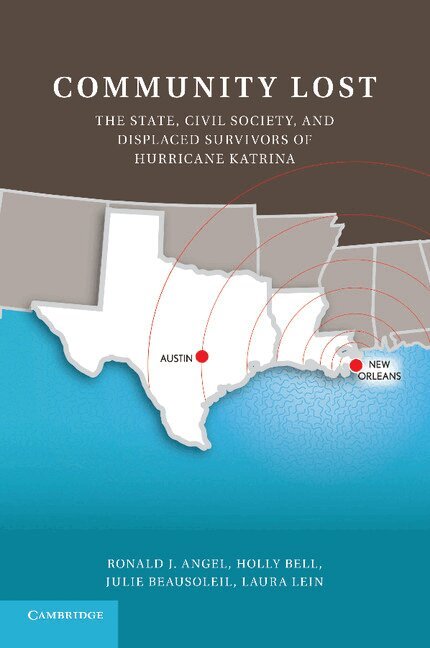
Neither government programs nor massive charitable efforts responded adequately to the human crisis that was Hurricane Katrina. In this study, the authors use extensive interviews with Katrina evacuees and reports from service providers to identify what helped or hindered the reestablishment of the lives of hurricane survivors who relocated to Austin, Texas. Drawing on social capital and social network theory, the authors assess the complementary, and often conflicting, roles of FEMA, other governmental agencies and a range of non-governmental organizations in addressing survivors' short- and longer-term needs. While these organizations came together to assist with immediate emergency needs, even collectively they could not deal with survivors' long-term needs for employment, affordable housing and personal records necessary to rebuild lives. Community Lost provides empirical evidence that civil society organizations cannot substitute for an efficient and benevolent state, which is necessary for society to function.
428 kr
Skickas inom 7-10 vardagar
Poor Families in America's Health Care Crisis examines the implications of the fragmented and two-tiered health insurance system in the United States for the health care access of low-income families. For a large fraction of Americans their jobs do not provide health insurance or other benefits and although government programs are available for children, adults without private health care coverage have few options. Detailed ethnographic and survey data from selected low-income neighborhoods in Boston, Chicago, and San Antonio document the lapses in medical coverage that poor families experience and reveal the extent of untreated medical conditions, delayed treatment, medical indebtedness, and irregular health care that women and children suffer as a result. Extensive poverty, the increasing proportion of minority households, and the growing dependence on insecure service sector work all influence access to health care for families at the economic margin.
1 228 kr
Skickas inom 7-10 vardagar
Poor Families in America's Health Care Crisis examines the implications of the fragmented and two-tiered health insurance system in the United States for the health care access of low-income families. For a large fraction of Americans their jobs do not provide health insurance or other benefits and although government programs are available for children, adults without private health care coverage have few options. Detailed ethnographic and survey data from selected low-income neighborhoods in Boston, Chicago, and San Antonio document the lapses in medical coverage that poor families experience and reveal the extent of untreated medical conditions, delayed treatment, medical indebtedness, and irregular health care that women and children suffer as a result. Extensive poverty, the increasing proportion of minority households, and the growing dependence on insecure service sector work all influence access to health care for families at the economic margin.
Community Lost
The State, Civil Society, and Displaced Survivors of Hurricane Katrina
Inbunden, Engelska, 2012
731 kr
Skickas inom 7-10 vardagar
Neither government programs nor massive charitable efforts responded adequately to the human crisis that was Hurricane Katrina. In this study, the authors use extensive interviews with Katrina evacuees and reports from service providers to identify what helped or hindered the reestablishment of the lives of hurricane survivors who relocated to Austin, Texas. Drawing on social capital and social network theory, the authors assess the complementary, and often conflicting, roles of FEMA, other governmental agencies and a range of non-governmental organizations in addressing survivors' short- and longer-term needs. While these organizations came together to assist with immediate emergency needs, even collectively they could not deal with survivors' long-term needs for employment, affordable housing and personal records necessary to rebuild lives. Community Lost provides empirical evidence that civil society organizations cannot substitute for an efficient and benevolent state, which is necessary for society to function.