
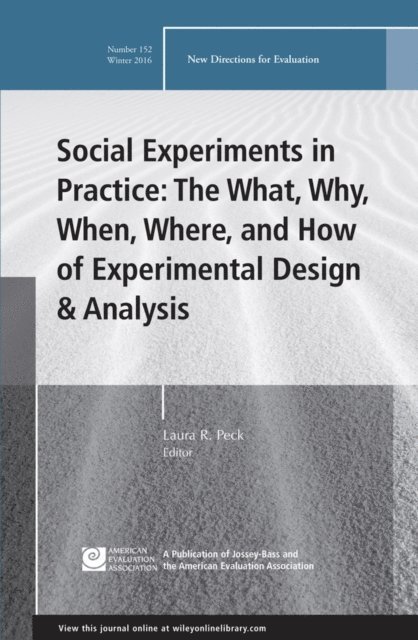
This issue considers social experiments in practice and how recent advances improve their value and potential applications. Although controversial, it is clear they are here to stay and are in fact increasing. With their greater abundance, experimental evaluations have stretched to address more diverse policy questions, no longer simply providing a treatment–control contrast but adding multiarm, multistage, and multidimensional (factorial) designs and analytic extensions to expose more about what works best for whom. Social experiments are also putting programs under the microscope when they are most ready for testing, enhancing the policy value of their findings. This volume provides new developments in all these areas from scholars instrumental to recent scientific advances. In some instances, established ideas are given new attention, connecting them to new opportunities to learn and inform policy. By all means, this issue aims to encourage stronger and more informative social experiments in the future.This is the 152nd issue in the New Directions for Evaluation series from Jossey-Bass. It is an official publication of the American Evaluation Association.
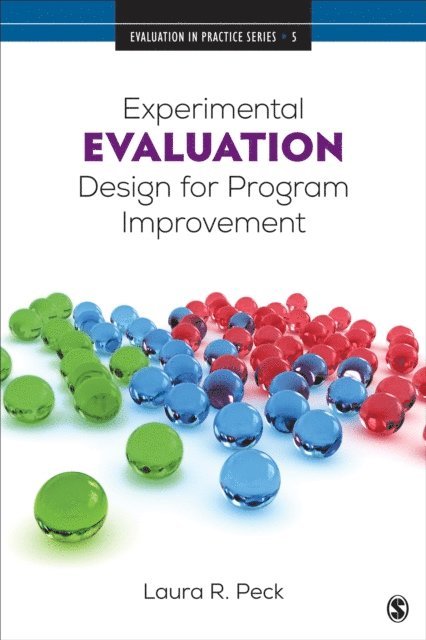
The concepts of cause and effect are critical to the field of program evaluation. Experimentally-designed evaluations—those that randomize to treatment and control groups—offer a convincing means for establishing a causal connection between a program and its effects. Experimental Evaluation Design for Program Improvement considers a range of impact evaluation questions, particularly those questions that focus on the impact of specific aspects of a program. Laura R. Peck shows how a variety of experimental evaluation design options can provide answers to these questions, and she suggests opportunities for experiments to be applied in more varied settings and focused on program improvement efforts.
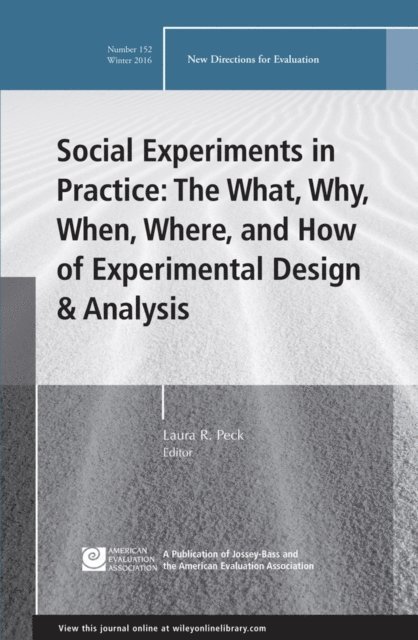
This issue considers social experiments in practice and how recent advances improve their value and potential applications. Although controversial, it is clear they are here to stay and are in fact increasing. With their greater abundance, experimental evaluations have stretched to address more diverse policy questions, no longer simply providing a treatment–control contrast but adding multiarm, multistage, and multidimensional (factorial) designs and analytic extensions to expose more about what works best for whom. Social experiments are also putting programs under the microscope when they are most ready for testing, enhancing the policy value of their findings. This volume provides new developments in all these areas from scholars instrumental to recent scientific advances. In some instances, established ideas are given new attention, connecting them to new opportunities to learn and inform policy. By all means, this issue aims to encourage stronger and more informative social experiments in the future.This is the 152nd issue in the New Directions for Evaluation series from Jossey-Bass. It is an official publication of the American Evaluation Association.
The concepts of cause and effect are critical to the field of program evaluation. Experimentally-designed evaluations—those that randomize to treatment and control groups—offer a convincing means for establishing a causal connection between a program and its effects. Experimental Evaluation Design for Program Improvement considers a range of impact evaluation questions, particularly those questions that focus on the impact of specific aspects of a program. Laura R. Peck shows how a variety of experimental evaluation design options can provide answers to these questions, and she suggests opportunities for experiments to be applied in more varied settings and focused on program improvement efforts.