Lawrence B. Holder – författare
Visar alla böcker från författaren Lawrence B. Holder. Handla med fri frakt och snabb leverans.
5 produkter
5 produkter
E-bok
PDF, Engelska, 20062 061 kr
Läs direkt efter köp
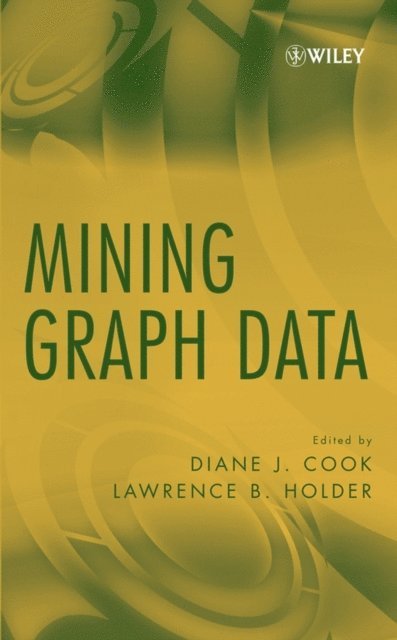
This text takes a focused and comprehensive look at mining data represented as a graph, with the latest findings and applications in both theory and practice provided. Even if you have minimal background in analyzing graph data, with this book you’ll be able to represent data as graphs, extract patterns and concepts from the data, and apply the methodologies presented in the text to real datasets.
There is a misprint with the link to the accompanying Web page for this book. For those readers who would like to experiment with the techniques found in this book or test their own ideas on graph data, the Web page for the book should be http://www.eecs.wsu.edu/MGD.
Inbunden, Engelska, 2006
1 818 kr
Skickas inom 5-8 vardagar
This text takes a focused and comprehensive look at mining data represented as a graph, with the latest findings and applications in both theory and practice provided. Even if you have minimal background in analyzing graph data, with this book you’ll be able to represent data as graphs, extract patterns and concepts from the data, and apply the methodologies presented in the text to real datasets. There is a misprint with the link to the accompanying Web page for this book. For those readers who would like to experiment with the techniques found in this book or test their own ideas on graph data, the Web page for the book should be http://www.eecs.wsu.edu/MGD.
E-bok
PDF, Engelska, 20062 036 kr
Läs direkt efter köp
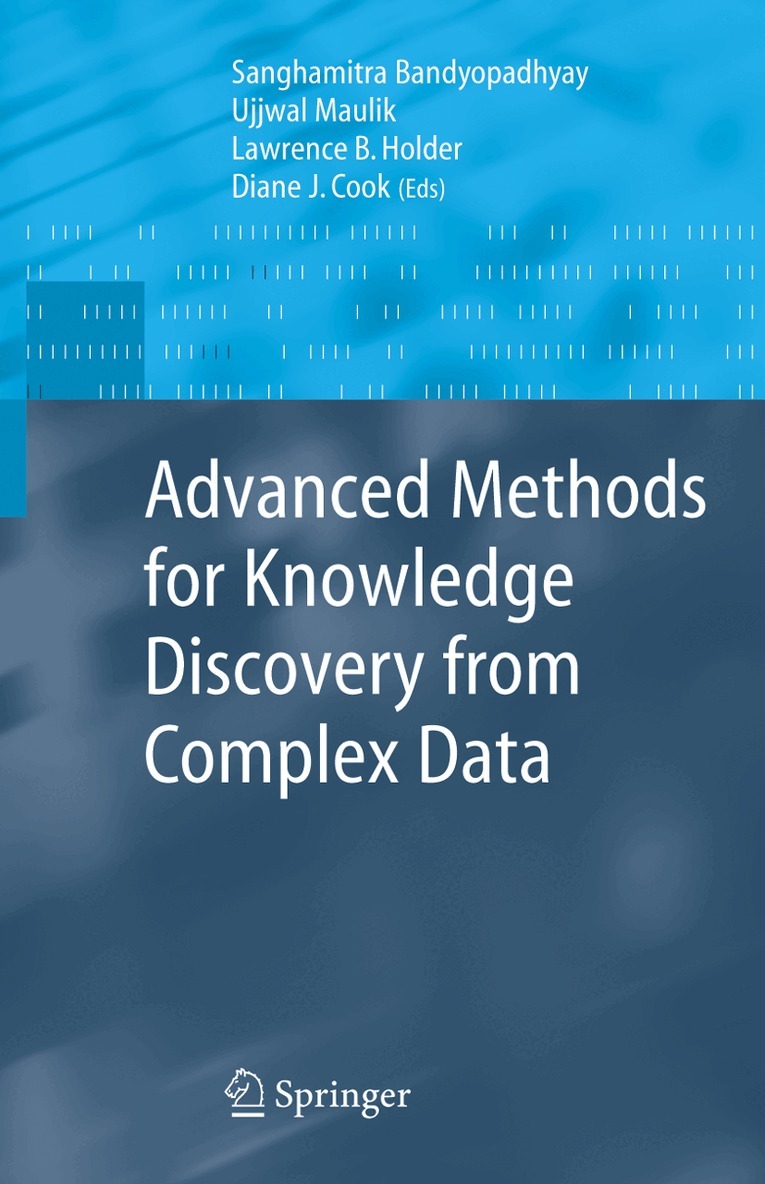
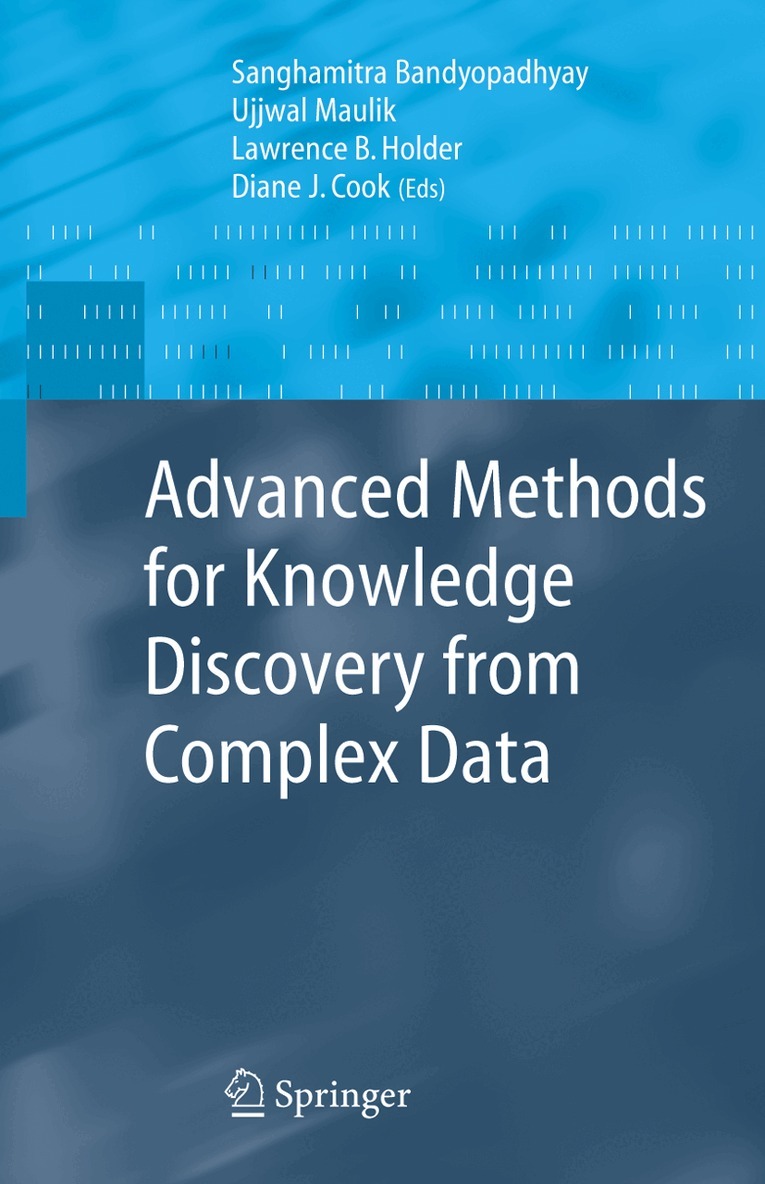
The growth in the amount of data collected and generated has exploded in recent times with the widespread automation of various day-to-day activities, advances in high-level scienti?c and engineering research and the development of e?cient data collection tools. This has given rise to the need for automa- callyanalyzingthedatainordertoextractknowledgefromit,therebymaking the data potentially more useful. Knowledge discovery and data mining (KDD) is the process of identifying valid, novel, potentially useful and ultimately understandable patterns from massive data repositories. It is a multi-disciplinary topic, drawing from s- eral ?elds including expert systems, machine learning, intelligent databases, knowledge acquisition, case-based reasoning, pattern recognition and stat- tics. Many data mining systems have typically evolved around well-organized database systems (e.g., relational databases) containing relevant information. But, more and more, one ?nds relevant information hidden in unstructured text and in other complex forms. Mining in the domains of the world-wide web, bioinformatics, geoscienti?c data, and spatial and temporal applications comprise some illustrative examples in this regard. Discovery of knowledge, or potentially useful patterns, from such complex data often requires the - plication of advanced techniques that are better able to exploit the nature and representation of the data. Such advanced methods include, among o- ers, graph-based and tree-based approaches to relational learning, sequence mining, link-based classi?cation, Bayesian networks, hidden Markov models, neural networks, kernel-based methods, evolutionary algorithms, rough sets and fuzzy logic, and hybrid systems. Many of these methods are developed in the followingchapters.
Häftad, Engelska, 2010
1 681 kr
Skickas inom 10-15 vardagar
The growth in the amount of data collected and generated has exploded in recent times with the widespread automation of various day-to-day activities, advances in high-level scienti?c and engineering research and the development of e?cient data collection tools. This has given rise to the need for automa- callyanalyzingthedatainordertoextractknowledgefromit,therebymaking the data potentially more useful. Knowledge discovery and data mining (KDD) is the process of identifying valid, novel, potentially useful and ultimately understandable patterns from massive data repositories. It is a multi-disciplinary topic, drawing from s- eral ?elds including expert systems, machine learning, intelligent databases, knowledge acquisition, case-based reasoning, pattern recognition and stat- tics. Many data mining systems have typically evolved around well-organized database systems (e.g., relational databases) containing relevant information. But, more and more, one ?nds relevant information hidden in unstructured text and in other complex forms. Mining in the domains of the world-wide web, bioinformatics, geoscienti?c data, and spatial and temporal applications comprise some illustrative examples in this regard. Discovery of knowledge, or potentially useful patterns, from such complex data often requires the - plication of advanced techniques that are better able to exploit the nature and representation of the data. Such advanced methods include, among o- ers, graph-based and tree-based approaches to relational learning, sequence mining, link-based classi?cation, Bayesian networks, hidden Markov models, neural networks, kernel-based methods, evolutionary algorithms, rough sets and fuzzy logic, and hybrid systems. Many of these methods are developed in the followingchapters.
Inbunden, Engelska, 2005
1 681 kr
Skickas inom 10-15 vardagar
The growth in the amount of data collected and generated has exploded in recent times with the widespread automation of various day-to-day activities, advances in high-level scienti?c and engineering research and the development of e?cient data collection tools. This has given rise to the need for automa- callyanalyzingthedatainordertoextractknowledgefromit,therebymaking the data potentially more useful. Knowledge discovery and data mining (KDD) is the process of identifying valid, novel, potentially useful and ultimately understandable patterns from massive data repositories. It is a multi-disciplinary topic, drawing from s- eral ?elds including expert systems, machine learning, intelligent databases, knowledge acquisition, case-based reasoning, pattern recognition and stat- tics. Many data mining systems have typically evolved around well-organized database systems (e.g., relational databases) containing relevant information. But, more and more, one ?nds relevant information hidden in unstructured text and in other complex forms. Mining in the domains of the world-wide web, bioinformatics, geoscienti?c data, and spatial and temporal applications comprise some illustrative examples in this regard. Discovery of knowledge, or potentially useful patterns, from such complex data often requires the - plication of advanced techniques that are better able to exploit the nature and representation of the data. Such advanced methods include, among o- ers, graph-based and tree-based approaches to relational learning, sequence mining, link-based classi?cation, Bayesian networks, hidden Markov models, neural networks, kernel-based methods, evolutionary algorithms, rough sets and fuzzy logic, and hybrid systems. Many of these methods are developed in the followingchapters.