Lawrence B. Mohr - Böcker
Understanding Significance Testing
767 kr
Skickas inom 3-6 vardagar
"The book begins with a clear and readable explanation of the idea of the sampling distribution....This text should be useful to the nonstatistical social researcher who wants to understand the concept of significance testing."
--Social Research Association News
"Good for refreshing a few basic ideas."
--Journal of the American Statistical Association
Significance testing is the most used, and arguably the most useful, of all techniques for analyzing social science data. In this practical volume, Mohr first defines basic terms such as variance, standard deviation, and parameter. He then carefully outlines the uses of significance testing and examines sampling distributions, probability distributions, and normal and t-tests of significance. Readers at all levels of research experience, from the first-semester student to the seasoned practitioner, will profit from this handy volume.
3 844 kr
Skickas inom 3-6 vardagar
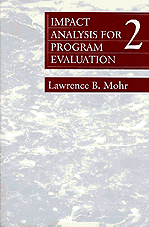
"Clarifies the concepts used in impact analysis and provides in-depth methodologies for research." --Educator's Update
"I learned much from reading the first edition of this book years ago, and this edition retains many of the positive features of that version, especially the regression framework and the lucid discussion of how regression discontinuity and randomized experimentation fit into that framework. I think that if this were the only book a person ever learned from, that person would be well-taught in the art of impact assessment, not be misled into going seriously wrong, and be more capable of doing impact assessment than most other applied social scientists."
--William R. Shadish Jr., Memphis State University
Successful in the first edition for its integration of multiple regression with evaluation design and for its systematic ways to select the proper goals for single - and multiple - outcome evaluations, this new edition is more helpful than ever. Impact Analysis for Program Evaluation, Second Edition has been revised to cover new issues and to further clarify the concepts used in impact analysis. It offers expanded coverage and explanation of quasi-experiments, a new section on the theory of impact analysis, updated information on the use of qualitative research for impact analysis, and expanded coverage of significance testing for program evaluation. It also includes an explanation of why the comparative-change design (i.e., Campbell and Stanley's "nonequivalent control group" design) is better than an ex post facto design from the standpoint of causal inference. A clarification of the effects of volunteering or self-selection is offered, along with a new, simplified appendix on regression artifacts.
Evaluators and applied researchers who want to enhance their understanding of research design and of threats to valid inference will find this book an effective guide to improving the utility of their evaluation results.
2 699 kr
Skickas inom 3-6 vardagar
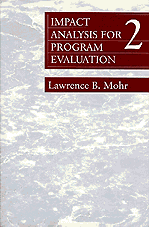
"Clarifies the concepts used in impact analysis and provides in-depth methodologies for research." --Educator's Update
"I learned much from reading the first edition of this book years ago, and this edition retains many of the positive features of that version, especially the regression framework and the lucid discussion of how regression discontinuity and randomized experimentation fit into that framework. I think that if this were the only book a person ever learned from, that person would be well-taught in the art of impact assessment, not be misled into going seriously wrong, and be more capable of doing impact assessment than most other applied social scientists."
--William R. Shadish Jr., Memphis State University
Successful in the first edition for its integration of multiple regression with evaluation design and for its systematic ways to select the proper goals for single - and multiple - outcome evaluations, this new edition is more helpful than ever. Impact Analysis for Program Evaluation, Second Edition has been revised to cover new issues and to further clarify the concepts used in impact analysis. It offers expanded coverage and explanation of quasi-experiments, a new section on the theory of impact analysis, updated information on the use of qualitative research for impact analysis, and expanded coverage of significance testing for program evaluation. It also includes an explanation of why the comparative-change design (i.e., Campbell and Stanley's "nonequivalent control group" design) is better than an ex post facto design from the standpoint of causal inference. A clarification of the effects of volunteering or self-selection is offered, along with a new, simplified appendix on regression artifacts.
Evaluators and applied researchers who want to enhance their understanding of research design and of threats to valid inference will find this book an effective guide to improving the utility of their evaluation results.