Leah Mascia – författare
Visar alla böcker från författaren . Handla med fri frakt och snabb leverans.
4 produkter
4 produkter
Inbunden, Engelska, 2023
2 093 kr
Skickas inom 5-8 vardagar
Over the last two decades, the study of graffiti has emerged as a bustling field, invigorated by increased appreciation for their historical, linguistic, sociological, and anthropological value and propelled by ambitious documentation projects. The growing understanding of graffiti as a perennial, universal phenomenon is spurring holistic consideration of this mode of graphic expression across time and space. Graffiti Scratched, Scrawled, Sprayed: Towards a Cross-Cultural Understanding complements recent efforts to showcase the diversity in creation, reception, and curation of graffiti around the globe, throughout history and up to the present day. Reflecting on methodology, concepts, and terminology as well as spatial, social, and historical contexts of graffiti, the book’s fourteen chapters cover ancient Egypt, Rome, Northern Arabia, Persia, India, and the Maya; medieval Eastern Mediterranean, Turfan, and Dunhuang; and contemporary Tanzania, Brazil, China, and Germany. As a whole, the collection provides a comprehensive toolkit for newcomers to the field of graffiti studies and appeals to specialists interested in viewing these materials in a cross-cultural perspective.
Del 35 - Studies in Manuscript Cultures
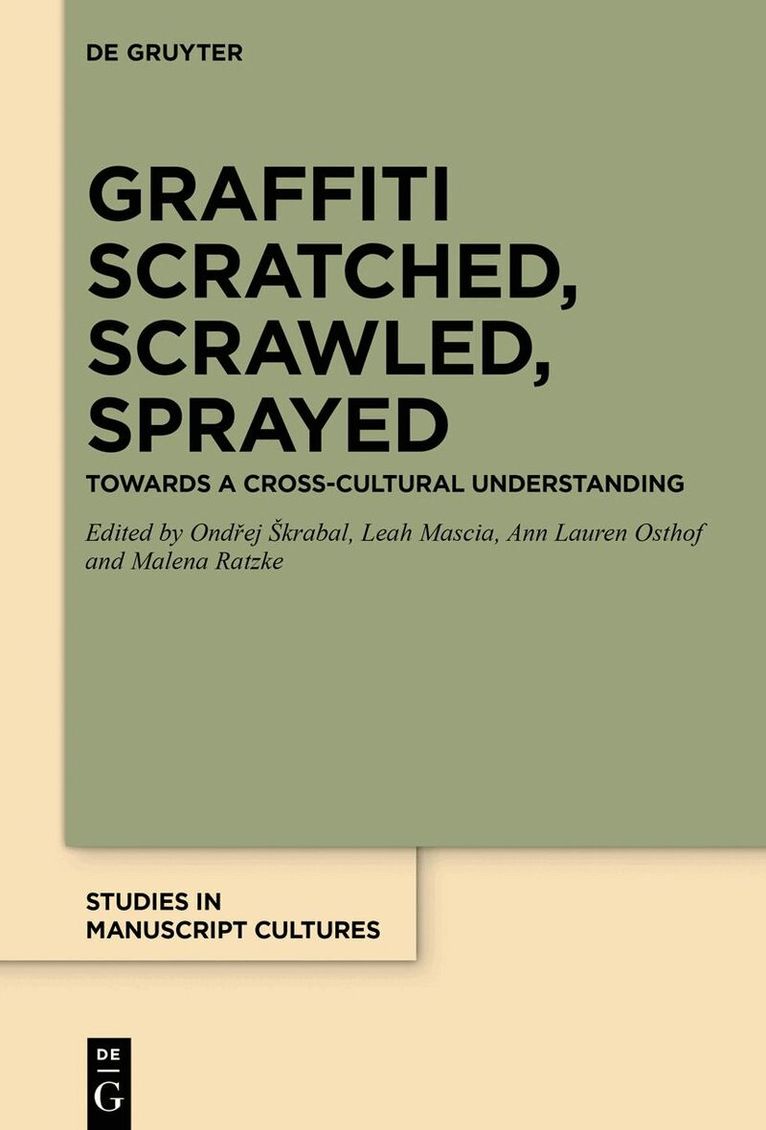
Graffiti Scratched, Scrawled, Sprayed
Towards a Cross-Cultural Understanding
Häftad, Engelska, 2025
476 kr
Skickas inom 3-6 vardagar
Over the last two decades, the study of graffiti has emerged as a bustling field, invigorated by increased appreciation for their historical, linguistic, sociological, and anthropological value and propelled by ambitious documentation projects. The growing understanding of graffiti as a perennial, universal phenomenon is spurring holistic consideration of this mode of graphic expression across time and space. Graffiti Scratched, Scrawled, Sprayed: Towards a Cross-Cultural Understanding complements recent efforts to showcase the diversity in creation, reception, and curation of graffiti around the globe, throughout history and up to the present day. Reflecting on methodology, concepts, and terminology as well as spatial, social, and historical contexts of graffiti, the book’s fourteen chapters cover ancient Egypt, Rome, Northern Arabia, Persia, India, and the Maya; medieval Eastern Mediterranean, Turfan, and Dunhuang; and contemporary Tanzania, Brazil, China, and Germany. As a whole, the collection provides a comprehensive toolkit for newcomers to the field of graffiti studies and appeals to specialists interested in viewing these materials in a cross-cultural perspective.
Inbunden, Engelska, 2026
1 290 kr
Skickas inom 3-6 vardagar
Transition from Traditional Cults to the Affirmation of Christian Beliefs in the City of Oxyrhynchus
E-bok
PDF, Engelska, 20261 082 kr
Läs direkt efter köp
Oxyrhynchus (modern el-Bahnasa) has been at the centre of scholarly attention for over a century. Its importance resides in the discovery of over half a million papyrus texts within this ancient site's rubbish dumps. However, the extraordinary importance of the Greek papyri unearthed during these investigations inevitably overshadowed texts in other languages, especially Egyptian, and also led to a lack of adequate publication of the numerous written artefacts other than papyri discovered. On the other hand, archaeological investigations carried out over the last decades are now providing essential data on this ancient city's religious and funerary landscape. The wealth of textual and archaeological evidence makes Oxyrhynchus a unique case study for comprehending the complex dynamics at work in the changing religious landscape of Roman and Late Antique Egypt. This e-book is the first attempt at "e;bridging the gap"e; between Oxyrhynchite papyrological, epigraphic, and archaeological evidence. The aim is to shed light on the religious panorama of this Egyptian city in the transition from traditional cults to Christianity (second fourth centuries), establishing a dialogue between textual and archaeological evidence.