Leandro Luiz Giatti - Böcker
Visar alla böcker från författaren Leandro Luiz Giatti. Handla med fri frakt och snabb leverans.
6 produkter
6 produkter
Participatory Research in the Post-Normal Age
Unsustainability and Uncertainties to Rethink Paulo Freire's Pedagogy of the Oppressed
Inbunden, Engelska, 2019
533 kr
Skickas inom 10-15 vardagar
This book shows how participatory research can provide tools to overcome the current epistemic and ethical challenges faced by traditional scientific approaches. Ever since Funtowicz and Ravetz proposed the notion of post-normal science, there has been a growing awareness of the limits of a form of knowledge production based only on the traditional scientific peer communities that excludes other social groups affected by its results and applications. The growing uncertainty and complexity posed by socio-ecological issues in the interactions between science, society and decision making has revealed the importance of a social quality control over crucial decisions that rely on scientific research and the necessary democratization of knowledge to tackle sustainability and health concerns.Departing from a reinterpretation of Paulo Freire’s Pedagogy of the Oppressed, this volume shows how participatory research can contribute to reconnect science and society by extending peer communities through the incorporation of different forms of knowledge and different social actors into research projects. To do so, the author presents a critical review of different participatory research approaches, identifying the elements that distinguish a true participatory research from a traditional one, and proposing a taxonomy of the various participatory methodologies. The volume also analyzes a diversity of social practices and understandings that deal with an ecology of knowledge and its systemic characteristics. Moreover, it demonstrates that uncertainties can be integrated in dialogical processes that open possibilities for a myriad of outcomes. Participatory Research in the Post-Normal Age - Unsustainability and Uncertainties to Rethink Paulo Freire's Pedagogy of the Oppressed will be of interest to researchers working with participatory approaches in different fields like health, environmental sciences, and education, as well as to practitioners of action research concerned with scientific dilemmas and counter-hegemonic strategies.
Participatory Research in the Post-Normal Age
Unsustainability and Uncertainties to Rethink Paulo Freire's Pedagogy of the Oppressed
Häftad, Engelska, 2021
533 kr
Skickas inom 10-15 vardagar
This book shows how participatory research can provide tools to overcome the current epistemic and ethical challenges faced by traditional scientific approaches. Ever since Funtowicz and Ravetz proposed the notion of post-normal science, there has been a growing awareness of the limits of a form of knowledge production based only on the traditional scientific peer communities that excludes other social groups affected by its results and applications. The growing uncertainty and complexity posed by socio-ecological issues in the interactions between science, society and decision making has revealed the importance of a social quality control over crucial decisions that rely on scientific research and the necessary democratization of knowledge to tackle sustainability and health concerns.Departing from a reinterpretation of Paulo Freire’s Pedagogy of the Oppressed, this volume shows how participatory research can contribute to reconnect science and society by extending peer communities through the incorporation of different forms of knowledge and different social actors into research projects. To do so, the author presents a critical review of different participatory research approaches, identifying the elements that distinguish a true participatory research from a traditional one, and proposing a taxonomy of the various participatory methodologies. The volume also analyzes a diversity of social practices and understandings that deal with an ecology of knowledge and its systemic characteristics. Moreover, it demonstrates that uncertainties can be integrated in dialogical processes that open possibilities for a myriad of outcomes. Participatory Research in the Post-Normal Age - Unsustainability and Uncertainties to Rethink Paulo Freire's Pedagogy of the Oppressed will be of interest to researchers working with participatory approaches in different fields like health, environmental sciences, and education, as well as to practitioners of action research concerned with scientific dilemmas and counter-hegemonic strategies.
1 585 kr
Skickas inom 10-15 vardagar
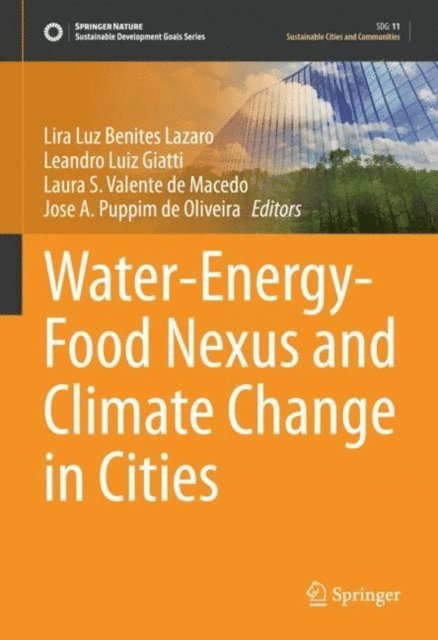
This book aims to contribute to the transdisciplinary study of the water-energy-food (WEF) nexus in cities and to help policy makers adopt a more integrated approach to natural resources management in urban environments to face the challenges and threats of climate change. This approach is based on a multidimensional scientific framework that seeks to understand the complex and non-linear interrelationships and interdependencies between water-energy-food under climate change and to generate solutions to reduce trade-offs among development goals and generate co-benefits that help encourage sustainable development and contribute to the achievement of SDGs, mainly SDG 11 (make cities and human settlements inclusive, safe, resilient and sustainable) and SDG 13 (take urgent action to combat climate change and its impacts).Governing the WEF nexus in cities is one of the greatest resource challenges of our time, as cities consume large amounts of WEF, but one that can also generate relevant alternatives with which to tackle climate change. To help fostering these alternatives, this book analyzes the governance, institutional and political economy factors that determine the effectiveness of the nexus approach and reviews the potential, the benefits and the policy implications of the adoption of the WEF nexus approach at the urban level. Through a series of hands-on cases, chapters in this book present the opportunities of the WEF nexus approach to achieve innovation and transformative change and discuss concrete areas of synergy and policy initiative to raise urban resilience. Water-Energy-Food Nexus and Climate Change in Cities will serve both as a guide for policy makers as well as a useful resource for students and researchers in fields such as urban studies, public health, environmental sciences, energy studies and public policy interested in learning how cities can represent possibilities to navigate and manage sustainability from local to global.
1 585 kr
Skickas inom 10-15 vardagar
This book aims to contribute to the transdisciplinary study of the water-energy-food (WEF) nexus in cities and to help policy makers adopt a more integrated approach to natural resources management in urban environments to face the challenges and threats of climate change. This approach is based on a multidimensional scientific framework that seeks to understand the complex and non-linear interrelationships and interdependencies between water-energy-food under climate change and to generate solutions to reduce trade-offs among development goals and generate co-benefits that help encourage sustainable development and contribute to the achievement of SDGs, mainly SDG 11 (make cities and human settlements inclusive, safe, resilient and sustainable) and SDG 13 (take urgent action to combat climate change and its impacts).Governing the WEF nexus in cities is one of the greatest resource challenges of our time, as cities consume large amounts of WEF, but one that can also generate relevant alternatives with which to tackle climate change. To help fostering these alternatives, this book analyzes the governance, institutional and political economy factors that determine the effectiveness of the nexus approach and reviews the potential, the benefits and the policy implications of the adoption of the WEF nexus approach at the urban level. Through a series of hands-on cases, chapters in this book present the opportunities of the WEF nexus approach to achieve innovation and transformative change and discuss concrete areas of synergy and policy initiative to raise urban resilience. Water-Energy-Food Nexus and Climate Change in Cities will serve both as a guide for policy makers as well as a useful resource for students and researchers in fields such as urban studies, public health, environmental sciences, energy studies and public policy interested in learning how cities can represent possibilities to navigate and manage sustainability from local to global.
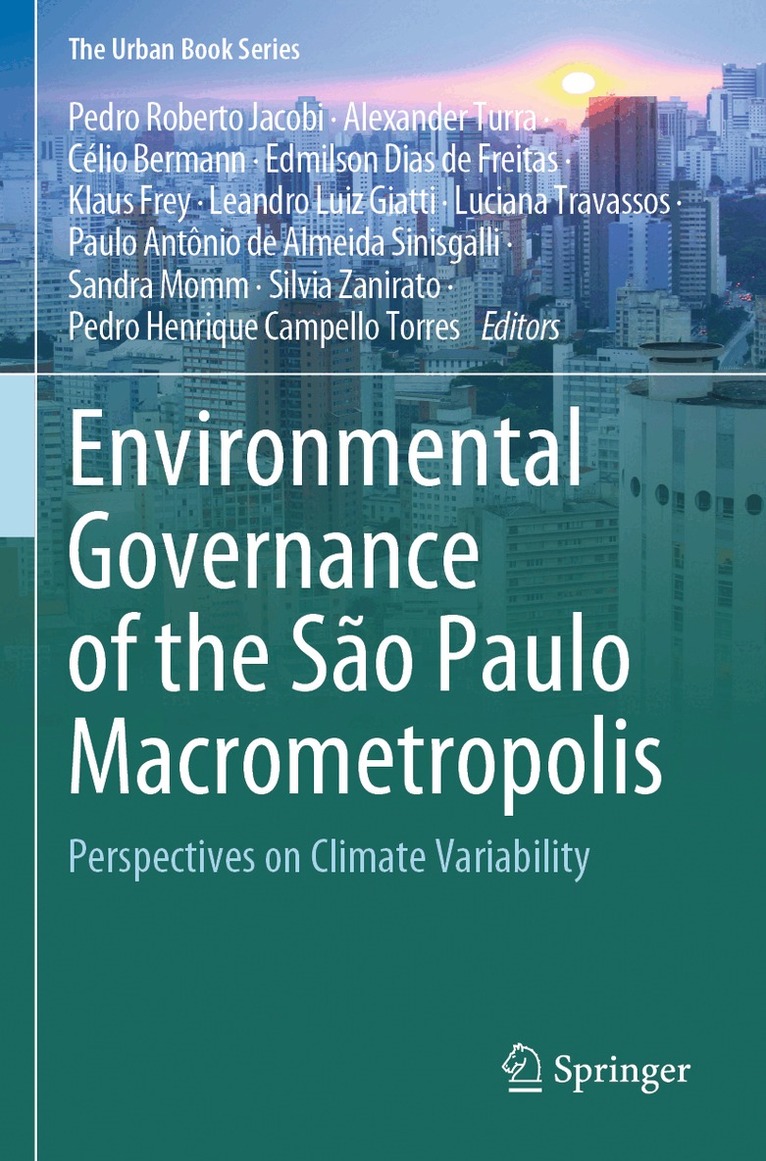
Environmental Governance of the São Paulo Macrometropolis
Perspectives on Climate Variability
Inbunden, Engelska, 2024
1 480 kr
Skickas inom 7-10 vardagar
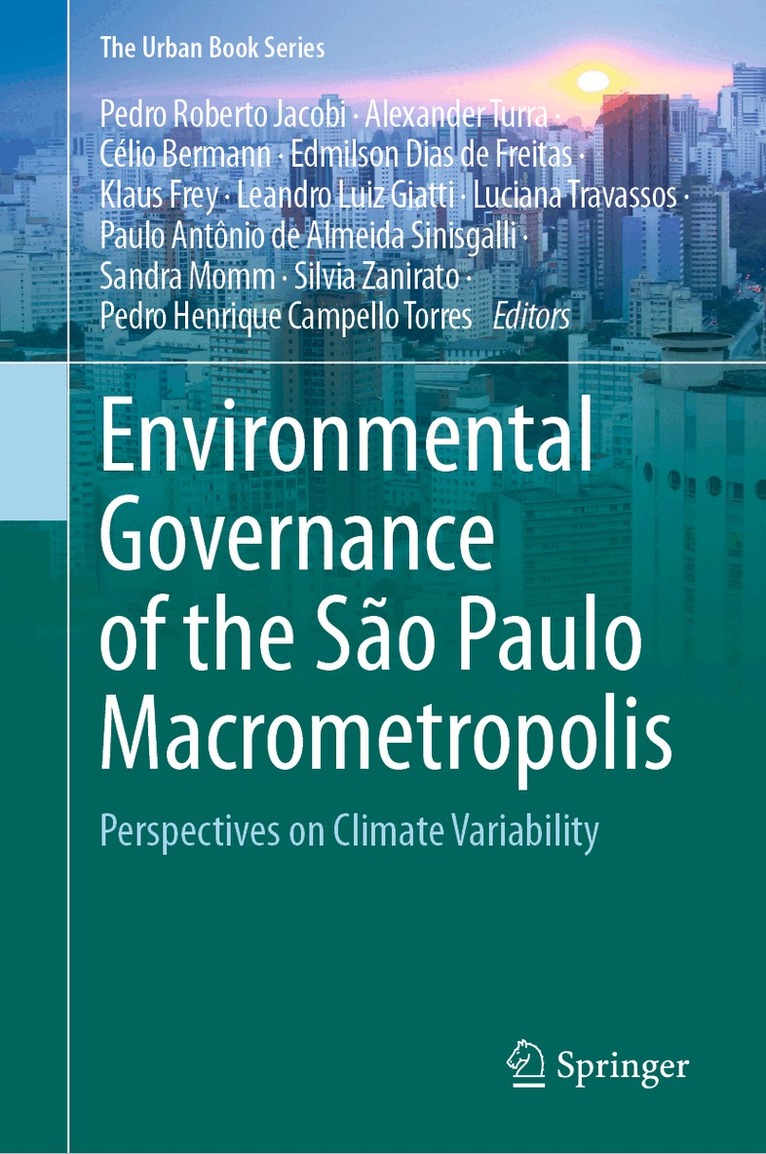
This book presents a set of chapters produced by six research groups that developed the São Paulo Research Foundation (FAPESP) Thematic Project Environmental Governance of the São Paulo macrometropolis (SPMM) in the face of Climate Variability (2017–2022).
Environmental Governance of the São Paulo Macrometropolis
Perspectives on Climate Variability
Häftad, Engelska, 2025
1 375 kr
Skickas inom 10-15 vardagar
This book presents a set of chapters produced by six research groups that developed the São Paulo Research Foundation (FAPESP) Thematic Project Environmental Governance of the São Paulo macrometropolis (SPMM) in the face of Climate Variability (2017–2022). It represents an academic experience based on the articulation of knowledge and interdisciplinary dialogue. For this publication, the individual research groups benefitted from internal expertise and interdisciplinary input, reflecting the collaborative process of the entire team.The SPMM is characterized by the diversity and complementarity of economic, social and environmental functions exercised in its territory, comprising 174 municipalities, with the capital city of São Paulo as its polarizing center. It is structured from a set of five metropolitan regions, two urban agglomerates and one micro-region—not institutionalized—in the State of São Paulo, sheltering around 34 million people who inhabit the richest and economically strongest region in Brazil. The SPMM, one of the urban territorial clusters of greatest expression in the southern hemisphere, is a strategic arena for the formulation and implementation of planning, governance and trans- and multi-scalar regional public policies.The English translation of this book from its Portuguese original manuscript was done with the help of artificial intelligence. A subsequent human revision of the content was done by the volume editors.