Leopold Flohe - Böcker
Visar alla böcker från författaren Leopold Flohe. Handla med fri frakt och snabb leverans.
5 produkter
5 produkter
725 kr
Skickas inom 10-15 vardagar
This is the first serious attempt to synthesize all that became known of glutathione over the last three decades. The book contains an update of glutathione biosynthesis with special emphasis on its regulation in adaptive stress responses. Other chapters review glutathione transport systems and glutathione peroxidases and their differences in substrate specificities and localization. Further contributions center on the diversified roles of different glutathione-S-transferases and the roles of nitrosoglutathione and glutaredoxins - a subfamily of redoxins. The book closes with discussions of the analogous or homologous thiol metabolism in pathogens and the potential suitability of involved enzymes as drug targets.Key selling features:Summarizing the way glutathione is involved in stress responsesCompiling the multiple ways glutathione affects inflammatory responsesDisclosing how glutathione dampens programmed cell death such as ferroptosisExploring the enigma of how enzymes accelerate glutathione-dependent processesDiscussing how detoxification and redox regulation is mediated by glutathionylationReviewing the ways glutaredoxins catalyze protein disulfide reductionHighlighting the medical impact of glutathione-related metabolic pathwaysIllustrating the role thiol metabolism of pathogens might play in drug discovery
3 163 kr
Skickas inom 10-15 vardagar
This is the first serious attempt to synthesize all that became known of glutathione over the last three decades. The book contains an update of glutathione biosynthesis with special emphasis on its regulation in adaptive stress responses. Other chapters review glutathione transport systems and glutathione peroxidases and their differences in substrate specificities and localization. Further contributions center on the diversified roles of different glutathione-S-transferases and the roles of nitrosoglutathione and glutaredoxins - a subfamily of redoxins. The book closes with discussions of the analogous or homologous thiol metabolism in pathogens and the potential suitability of involved enzymes as drug targets.Key selling features:Summarizing the way glutathione is involved in stress responsesCompiling the multiple ways glutathione affects inflammatory responsesDisclosing how glutathione dampens programmed cell death such as ferroptosisExploring the enigma of how enzymes accelerate glutathione-dependent processesDiscussing how detoxification and redox regulation is mediated by glutathionylationReviewing the ways glutaredoxins catalyze protein disulfide reductionHighlighting the medical impact of glutathione-related metabolic pathwaysIllustrating the role thiol metabolism of pathogens might play in drug discoveryChapter 11 of this book is freely available as a downloadable Open Access PDF at http://www.taylorfrancis.com under a Creative Commons Attribution (CC-BY) 4.0 license.
2 100 kr
Skickas inom 10-15 vardagar
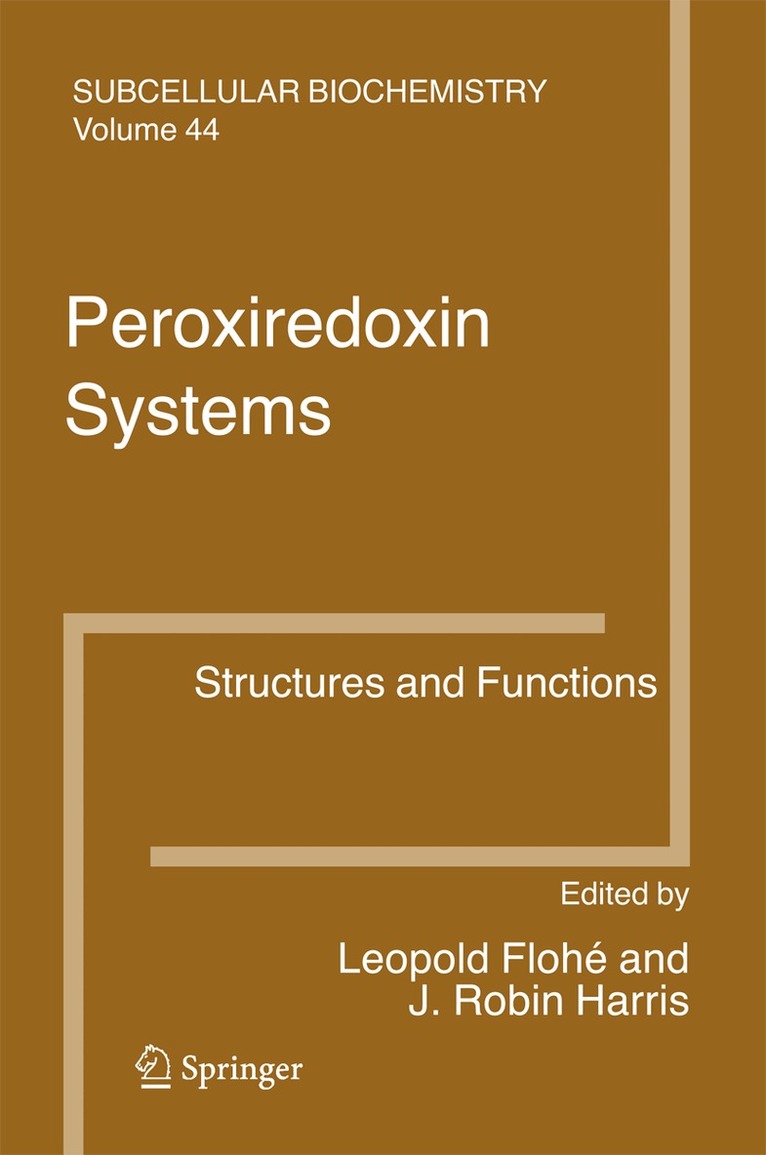
A volume within the Subcellular Biochemistry series is an appropriate setting for the first multi-author book devoted to the new family of antioxidant and cell signalling proteins, the peroxiredoxins. Within the antioxidant and cell signalling fields, even the existence of the peroxiredoxins has yet to be appreciated by many; with this book we aim to rectify this situation. We have tried to select diverse chapter topics to cover relevant aspects of the subject and to persuade knowledgeable authors to contribute a manuscript. As almost inevitable, a few authors let us down by failing to respond, others could not submit a manuscript in time for personal reasons. These unfortunately were two of the pioneers, Earl Stadtman and Sue Goo Rhee, but we appreciate that they communicated a lot of details that helped us to reconstruct the early phase of peroxiredoxin enzymology. We have thus compiled a book that competently covers the peroxiredoxin field from its beginnings through to currently relevant topics. In the introductory Chapter 1 we provide a short historical survey of the subject, based upon the early structural and enzymic studies on peroxiredoxins, and then lead into some of our current personal interests, such as the likely continuing contribution of transmission electron microscopy (TEM) for the study of high molecular mass peroxiredoxin complexes and the association of peroxiredoxins with other proteins, and the targeting of drugs against microbial peroxiredoxins, as future therapeutic approaches.
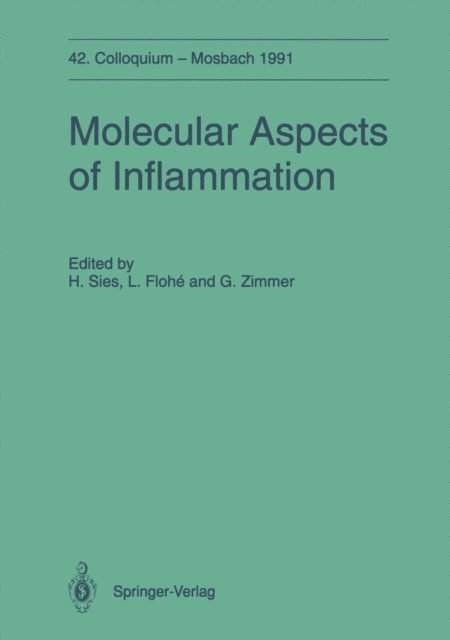
Molecular Aspects of Inflammation
42. Colloquium der Gesellschaft für Biologische Chemie 11.-13. April 1991 in Mosbach/Baden
Häftad, Engelska, 2011
1 624 kr
Skickas inom 10-15 vardagar
Understanding the molecular basis of complex biological processes has been a major goal of biological chemistry from early on. Inflammation is one such entity, and recent years have seen exciting progress in the under- standing of molecular interactions; there has been a long way from dolor, rubor, calor, and tumor as a fundamental description of the phenomenon to current knowledge, e.g., on the control of the respiratory burst of the granulocyte, the atomic details of protease regulation, or the interaction of cytokines. We were glad to have been given the opportunity by the Gesellschaft fUr Biologische Chemie to call upon experts in this bustling field of research for this Colloquium. The sessions were organized in the order of increasing complexity, starting with the key phenomena of the inflamma- tory response and its modulation by cytokines to intravascular events and shock and sepsis; thus, the current attempts to apply basic knowledge on mediators of inflammation to the clinical situation were also considered. In-depth chapters presenting the state of the art in these areas are collected in this book, and we thank the authors for their efforts.We also thank the Chairmen of the sessions, Profs. C. Sorg (Munster), D. Roos (Amsterdam), S. Bhakdi (Mainz), H. J. Muller-Eberhard (Hamburg), H. G. Schwick (Marburg), K. Resch (Hannover), W. Schaper (Bad Nauheim), D. Keppler (Heidelberg), and O. Trentz (Zurich) for their input, and it is a great pleasure to acknowledge the support by Drs.
2 100 kr
Skickas inom 10-15 vardagar
A volume within the Subcellular Biochemistry series is an appropriate setting for the first multi-author book devoted to the new family of antioxidant and cell signalling proteins, the peroxiredoxins. Within the antioxidant and cell signalling fields, even the existence of the peroxiredoxins has yet to be appreciated by many; with this book we aim to rectify this situation. We have tried to select diverse chapter topics to cover relevant aspects of the subject and to persuade knowledgeable authors to contribute a manuscript. As almost inevitable, a few authors let us down by failing to respond, others could not submit a manuscript in time for personal reasons. These unfortunately were two of the pioneers, Earl Stadtman and Sue Goo Rhee, but we appreciate that they communicated a lot of details that helped us to reconstruct the early phase of peroxiredoxin enzymology. We have thus compiled a book that competently covers the peroxiredoxin field from its beginnings through to currently relevant topics. In the introductory Chapter 1 we provide a short historical survey of the subject, based upon the early structural and enzymic studies on peroxiredoxins, and then lead into some of our current personal interests, such as the likely continuing contribution of transmission electron microscopy (TEM) for the study of high molecular mass peroxiredoxin complexes and the association of peroxiredoxins with other proteins, and the targeting of drugs against microbial peroxiredoxins, as future therapeutic approaches.