Leslie A. Schwindt-Bayer - Böcker
Visar alla böcker från författaren Leslie A. Schwindt-Bayer. Handla med fri frakt och snabb leverans.
7 produkter
7 produkter
1 408 kr
Skickas inom 5-8 vardagar
Just as Latin American countries began to transition to democracy in the late 1970s and early 1980s, the region also saw gains in social, cultural and economic gender equality. In accordance with modernization theories, women in the region have also made significant inroads into elected office. However, these gains vary a great deal between countries in Latin America. They also vary significantly at different levels of government even within the same country. Inside government arenas, representation is highly gendered with rules and norms that advantage men and disadvantage women, limiting women's access to full political power. While one might expect these variations to map onto socioeconomic and cultural conditions within each country, they don't correlate. This book makes, for the first time, a comprehensive comparison of gender and representation across the region -- in seven countries -- and at five different levels: the presidency, cabinets, national legislatures, political parties, and subnational governments. Overall, it argues that gender inequality in political representation in Latin America is rooted in democratic institutions and the democratic challenges and political crises facing the region. Institutions and political context not only influence the number of women and men elected to office, but also what they do once in office, the degree of power to which they gain access, and how their presence and actions influence democracy and society, more broadly. Drawing on the expertise of scholars of women, gender, and political institutions, this book is the most comprehensive analysis of women's representation in Latin America to date, and an important resource for research on women's representation worldwide. The causes, consequences, and challenges to women's representation in Latin America are not unique to that region, and the book uses Latin American patterns to draw broad conclusions about gendered representation in other areas of the world.
494 kr
Skickas inom 5-8 vardagar
Just as Latin American countries began to transition to democracy in the late 1970s and early 1980s, the region also saw gains in social, cultural and economic gender equality. In accordance with modernization theories, women in the region have also made significant inroads into elected office. However, these gains vary a great deal between countries in Latin America. They also vary significantly at different levels of government even within the same country. Inside government arenas, representation is highly gendered with rules and norms that advantage men and disadvantage women, limiting women's access to full political power. While one might expect these variations to map onto socioeconomic and cultural conditions within each country, they don't correlate. This book makes, for the first time, a comprehensive comparison of gender and representation across the region -- in seven countries -- and at five different levels: the presidency, cabinets, national legislatures, political parties, and subnational governments. Overall, it argues that gender inequality in political representation in Latin America is rooted in democratic institutions and the democratic challenges and political crises facing the region. Institutions and political context not only influence the number of women and men elected to office, but also what they do once in office, the degree of power to which they gain access, and how their presence and actions influence democracy and society, more broadly. Drawing on the expertise of scholars of women, gender, and political institutions, this book is the most comprehensive analysis of women's representation in Latin America to date, and an important resource for research on women's representation worldwide. The causes, consequences, and challenges to women's representation in Latin America are not unique to that region, and the book uses Latin American patterns to draw broad conclusions about gendered representation in other areas of the world.
The Gendered Effects of Electoral Institutions
Political Engagement and Participation
Inbunden, Engelska, 2012
1 391 kr
Skickas inom 5-8 vardagar
In most countries around the world, women continue to lag behind men in an array of political orientations and activities. Understanding why this is the case and why some countries have been more successful than others at moderating gender gaps in political involvement is imperative for producing stronger and more representative democracies. Cultural, socioeconomic, and political factors explain some of the gender gaps in political involvement, but not all of them. In this book, the authors argue that electoral institutions attenuate gender gaps in mass political engagement and participation by drawing women, an 'undertapped' constituency, into the democratic process. Using cross-national and country-specific analyses, the authors show that electoral institutions play a complementary and significant role in reducing gender gaps in political involvement. The cross-national analyses draw on comparative survey data from a wide range and large number of countries. The case studies draw out the processes underlying changes in political attitudes and behaviors with evidence from four country studies: New Zealand, Russia, France, and Uruguay. All four countries have altered their electoral institutions, either through large-scale reform of the electoral system itself or adopting gender quotas, allowing the authors to examine patterns of political involvement pre- and post-reform. The book finds that inclusive electoral systems that produce more proportional electoral outcomes have larger effects on women's political engagement and participation than on men's. Gender quotas also mediate women's engagement and participation, but to a lesser degree. On the whole, the book concludes that electoral rules designed to promote social inclusion in parliament are critical for promoting social group inclusion among the electorate.Comparative Politics is a series for students, teachers, and researchers of political science that deals with contemporary government and politics. Global in scope, books in the series are characterised by a stress on comparative analysis and strong methodological rigour. The series is published in association with the European Consortium for Political Research. For more information visit: www.ecprnet.eu. The Comparative Politics Series is edited by Professor David M. Farrell, School of Politics and International Relations, University College Dublin, Kenneth Carty, Professor of Political Science, University of British Columbia, and Professor Dirk Berg-Schlosser, Institute of Political Science, Philipps University, Marburg.
529 kr
Skickas inom 5-8 vardagar
The number of women elected to national legislatures has grown significantly over the past thirty years -- worldwide, the average percentage of women in legislatures is currently 18%; in a number of developing countries (particularly in Africa and Latin America) women hold 30-40% of legislative seats. This increase in the number of women elected to national office is due, in large part, to gender-friendly electoral rules such as gender quotas and proportional electoral systems, and it has, in turn, fostered constituent support for representative democracy. Still, as this book argues, although women are gaining political voice and bringing women's issues to state agendas, they are not gaining political power. Women are marginalized by the male majority in office and relegated to the least powerful committees and leadership posts, hindering progress toward real political equality. In order to make this argument, Schwindt-Bayer presents a comparative study of recent trends in women's representation in Latin America, using aggregate data from all eighteen Latin American democracies and original fieldwork in Argentina, Columbia and Costa Rica. She develops an integrated theory of women's representation that analyzes and connects trends in relation to four facets of political representation: formal, descriptive, substantive and symbolic. This is the first English-language book on women's political representation in Latin America, and it is the first empirical study of the multiple dimensions of representation.
386 kr
Skickas inom 5-8 vardagar
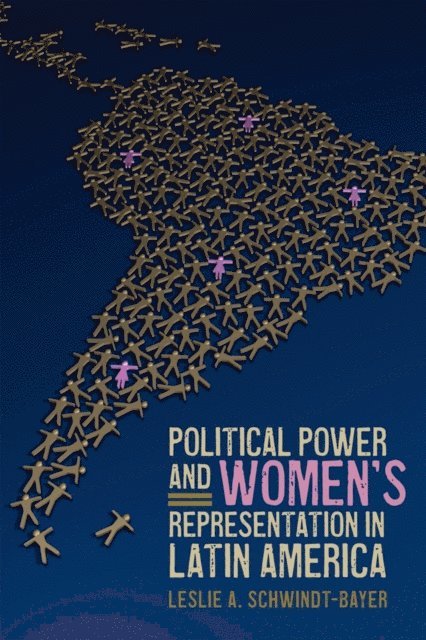
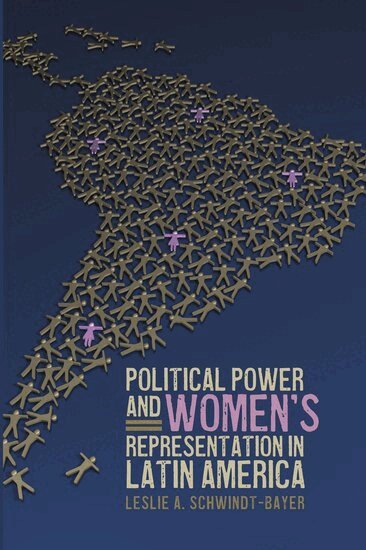
The number of women elected to Latin American legislatures has grown significantly over the past thirty years. This increase in the number of women elected to national office is due, in large part, to gender-friendly electoral rules such as gender quotas and proportional electoral systems, and it has, in turn, fostered constituent support for representative democracy. Still, this book argues that women are gaining political voice and bringing women's issues to state agendas, but they are not gaining political power. Women are marginalized by the male majority in office and relegated to the least powerful committees and leadership posts, hindering progress toward real political equality.In Political Power and Women's Representation in Latin America, Leslie Schwindt-Bayer examines the causes and consequences of women's representation in Latin America. She does so by asking a series of politically relevant and theoretically challenging questions, including why the numbers of women in office have increased in some countries but vary across others; what the presence of women in office means for the way representatives legislate; and what consequences the election of women bears for representative democracy more generally. Schwindt-Bayer articulates a comprehensive theory of women's representation that analyzes and connects trends in relation to four facets of political representation: formal, descriptive, substantive and symbolic. She then tests this theory empirically using aggregate data from all eighteen Latin American democracies and original fieldwork in Argentina, Colombia and Costa Rica. Ultimately, this book communicates the complex and often incomplete nature of women's political representation in Latin America.
823 kr
Skickas inom 7-10 vardagar
Corruption is a significant problem for democracies throughout the world. Even the most democratic countries constantly face the threat of corruption and the consequences of it at the polls. Why are some governments more corrupt than others, even after considering cultural, social, and political characteristics? In Clarity of Responsibility, Accountability, and Corruption, the authors argue that clarity of responsibility is critical for reducing corruption in democracies. The authors provide a number of empirical tests of this argument, including a cross-national time-series statistical analysis to show that the higher the level of clarity the lower the perceived corruption levels. Using survey and experimental data, the authors show that clarity causes voters to punish incumbents for corruption. Preliminary tests further indicate that elites respond to these electoral incentives and are more likely to combat corruption when clarity is high.
428 kr
Skickas inom 7-10 vardagar
Corruption is a significant problem for democracies throughout the world. Even the most democratic countries constantly face the threat of corruption and the consequences of it at the polls. Why are some governments more corrupt than others, even after considering cultural, social, and political characteristics? In Clarity of Responsibility, Accountability, and Corruption, the authors argue that clarity of responsibility is critical for reducing corruption in democracies. The authors provide a number of empirical tests of this argument, including a cross-national time-series statistical analysis to show that the higher the level of clarity the lower the perceived corruption levels. Using survey and experimental data, the authors show that clarity causes voters to punish incumbents for corruption. Preliminary tests further indicate that elites respond to these electoral incentives and are more likely to combat corruption when clarity is high.