Levente Buttyán - Böcker
Visar alla böcker från författaren Levente Buttyán. Handla med fri frakt och snabb leverans.
3 produkter
3 produkter
660 kr
Skickas inom 10-15 vardagar
This book explains the development of cryptographic obfuscation, providing insight into the most important ideas and techniques. It will be a useful reference for researchers in cryptography and theoretical computer science.
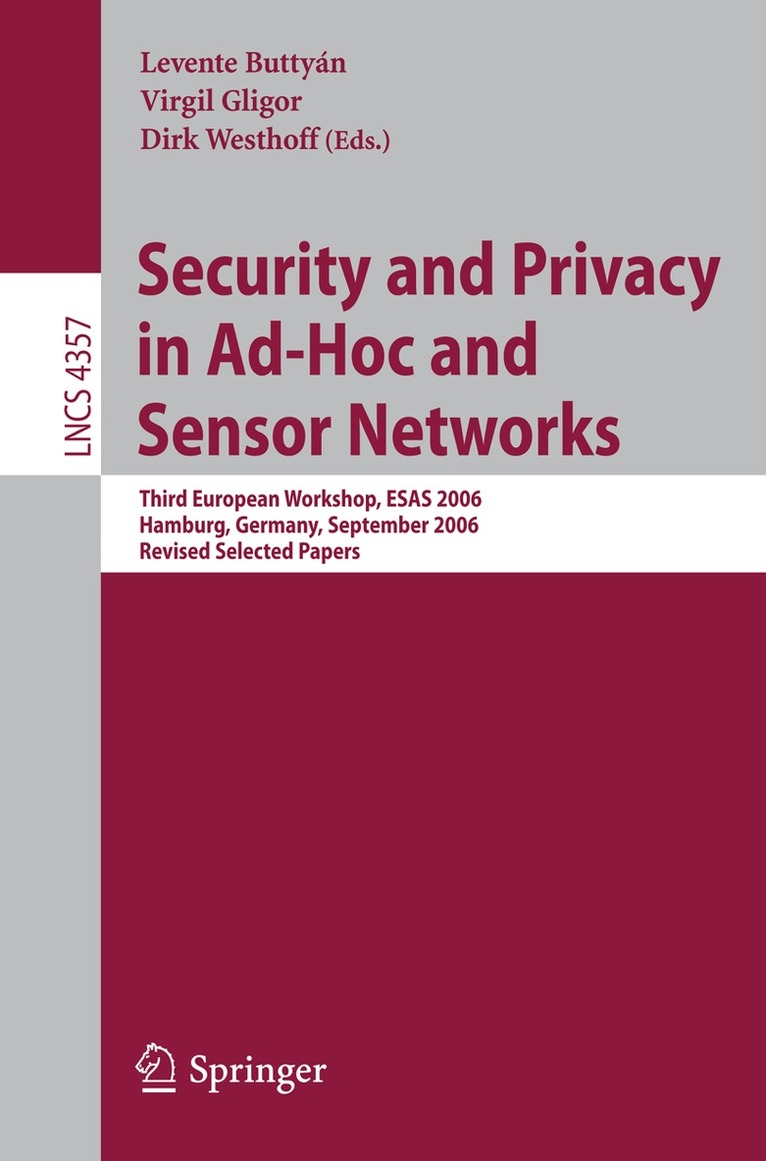
Security and Privacy in Ad-Hoc and Sensor Networks
Third European Workshop, ESAS 2006, Hamburg, Germany, September 20-21, 2006, Revised Selected Papers
Häftad, Engelska, 2006
552 kr
Skickas inom 10-15 vardagar
Theseproceedingscontainthepapersofthe3rdEuropeanWorkshoponSecurity and Privacy in Ad Hoc and Sensor Networks (ESAS 2006), which was held in Hamburg, Germany, September 20–21, 2006, in conjunction with the 11th European Symposium on Research in Computer Security (ESORICS 2006). This year, a total of 44 full papers were submitted to ESAS. Each subm- ted paper was reviewed by at least three expert referees. After a short period of discussion and deliberation, the Program Committee selected 14 papers for presentation and subsequent publication in the workshop proceedings. This c- responds to an acceptance rate of 32% – a respectable rate by any measure. In addition to the presented papers, this year’s workshop also featured two keynote speeches and seven project presentations. In the ?rst keynote, Jean-Pierre Hubaux (EPFL) gave an overview of “Security and Cooperation in WirelessNetworks”.ThesecondkeynotewasgivenbyPimTuyls(Philips)onthe interesting topic of “Grey-Box Cryptography: Physical Unclonable Functions”. The project presentations covered the following European Projects: S3MS, SeVeCom, BIONETS, CASCADAS, MOBIUS, EYES and UbiSecSens. Unf- tunately, the extended abstracts of these presentations could not be included in the proceedings. As the Chairs of ESAS 2006, we are very happy with the outcome of the workshop that clearly demonstrates the continued importance, popularity, and timeliness of the topic: Security and Privacy in Ad Hoc and Sensor Networks.
Decision and Game Theory for Security
First International Conference, GameSec 2010, Berlin, Germany, November 22-23, 2010. Proceedings
Häftad, Engelska, 2010
536 kr
Skickas inom 10-15 vardagar
Securing complex and networked systems has become increasingly important as these systems play an indispensable role in modern life at the turn of the - formation age. Concurrently, security of ubiquitous communication, data, and computing poses novel research challenges. Security is a multi-faceted problem due to the complexity of underlying hardware, software, and network inter- pendencies as well as human and social factors. It involves decision making on multiple levels and multiple time scales, given the limited resources available to both malicious attackers and administrators defending networked systems. - cision and game theory provides a rich set of analyticalmethods and approaches to address various resource allocation and decision-making problems arising in security. This edited volume contains the contributions presented at the inaugural Conference on Decision and Game Theory for Security - GameSec 2010. These 18 articles (12 full and 6 short papers) are thematically categorized into the following six sections: – “Security investments and planning” contains two articles, which present optimization methods for (security) investments when facing adversaries. – “Privacy and anonymity” has three articles discussing location privacy, - line anonymity, and economic aspects of privacy. – “Adversarial and robust control” contains three articles, which investigate security and robustness aspects of control in networks. – “Networksecurityandbotnets”hasfourarticlesfocusingondefensivestra- giesagainstbotnetsaswellasdetectionofmaliciousadversariesinnetworks. – “Authorizationandauthentication”hasanarticleonpasswordpracticesand another one presenting a game-theoretic authorization model. – “Theory and algorithms for security” containsfour articles on various th- retic and algorithmic aspects of security.