L.I. Slutski – författare
Visar alla böcker från författaren L.I. Slutski. Handla med fri frakt och snabb leverans.
3 produkter
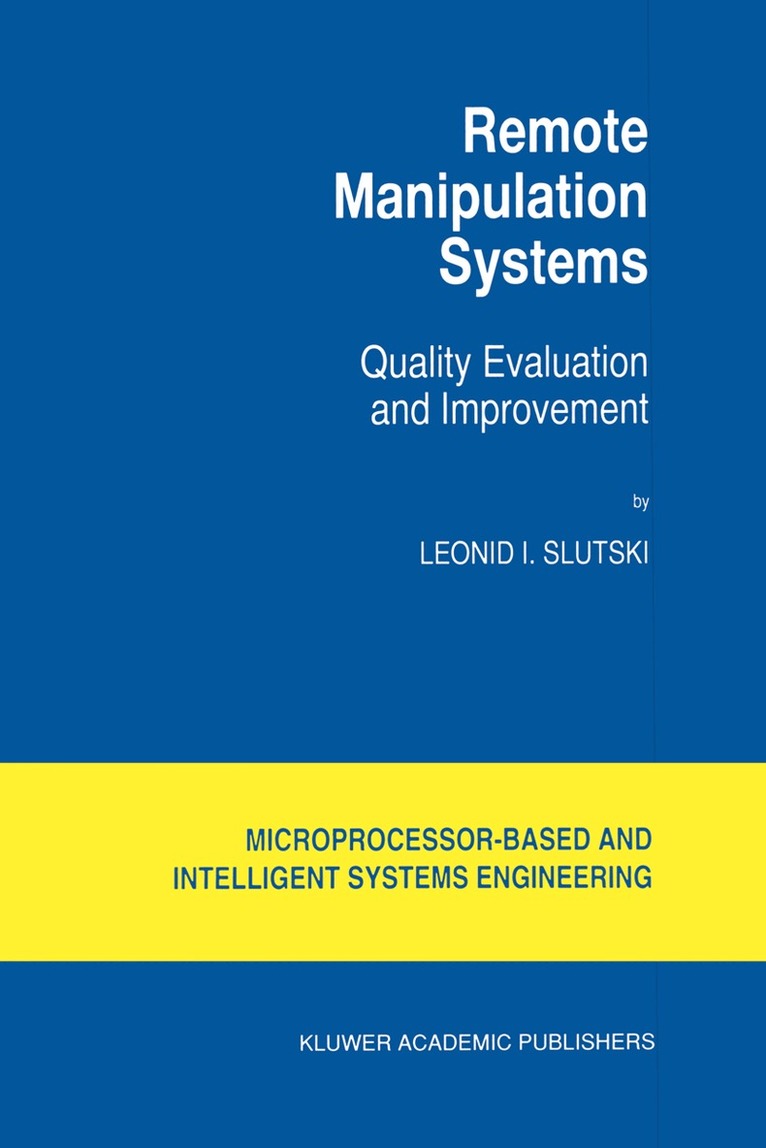
Remote Manipulation Systems
Quality Evaluation and Improvement
Av L.I. Slutski
Inbunden, 1997
1643 kr
Lägg i varukorg
A famous French writer, Anatole France, liked to say, "The future is a convenient place to position our dreams" (1927). Indeed, this remark gains full meaning when one considers the history of what we call today "Robotics." For more than 3000 years, mankind has dreamt ofthe possibility of arti …
Remote Manipulation Systems
Quality Evaluation and Improvement
Av L.I. Slutski
Häftad, 2012
1643 kr
Lägg i varukorg
A famous French writer, Anatole France, liked to say, "The future is a convenient place to position our dreams" (1927). Indeed, this remark gains full meaning when one considers the history of what we call today "Robotics." For more than 3000 years, mankind has dreamt ofthe possibility of arti …
Remote Manipulation Systems
Quality Evaluation and Improvement
Av L.I. Slutski
E-bok, 2012
2111 kr
Lägg i varukorg
A famous French writer, Anatole France, liked to say, "The future is a convenient place to position our dreams" (1927). Indeed, this remark gains full meaning when one considers the history of what we call today "Robotics." For more than 3000 years, mankind has dreamt ofthe possibility of arti …