Lim Tai Wei Lim – författare
Visar alla böcker från författaren Lim Tai Wei Lim. Handla med fri frakt och snabb leverans.
13 produkter
13 produkter
E-bok
Engelska, 2015501 kr
Läs direkt efter köp
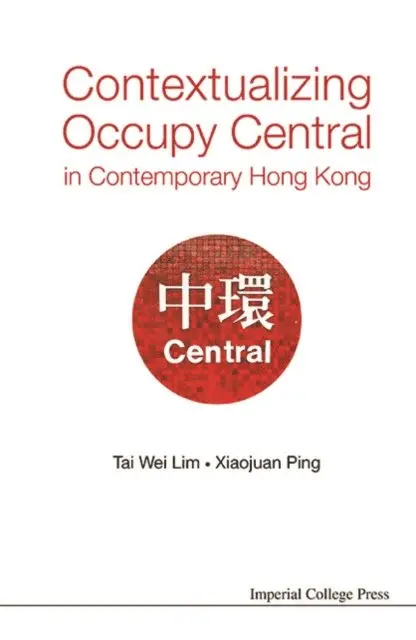
In the past 18 years, after the handover of the former British colony Hong Kong to China, Beijing and the Special Administration Region (SAR) have been trying to work out a mutually beneficial relationship based on pragmatism and a focus on economic prosperity. The Occupy Central with Love and Peace in Hong Kong (September to December 2014) movement represents a significant event in Hong Kong''s history of public advocacy for change by pro-democracy residents. It is viewed differently by various groups within Hong Kong, including eliciting counter-reactions from an opposing movement.To contextualize the current discussions, the authors have identified three phases of the movement; and included a historical anatomy of Hong Kong''s quest to reach an equilibrium between status quo and changes advocated through its social movements. Though the account does not pretend to be comprehensive, it distils the most significant events in each of the three stages of the movement. Centrist, moderate, and conservative views on Occupy Central, as well as the liberal and progressive positions on the movement are discussed and analyzed in the book.
E-bok
Engelska, 2016578 kr
Läs direkt efter köp
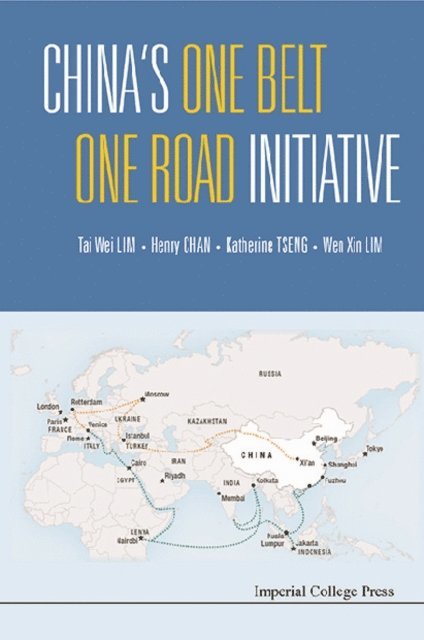
Chinese President Xi Jinping launched the Silk Road Economic Belt component of the One Belt One Road (OBOR) initiative at Kazakhstan in 2013. OBOR is a development strategy and framework that focuses on connectivity and cooperation among countries primarily in Eurasia. It consists of two main components, the land-based ''Silk Road Economic Belt'' (SREB) and ocean-going ''Maritime Silk Road'' (MSR). This book studies the equilibrium or balance between overland and maritime trade routes of OBOR.This book has two major sections. The interpretive section examines contemporary media narratives related to the OBOR initiative and how contemporary commentators appropriate narratives about historical events related to the maritime Silk Road to interpret current policy agendas and legitimize diplomatic or economic exchanges. In terms of institutional studies, the chapters related to Asian Infrastructure Investment Bank (AIIB) will look at the issues facing the Bank in its quest in forming a new world platform for multilateral development financing.The other section, the empirical case study of the publication highlights the fact that Euro-China High Speed Rail (HSR) and Central Asia-China HSR are not viable at the moment as passenger volume is not sufficient to justify the HSR line. This section examines the overland route of the OBOR and looks at recent Chinese HSR history and conventional sub-high speed rail technology development, and identifies technical & economic criteria determining the appropriate technology for a certain line. The chapter in this section will use the developed criteria to analyze the various rail linkage projects currently under study in the OBOR framework, highlight the economic, bureaucratic and geo-political challenges that these projects likely face and lay down conditions that will determine the outcome of these projects.
E-bok
Engelska, 2016590 kr
Läs direkt efter köp
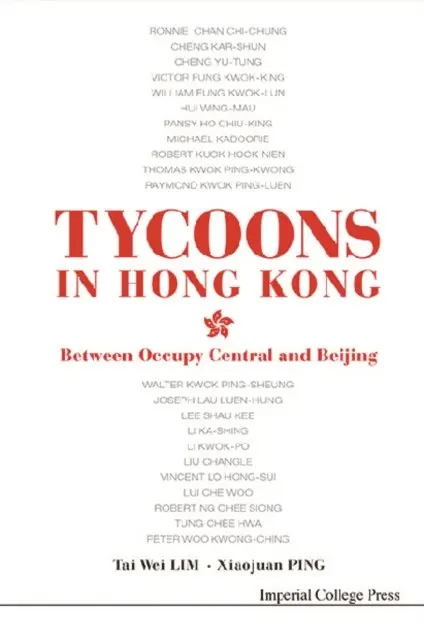
This book seeks to survey the role of tycoons in Hong Kong''s socio-political and socioeconomic developments. Summoned to Beijing just before the onset of the territory''s longest social movement, it highlights the tycoons'' symbolic intermediary role between Beijing''s elite and the people of Hong Kong. Also investigated is the unwritten social contract between Beijing''s elite and Hong Kong society — that the tycoons will be rewarded economically or left alone to conduct their business activities if they remain compatible with Beijing''s policy directions (or at least remain neutral in contentious issues) and facilitate policy implementation if necessary.Tycoons in Hong Kong has three research objectives: first, in understanding the roles that tycoons play in Hong Kong, it is necessary to understand Beijing''s crafted political and social spaces for Hong Kong''s economic elites to exert their influence. Second, it examines the integrated roles that the tycoons play as consultative members of the Chinese one-party socio-political structures. Third, it presents the humanized side of the tycoons, highlights the positive contributions that tycoons make to Hong Kong and mainland China and deconstructs the idea of a hegemonic tycoon class by emphasizing their heterogeneity in the biographical entries section of the publication.
E-bok
PDF, Engelska, 2021716 kr
Läs direkt efter köp
This volume will look into some macro factors that have an impact on gender conceptualizations in China. First, China is a highly-centralized state with a one-party political system that is also an authoritarian strongman regime. Thus, policies (including those related to gender) from the center are promulgated centripetally to provinces, cities, towns, villages, and local areas effectively.In terms of policy-making, the Chinese government noted that they have strengthened the Chinese Communist Party''s (CCP) guide for women''s work, enacted/upgraded rights protection law in the National People''s Congress (NPC), actualized mechanisms for women''s cause in the Chinese People''s Political Conservative Conference (CPPCC), streamlined work systems for effective implementation of national gender equality policies, and augmented the Women''s Federation as an intermediary between the Communist Party of China (CPC), the state, and all Chinese women.As productive forces, Chinese women in the socialist era were exemplary models of mothers and career women who treated family life and work as equally important priorities. They were upper middle class to high net worth individuals who showed their successes in juggling both as objects of moral suasion for other Chinese women in state-led publicity. Some of them were touted by the state as ideal modern Chinese women in state media, moral suasion campaigns, and/or propaganda.
E-bok
Engelska, 2021748 kr
Läs direkt efter köp
The publication started with a succinct and brief literature review of the different definitions of the term ''entrepreneurship''. After examining the different conceptual ideas of entrepreneurship, the ecological system of entrepreneurship was identified with a wide array and universe of stakeholders like the state, venture capitalists, non-profit organizations (NPOs), students, universities, instructors/trainers, educators, local communities, bureaucracy, and many other entities.In the East Asian region''s desire to tap into entrepreneurship, the economies are also keen to tap on formerly marginalized groups to power up the entrepreneurship game like women, energetic youths and reskilled individuals. Institutes of Higher Learning (IHLs) teaches practical applied learning courses to students and arm them with the necessary skills to tackle the many challenges of being an entrepreneur.Both tangible and intangible barriers to entrepreneurship were discussed in the writing. One of the intangible barriers discussed was the element of mindset. In some of the case studies, it appeared fear of failure was a major mindset barrier to would-be entrepreneurs pursuing their business ideas to actualize them. Measures carried out to remove the stigmatization of failure are discussed in the volume.
E-bok
Engelska, 2016210 kr
Läs direkt efter köp
Anime, Manga, Sushi, Teriyaki, J-pop, Harajuku fashion ... these are just some of the cultural exports from Japan that the rest of the world have embraced and Singapore is one of Japan''s biggest fans. Singaporeans have benefited not just by being a consumer of the many technological advances from Japan (Mitsubishi, Toyota, Honda, Panasonic, and Sony to name a few) but also shared and learnt through economic, political, and intellectual exchanges over the past 50 years since the start of the bilateral ties between these two nations.In 1868, Japan was the first East Asian country that underwent rapid modernization and its development was shared with Singapore from the 1970s onwards as the Japanese growth model was selectively emulated by the Four Asian Tigers (Hong Kong, Singapore, South Korea, and Taiwan). Currently, as the most advanced economies in Southeast and Northeast Asia respectively, Singapore and Japan will continue to be demonstrative case studies of economic development in the region. There are similarities too between these two countries: an aging population, changing geopolitical realities, mature economies, and environmental challenges. The Merlion and Mt. Fuji is not just a historical account of the bilateral cooperation but also includes honest narratives on what it is like being a Singaporean student on exchange in Japan, an anime and manga fan outside of Japan, and some omotenashi appreciation.
E-bok
Engelska, 20181 200 kr
Läs direkt efter köp
This book captures the essence of Hong Kong''s development in the past two decades from 1997 to 2017. It is broken into four parts — economics, society, politics and culture.Hong Kong''s role remains as a gateway for global trading houses, businessmen, investors and traders. Hong Kong continues to be an open economy and has stuck to free trade policies, as one of the former four successful ''tiger economies'' in East Asia. In the political and international relations realm, this book examines Hong Kong''s relations with China, other major powers and the world at large. It also covers domestic developments, including legal developments. Other chapters in the book examine cultural developments in Hong Kong from specific case studies of iconic animation character to trans-boundary popularity of Hong Kong popular culture in China.With contributions from Alvin CAMBA, Henry CHAN, Yoshihisa GODO, Wing Lok HUNG, Sean KING, Tuan Yuen KONG, Tai Wei LIM, Carol MA, Samantha MA, Parama SINHA PALIT, Zhengqi PAN, SIM Japanese Culture and Gaming Society, Hiroshi TAKAHASHI, Ghim Yeow TAN, Katherine TSENG, Elim WONG, Kai Keat YEO and Chun Wang YEUNG, this book provides a snapshot of Hong Kong in the past twenty years and is a fascinating read.
E-bok
Engelska, 2017888 kr
Läs direkt efter köp
This edited book reflects the ''yin-yang'' of East Asia — the analogy of co-existing ''hot and cold'' trends in that region. To concentrate only on geopolitical competition and regional ''hot spots'' will exaggerate, if not misrepresent East Asia as a Hobbesian world. Nevertheless, geopolitical competition cannot be ignored because a failure of the balance of power and deterrence between China and the United States (and its allies) will destabilise the region. There are four ''vectors'' in the geopolitics of East Asia: China rising, the United States ''rebalancing'' to this region, Japan ''normalising'' as a nation-state and ASEAN emerging as a regional community. The interplay of these four ''vectors'' will set the trajectory of geopolitics in East Asia. Another focus of this volume is on the politics of identity. The distinctiveness, character and flavour of a group, real or imagined, can be ''cool''. ''Cool'' as in being charming and appealing transcends national boundaries. Plurality and diversity of identities and cultures in East Asia can be a celebration of life and humanity. However, xenophobic identities, often based on exclusive race, language, religion and hegemony, and its subsequent politicisation can rend a nation apart. Indeed, the affirmation of one''s identity may be at the expense or denial of the identity of ''the other''. Similarly, the assertion and the intricacy of identity and nationalism in East Asia can also be problematic. However, a person or group can have multiple and different scales of identities. Indeed, identities can be fluid and situational.
E-bok
PDF, Engelska, 2009531 kr
Läs direkt efter köp
The most remarkable phenomenon in Asia in the 21st century is arguably the economic rise of China and India. Amazingly, the two most populous countries in the world are uplifting millions of their citizens annually from poverty through rapid economic growth. What is the impact on the region, given the ascendance of China and India? There are at least two possible outcomes: the rise of the two great Asian powers may challenge the US and instill fear among the smaller countries in Asia, or, China and India will act as new economic dynamos that will benefit the region even if US economic presence in the region is to decline in the future. This book explores the opportunities and obstacles to a “harmonious” region underpinned by the rise of China and India.
E-bok
PDF, Engelska, 2009487 kr
Läs direkt efter köp
This book looks at the emergence of China as a major importer and consumer of energy as well as examines contemporary issues within the Chinese oil industry. As China benefits from globalization, what is the impact on China''s relations with countries in its neighbouring region when it seeks more oil importation from overseas sources? China''s industrial growth in the Pan Pearl River Delta Region is outstripping its oil supply and China is turning to the ASEAN countries connected to its Pearl River tributaries to form a Pan region that acts both as a conduit for oil supply from other sources as well as the supply source itself.Geopolitics in the region represents one of the main obstacles standing in China''s way for a regional agreement on maritime resources. Would the pressure on China for more energy translate into tension and conflicts? How will Japan view or compete with China''s initiatives in ASEAN given that Japan is still the region''s largest investor.After China''s landmark energy crisis in 2004, how will China be able to strike a balance between economic growth and energy consumption? With the growing importance of post-industrial debate and environmentalism, what are the implications of post-industrialism for China? For future energy use, how will China utilize the options of alternative energy, energy conservation and reinvigoration of old energy resources to meet its future oil needs?
E-bok
PDF, Engelska, 2009216 kr
Läs direkt efter köp
The current financial crisis provides a valuable occasion for the world to re-examine the grand statements of wisdom which dominate the financial world for a long time. The impact is extremely serious as a result of the convergence of a number of factors such as huge current account deficits of the United States, globalization, deregulation, loose monetary policy, and excessive liquidity. This book seeks to address the critical issues in deregulation, derivatives, leveraging, remuneration systems, and rating agencies.This book will also examine Asia''s response and why Asian economies have been less affected by the global financial crisis. Are corporate governance, culture, management styles or even a state-led model the main reasons? Would the Asian sovereign funds help to be the last line of defense against the excesses of the crisis? Is the US$80 billion Asian crisis fund envisaged as the first instance of a coordinated East Asian response to the crisis and would this truly underpin the creation of an East Asian regional order? This book reaffims the need for banks and financial institutions to provide value-adding services, exercise prudence and due diligence and pay due regard for societal interest.
E-bok
PDF, Engelska, 2009516 kr
Läs direkt efter köp
This book examines the political and conceptual metamorphosis of China''s oil industry from self-reliance to internationalization. Through the empirical case study of Daqing, the premiere oilfield of the People''s Republic of China (PRC) for most of the postwar period and a symbol of industrialization as well as self-reliance, key historical developmental concepts and events are analyzed. Japan''s role in stimulating the development of the China''s oil industry will also be highlighted as the Japanese government and its business sectors emerged as a supplier of technology and equipment to the Chinese oil industry as well as China''s first major oil customer in the early internationalization phase of the PRC''s oil industry.
E-bok
Engelska, 20161 375 kr
Läs direkt efter köp
This book aims to provide comprehensive empirical and theoretical studies of expanding fandom communities in East Asia through the commodification of Japanese, Korean and Chinese popular cultures in the digital era. Using a multidisciplinary approach including political economy, East Asian studies, political science, international relations concepts and history, this book focuses on a few research objectives. In terms of methodology, it is an area studies approach based on interpretative work, observation studies, policy and textual analysis. First, it aims to examine the closely intertwined relationship between the three major stakeholders in the iron triangle of production companies, consumers and states (i.e., role of government in policy promotion). Second, it studies the interpenetration, adaptation, innovation and hybridization of exogenous Western culture with traditional popular cultures in (North) East Asia. Third, it studies the influence of popular cultures and how cultural products resonate with a regional audience through collective consumption, contents reflective of normative values, the emotive and cognitive appeal of familiar images and social learning as well as peer effect found in fan communities. It then examines how consumption contributes to soft cultural influence and how governments leverage on its comparative advantages and cultural assets for commercial success and in the process augment national (cultural) influence. These questions will be discussed and analyzed and contextualized through the case studies of J-pop (Japanese popular culture), K-pop (Korean popular culture or Hallyu) and Chinese popular culture (including Mando-pop and Taiwanese popular culture).