Lima Susan D. Lima – författare
Visar alla böcker från författaren Lima Susan D. Lima. Handla med fri frakt och snabb leverans.
2 produkter
2 produkter
E-bok
PDF, Engelska, 19921 618 kr
Läs direkt efter köp
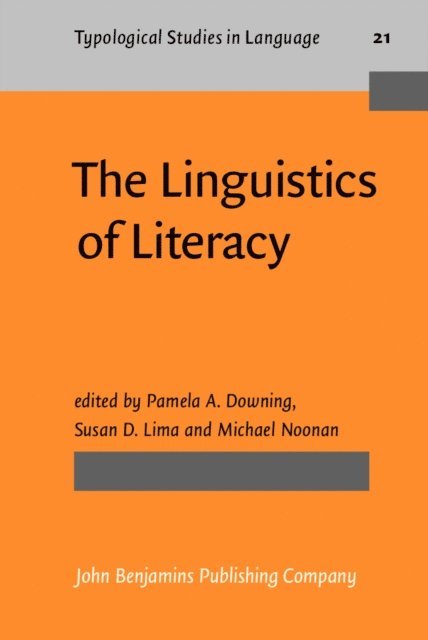
This volume grew out of the Seventeenth Annual University of Wisconsin-Milwaukee Linguistics Symposium, which was held in Milwaukee on April 8-10, 1988. The theme of the conference was the relationship between linguistics and literacy. In this volume, a selection of papers are presented which cluster around three of the major themes that developed during the conference: the linguistic differences between written and spoken genres, the relationship between orthographic systems and phonology, and the psychology of orthography. The volume concludes with a solicited paper by Walter J. Ong which draws together the various strands considered in the other sections of the book and addresses the broader question of the social and psychological consequences of literacy.
E-bok
PDF, Engelska, 19941 824 kr
Läs direkt efter köp
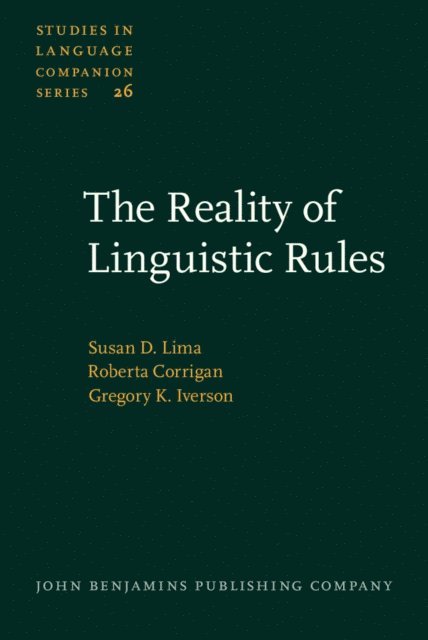
This volume presents a selection of the best papers from the 21st Annual University of Wisconsin-Milwaukee Linguistics Symposium. Researchers from linguistics, psychology, computer science, and philosophy, using many different methods and focusing on many different facts of language, addressed the question of the existence of linguistic rules. Are such rules best seen as convenient tools for the description of languages, or are rules actually invoked by individual language users? Perhaps the most serious challenge to date to the linguistic rule is the development of connectionist architecture. Indeed, these systems must be viewed as a serious challenge to the foundations of all of contemporary linguistics. Four broad themes emerged from the Milwaukee conference, corresponding to the four parts of the volume. Part I centers on arguments for the existence of symbolic rules in linguistic competence and performance. Part II contains arguments against symbolic rules, presenting connectionist models and other alternatives to the symbolic paradigm. Parts III and IV take up two issues that are central to a number of language researchers: Language acquisition and learnability, and modularity. These issues are addressed from within both rule-based and non-rule-based perspectives. Contributors: Farrell Ackerman, Michael Barlow, Catherine Best, David Corina, Roberta Corrigan, Kim Daugherty, Bruce Derwing, Jeff Elman, Alice Faber, John Goldsmith, Helen Goodluck, Neil Jacobs, Richard Janda, Brian Joseph, Michael Kac, Alan Kawamoto, Suzanne Kemmer, Susan Lima, Brian MacWhinney, Steven Pinker, Alan Prince, Gerald Sanders, Hinrich Schutze, Mark Seidenberg, Royal Skousen, Nicholas Sobin, Joseph Stemberger, Gregory Stone, Ann Thyme, Robert Van Valin.