Linda Faye Williams – författare
Visar alla böcker från författaren Linda Faye Williams. Handla med fri frakt och snabb leverans.
2 produkter
2 produkter
Häftad, Engelska, 2003
667 kr
Skickas inom 5-8 vardagar
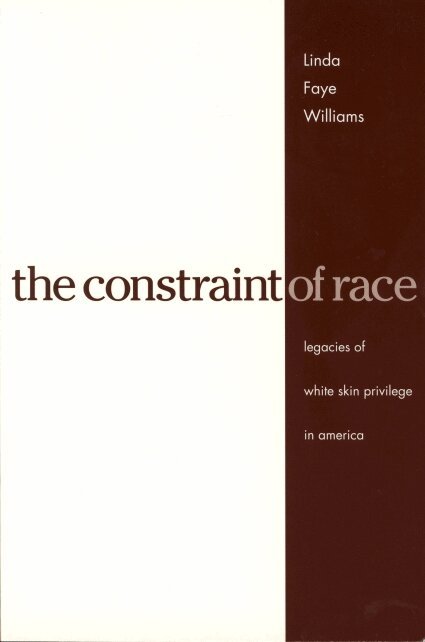
The Constraint of Race offers a challenging new approach to understanding the evolution of American social policy and the racial politics shaping it. Rather than focusing on the disadvantages suffered by blacks in the American welfare state, Linda Faye Williams looks at the other side of the coin: the advantages enjoyed by whites. Her hope is that rendering the benefits of “white skin privilege” more visible will help undermine their acceptance as “normal” and motivate renewed efforts toward achieving a more just and equitable society. Williams begins her analysis by comparing two programs of federal provision in the mid-nineteenth century—the Freedmen’s Bureau and the Civil War Veterans’ Pension system. Already at this early stage of its development, she shows, the emerging welfare state effectively denied blacks the protections it provided white Americans and simultaneously stigmatized blacks as welfare “dependents.” The linkages among race, moral worthiness, and social policy established then have persisted to the present. Her reexamination of key episodes in the later evolution of the American welfare state from the New Deal through the Clinton administration reveals how developments in social policy have advanced the privileges attached to “whiteness” by a variety of mechanisms: the ongoing reinterpretation of the American tradition of liberal individualism in racialized ways; the slow accretion of policy legacies; the construction of “whiteness” itself as a political category; and the normal procedures of coalition building and electoral politics. Through these connected processes, whiteness and the protection of white privilege became fundamental to the operation of American democracy, and their centrality has been continually reinforced by social policy. The result has been a politics in which race is used as a weapon by political parties and candidates to constrain and turn back the American welfare state. Looking to the future, Williams concludes by considering the socioeconomic conditions and political mechanisms that might help overcome the iron grip that white privilege holds on American social politics. “There can be little genuine progress in solving the so-called race problem or in creating the kind of social citizenship all Americans deserve unless and until continuing white skin privilege is openly acknowledged and addressed. In effect, the problem of the twenty-first century is not the color line but finding a way to successfully challenge whiteness as ideology and reality.”—From The Constraint of Race
Inbunden, Engelska, 1991
683 kr
Skickas inom 10-15 vardagar
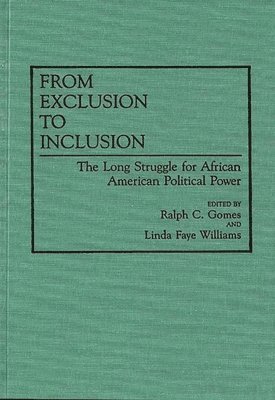
This book is designed to explore the historical and current level of African-American political participation, to assess the fruits of participation, and to provide recommendations for improving the efficacy of African American political participation in the future. Part One focuses on the historic struggle for securing and expanding African-American voting rights; Part Two focuses on the economic, legal, philosophic, and cultural context of African-American politics; Part Three focuses on prospects for African-American politics in the future--particularly the opportunities to develop successful electoral coalitions; and Part Four provides specific recommendations to produce fuller inclusion of African-Americans in the American polity.By providing a balanced account from the national perspective, this volume assesses the historical and current positions of African-Americans in politics throughout the nation. It assesses the impact of the Voting Rights Act of 1965 and clarifies the significance of the struggle for voting rights--and how extensively equitable voting rights have been achieved. By focusing on the economic, legal, and cultural contexts of African-American politics, it evaluates both the potential for success and the built-in limitations of American society in improving black status and everyday life-chances through the political arena. The possibilities for coalition politics are carefully analyzed--providing useful insights into the pitfalls and opportunities of coalition building among minorities and between minorities and various sectors of whites. The book also makes recommendations for increasing African-American political participation and provides strategies for the future. This collection will be invaluable to Black Studies programs and those concerned with current American socio-political developments.