Lindstrom Jan Lindstrom – författare
Visar alla böcker från författaren Lindstrom Jan Lindstrom. Handla med fri frakt och snabb leverans.
2 produkter
2 produkter
E-bok
Engelska, 20211 305 kr
Läs direkt efter köp
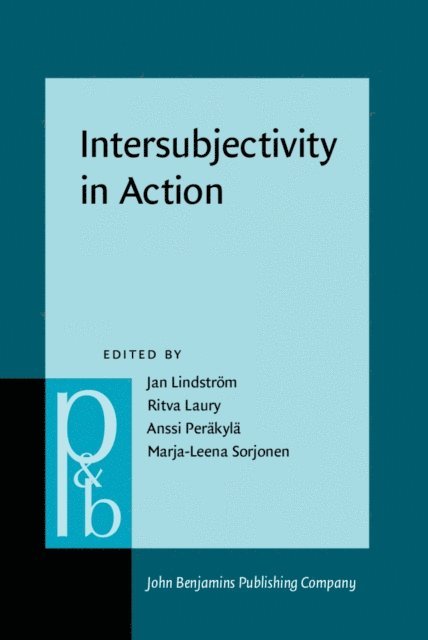
Intersubjectivity is a precondition for human life - for social organization as well as for individual development and well-being. Through empirical examination of social interactions in everyday and institutional settings, the authors in this volume explore the achievement and maintenance of intersubjectivity. The contributions show how language codes and creates intersubjectivity, how interactants move towards shared understanding in interaction, how intersubjectivity is central to phenomena and experiences often considered merely individual, and how intersubjectivity evolves through learning. While the core methodology of the studies is Conversation Analysis, the volume highlights the advantages of using several methods to tackle intersubjectivity.
1 305 kr
Läs direkt efter köp
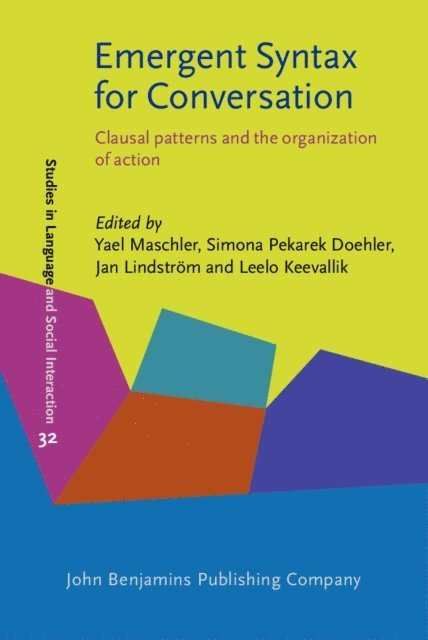
This volume explores how emergent patterns of complex syntax - that is, syntactic structures beyond a simple clause - relate to the local contingencies of action formation in social interaction. It examines both the on-line emergence of clause-combining patterns as they are 'patched together' on the fly, as well as their routinization and sedimentation into new grammatical patterns across a range of languages - English, Estonian, Finnish, French, German, Hebrew, Italian, Mandarin, and Swedish. The chapters investigate how the real-time organization of complex syntax relates to the unfolding of turns and actions, focusing on: (i) how complex syntactic patterns, or routinized fragments of 'canonical' patterns, serve as resources for projection, (ii) how complex syntactic patterns emerge incrementally, moment-by-moment, out of the real-time trajectories of action, (iii) how formal variants of such patterns relate to social action, and (iv) how all of these play out within the multimodal ecologies of action formation.The empirical findings presented in this volume lend support to a conception of syntax as fundamentally temporal, emergent, dialogic, sensitive to local interactional contingencies, and interwoven with other semiotic resources.