Lisa Gitelman - Böcker
Visar alla böcker från författaren Lisa Gitelman. Handla med fri frakt och snabb leverans.
6 produkter
6 produkter
374 kr
Tillfälligt slut
341 kr
Tillfälligt slut
564 kr
Skickas inom 5-8 vardagar
Scripts, Grooves, and Writing Machines
Representing Technology in the Edison Era
Häftad, Engelska, 2000
371 kr
Skickas inom 7-10 vardagar
This is a richly imaginative study of machines for writing and reading at the end of the nineteenth century in America. Its aim is to explore writing and reading as culturally contingent experiences, and at the same time to broaden our view of the relationship between technology and textuality.At the book's heart is the proposition that technologies of inscription are materialized theories of language. Whether they failed (like Thomas Edison's "electric pen") or succeeded (like typewriters), inscriptive technologies of the late nineteenth century were local, often competitive embodiments of the way people experienced writing and reading. Such a perspective cuts through the determinism of recent accounts while arguing for an interdisciplinary method for considering texts and textual production.Starting with the cacophonous promotion of shorthand alphabets in postbellum America, the author investigates the assumptions—social, psychic, semiotic—that lie behind varying inscriptive practices. The "grooves" in the book's title are the delicate lines recorded and played by phonographs, and readers will find in these pages a surprising and complex genealogy of the phonograph, along with new readings of the history of the typewriter and of the earliest silent films. Modern categories of authorship, representation, and readerly consumption emerge here amid the un- or sub-literary interests of patent attorneys, would-be inventors, and record producers. Modern subjectivities emerge both in ongoing social constructions of literacy and in the unruly and seemingly unrelated practices of American spiritualism, "Coon" songs, and Rube Goldberg-type romanticism.Just as digital networks and hypertext have today made us more aware of printed books as knowledge structures, the development and dissemination of the phonograph and typewriter coincided with a transformed awareness of oral and inscribed communication. It was an awareness at once influential in the development of consumer culture, literary and artistic experiences of modernity, and the disciplinary definition of the "human" sciences, such as linguistics, anthropology, and psychology. Recorded sound, typescripts, silent films, and other inscriptive media are memory devices, and in today's terms the author offers a critical theory of ROM and RAM for the century before computers.
1 567 kr
Skickas inom 3-6 vardagar
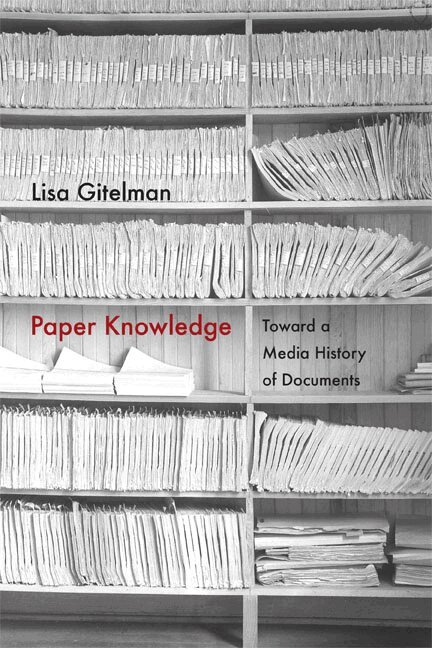
Paper Knowledge is a remarkable book about the mundane: the library card, the promissory note, the movie ticket, the PDF (Portable Document Format). It is a media history of the document. Drawing examples from the 1870s, the 1930s, the 1960s, and today, Lisa Gitelman thinks across the media that the document form has come to inhabit over the last 150 years, including letterpress printing, typing and carbon paper, mimeograph, microfilm, offset printing, photocopying, and scanning. Whether examining late nineteenth century commercial, or "job" printing, or the Xerox machine and the role of reproduction in our understanding of the document, Gitelman reveals a keen eye for vernacular uses of technology. She tells nuanced, anecdote-filled stories of the waning of old technologies and the emergence of new. Along the way, she discusses documentary matters such as the relation between twentieth-century technological innovation and the management of paper, and the interdependence of computer programming and documentation. Paper Knowledge is destined to set a new agenda for media studies.
270 kr
Skickas inom 7-10 vardagar
Paper Knowledge is a remarkable book about the mundane: the library card, the promissory note, the movie ticket, the PDF (Portable Document Format). It is a media history of the document. Drawing examples from the 1870s, the 1930s, the 1960s, and today, Lisa Gitelman thinks across the media that the document form has come to inhabit over the last 150 years, including letterpress printing, typing and carbon paper, mimeograph, microfilm, offset printing, photocopying, and scanning. Whether examining late nineteenth century commercial, or "job" printing, or the Xerox machine and the role of reproduction in our understanding of the document, Gitelman reveals a keen eye for vernacular uses of technology. She tells nuanced, anecdote-filled stories of the waning of old technologies and the emergence of new. Along the way, she discusses documentary matters such as the relation between twentieth-century technological innovation and the management of paper, and the interdependence of computer programming and documentation. Paper Knowledge is destined to set a new agenda for media studies.