L.N. Kanal – författare
Visar alla böcker från författaren L.N. Kanal. Handla med fri frakt och snabb leverans.
9 produkter
9 produkter
E-bok
PDF, Engelska, 2012692 kr
Läs direkt efter köp
The 1985 Amsterdam conference brought together researchers active in pattern recognition methodology and the development of practical applications. The first part of the book covers various methodological aspects of image processing, knowledge based and model driven image understanding systems, 3-D reconstruction methods, and application oriented papers. Part II deals with aspects of statistical pattern recognition, the problem of population classification, and topics common to both pattern recognition and artificial intelligence.
E-bok
PDF, Engelska, 2014779 kr
Läs direkt efter köp
Parallel processing for AI problems is of great current interest because of its potential for alleviating the computational demands of AI procedures. The articles in this book consider parallel processing for problems in several areas of artificial intelligence: image processing, knowledge representation in semantic networks, production rules, mechanization of logic, constraint satisfaction, parsing of natural language, data filtering and data mining. The publication is divided into six sections. The first addresses parallel computing for processing and understanding images. The second discusses parallel processing for semantic networks, which are widely used means for representing knowledge - methods which enable efficient and flexible processing of semantic networks are expected to have high utility for building large-scale knowledge-based systems. The third section explores the automatic parallel execution of production systems, which are used extensively in building rule-based expert systems - systems containing large numbers of rules are slow to execute and can significantly benefit from automatic parallel execution. The exploitation of parallelism for the mechanization of logic is dealt with in the fourth section. While sequential control aspects pose problems for the parallelization of production systems, logic has a purely declarative interpretation which does not demand a particular evaluation strategy. In this area, therefore, very large search spaces provide significant potential for parallelism. In particular, this is true for automated theorem proving. The fifth section considers the problem of constraint satisfaction, which is a useful abstraction of a number of important problems in AI and other fields of computer science. It also discusses the technique of consistent labeling as a preprocessing step in the constraint satisfaction problem. Section VI consists of two articles, each on a different, important topic. The first discusses parallel formulation for the Tree Adjoining Grammar (TAG), which is a powerful formalism for describing natural languages. The second examines the suitability of a parallel programming paradigm called Linda, for solving problems in artificial intelligence.Each of the areas discussed in the book holds many open problems, but it is believed that parallel processing will form a key ingredient in achieving at least partial solutions. It is hoped that the contributions, sourced from experts around the world, will inspire readers to take on these challenging areas of inquiry.
E-bok
PDF, Engelska, 2014779 kr
Läs direkt efter köp
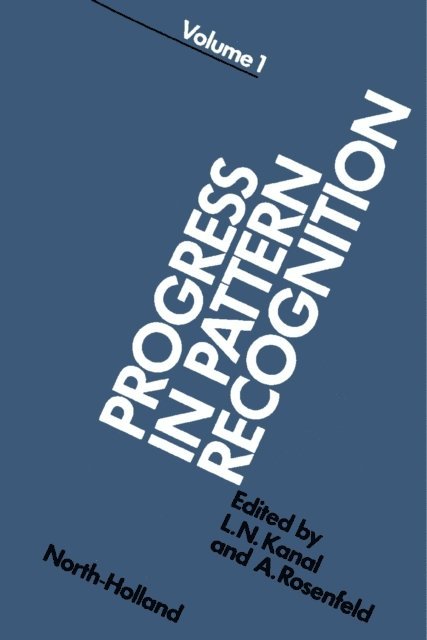
Progress in Pattern Recognition 1
E-bok
PDF, Engelska, 20141 681 kr
Läs direkt efter köp
How to deal with uncertainty is a subject of much controversy in Artificial Intelligence. This volume brings together a wide range of perspectives on uncertainty, many of the contributors being the principal proponents in the controversy.Some of the notable issues which emerge from these papers revolve around an interval-based calculus of uncertainty, the Dempster-Shafer Theory, and probability as the best numeric model for uncertainty. There remain strong dissenting opinions not only about probability but even about the utility of any numeric method in this context.
E-bok
PDF, Engelska, 2014779 kr
Läs direkt efter köp
This second volume is arranged in four sections: Analysis contains papers which compare the attributes of various approaches to uncertainty. Tools provides sufficient information for the reader to implement uncertainty calculations. Papers in the Theory section explain various approaches to uncertainty. The Applications section describes the difficulties involved in, and the results produced by, incorporating uncertainty into actual systems.
E-bok
PDF, Engelska, 2014779 kr
Läs direkt efter köp
Clearly illustrated in this volume is the current relationship between Uncertainty and AI.It has been said that research in AI revolves around five basic questions asked relative to some particular domain: What knowledge is required? How can this knowledge be acquired? How can it be represented in a system? How should this knowledge be manipulated in order to provide intelligent behavior? How can the behavior be explained? In this volume, all of these questions are addressed. From the perspective of the relationship of uncertainty to the basic questions of AI, the book divides naturally into four sections which highlight both the strengths and weaknesses of the current state of the relationship between Uncertainty and AI.
E-bok
PDF, Engelska, 2017779 kr
Läs direkt efter köp
This volume, like its predecessors, reflects the cutting edge of research on the automation of reasoning under uncertainty.A more pragmatic emphasis is evident, for although some papers address fundamental issues, the majority address practical issues. Topics include the relations between alternative formalisms (including possibilistic reasoning), Dempster-Shafer belief functions, non-monotonic reasoning, Bayesian and decision theoretic schemes, and new inference techniques for belief nets. New techniques are applied to important problems in medicine, vision, robotics, and natural language understanding.
E-bok
PDF, Engelska, 2014779 kr
Läs direkt efter köp
The era of detailed comparisons of the merits of techniques of pattern recognition and artificial intelligence and of the integration of such techniques into flexible and powerful systems has begun.So confirm the editors of this fourth volume of Pattern Recognition in Practice, in their preface to the book.The 42 quality papers are sourced from a broad range of international specialists involved in developing pattern recognition methodologies and those using pattern recognition techniques in their professional work. The publication is divided into six sections: Pattern Recognition, Signal and Image Processing, Probabilistic Reasoning, Neural Networks, Comparative Studies, and Hybrid Systems, giving prospective users a feeling for the applicability of the various methods in their particular field of specialization.
E-bok
PDF, Engelska, 2014779 kr
Läs direkt efter köp
This volume brings together the results of research into the methodology and applications of pattern recognition, with particular emphasis given to the incorporation of artificial intelligence methodologies into pattern recognition systems.The first part of this volume covers image analysis and processing software, systems and algorithms. Pattern analysis and classifier design are dealt with in part two, while the last part deals with model based and expert systems, including uncertainty calculus methods in pattern analysis and object recognition. A number of specific application areas are considered, including such diverse topics as fingerprinting, astronomy, molecular biology and pathology.