Louis-André Gérard-Varet - Böcker
Visar alla böcker från författaren Louis-André Gérard-Varet. Handla med fri frakt och snabb leverans.
4 produkter
4 produkter
3 335 kr
Skickas inom 5-8 vardagar
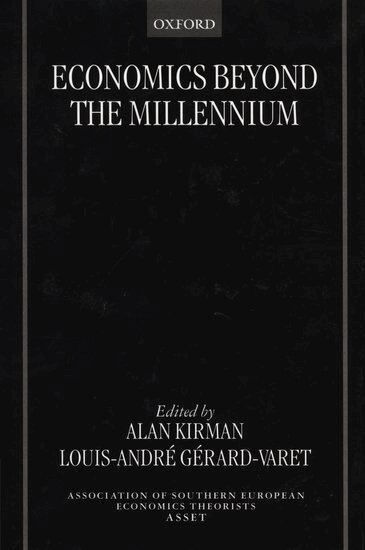
Economics: Beyond the Millennium contains articles by leading authorities in various fields of economic theory and econometrics, each of whom gives an account of the current state of the art in their own field and indicate the direction that they think it will take in the next ten years. The fields covered are grouped into three categories: the microfoundations of macroeconomics, where Malinvaud evaluates the theory of resource allocation and Hildenbrand examines the empirical content of economic thories; markets and and organizations, where both Gabszewicz and D'Aspremont et al. look at imperfect competition and general equilibrium, Scotchmer and Thiess consider spatial economics, Ponssard the future of managerial economics, while Van Damme looks at the next stage of game theory; and econometrics, where Gourieroux reviews econometric modelling in general, Maravall looks at time series, Lubrand and Bauwens examine Bayesian analysis, and Blundell looks at the rapidly expanding area of microeconometrics.
1 049 kr
Skickas inom 10-15 vardagar
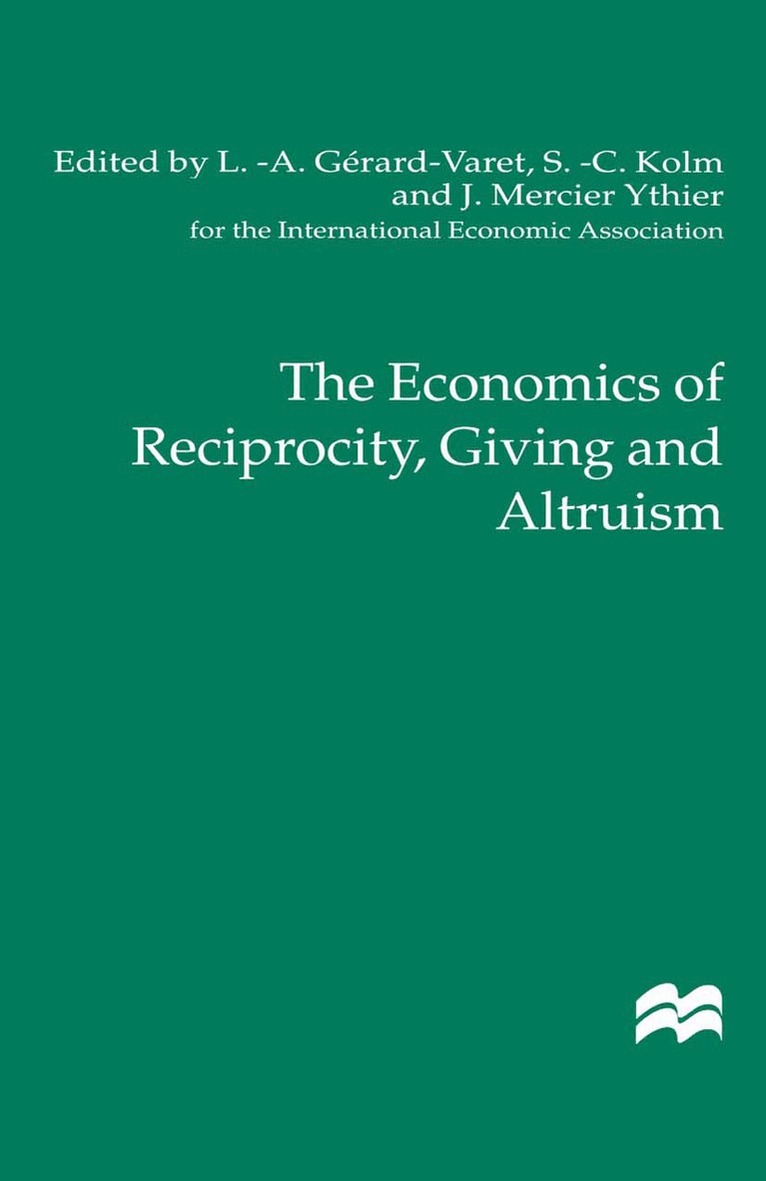
Reciprocity is a pervasive type of social interaction in encounters, groups and organizations. This volume gathers basic recent works in its main domains such as the theory of reciprocity, the public economics of transfers, the economics of the family, charities, gifts of organs, or the motivations for gift-giving.
2 333 kr
Skickas inom 10-15 vardagar
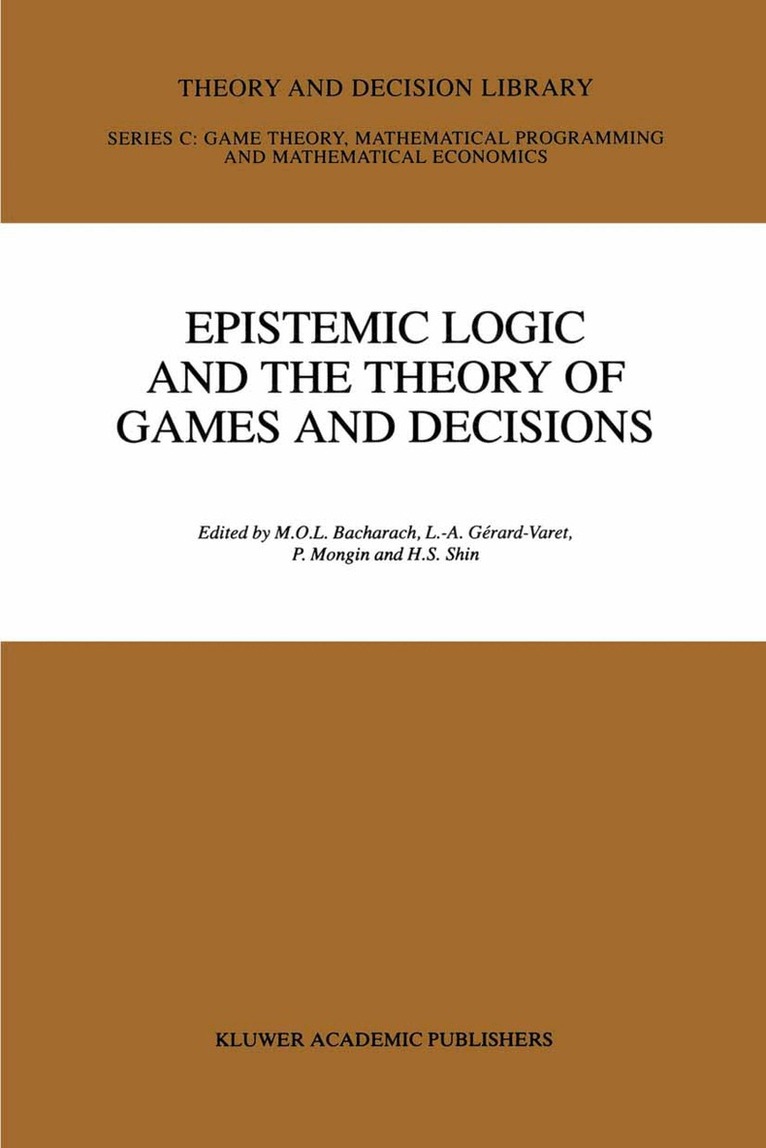
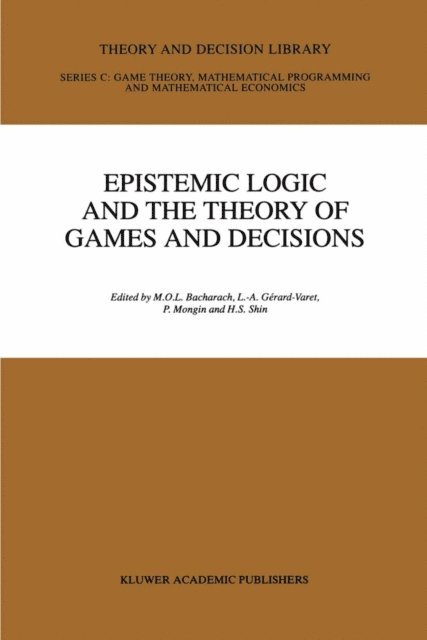
This book arose out of a conference on "Epistemic Logic and the Theory of Games and Decisions" that took place in January 1994 at the Centre Inter- national de Recherches Mathematiques in Marseille. The convergence of game theory and epistemic logic has been in progress for two decades. The aim of the conference was to explore this rapprochement further by gathering spe- cialists from different professional communities, i. e. , economics, mathematics, philosophy, and computer science. Also, the organizors aimed at fostering the work centered on the issues of knowledge and belief that has recently been pursued amongst game theorists and decision theorists. The conference was funded by the following institutions: Centre National de la Recherche Sci- entifique (France), Ministere de l'Enseignement Superieur et de la Recherche (France), Association pour Ie Developpement de la Recherche en Economie et Statistique (France). It was also supported by the Human Capital and Mobility Programme of the EU, as well as, locally, by the Ville de Marseille. We would like to express our gratitude to these institutions for their generous help.Despite the success of the conference, it was not the editors' intention to circulate just another volume of proceedings in the usual style. Throughout the more than two-year editorial process, they have pursued the goal of providing a no doubt non-exhaustive, but hopefully thorough and accurate, state of the art account of a promising field of research.
2 333 kr
Skickas inom 10-15 vardagar
This book arose out of a conference on "Epistemic Logic and the Theory of Games and Decisions" that took place in January 1994 at the Centre Inter- national de Recherches Mathematiques in Marseille. The convergence of game theory and epistemic logic has been in progress for two decades. The aim of the conference was to explore this rapprochement further by gathering spe- cialists from different professional communities, i. e. , economics, mathematics, philosophy, and computer science. Also, the organizors aimed at fostering the work centered on the issues of knowledge and belief that has recently been pursued amongst game theorists and decision theorists. The conference was funded by the following institutions: Centre National de la Recherche Sci- entifique (France), Ministere de l'Enseignement Superieur et de la Recherche (France), Association pour Ie Developpement de la Recherche en Economie et Statistique (France). It was also supported by the Human Capital and Mobility Programme of the EU, as well as, locally, by the Ville de Marseille. We would like to express our gratitude to these institutions for their generous help.Despite the success of the conference, it was not the editors' intention to circulate just another volume of proceedings in the usual style. Throughout the more than two-year editorial process, they have pursued the goal of providing a no doubt non-exhaustive, but hopefully thorough and accurate, state of the art account of a promising field of research.