Louis Arnaud Reid - Böcker
Visar alla böcker från författaren Louis Arnaud Reid. Handla med fri frakt och snabb leverans.
5 produkter
5 produkter
3 161 kr
Skickas inom 10-15 vardagar
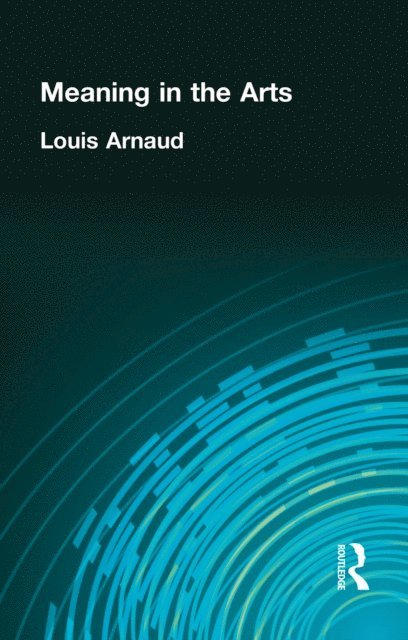
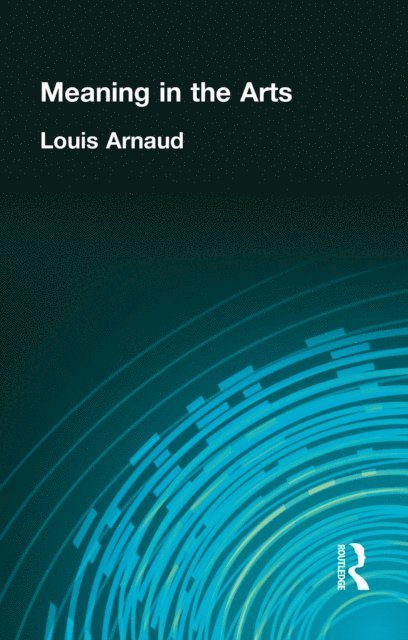
This is Volume II of three in a collection on Aesthetics. Originally published in 1969, this volume of the Muirhead library of philosophy. After distinguishing, and relating, the functions of Criticism and Aesthetics in Part I, Part II develops the basic thesis of the book, which is that the central defining characteristic of the aesthetic is 'embodiment' rather than 'expression'. Part III tests this out in examples from the different arts, 'representative' and 'abstract', with very special attention to music (as an 'abstract' art), in which the problem of art's apparently contradictory characters-of being both autonomous and yet expressive of life outside art-is seen in its most acute form. Part IV is a philosophical analysis of the main concepts so far involved-meaning, symbolism, knowledge, truth, standards-in art as distinct from other, discursive knowledge. It concludes with a discussion of the question whether art is in any sense a 'revelation'. Part V considers the bearing of the arguments of the book on aesthetic education.
671 kr
Skickas inom 10-15 vardagar
This is Volume II of three in a collection on Aesthetics. Originally published in 1969, this volume of the Muirhead library of philosophy. After distinguishing, and relating, the functions of Criticism and Aesthetics in Part I, Part II develops the basic thesis of the book, which is that the central defining characteristic of the aesthetic is 'embodiment' rather than 'expression'. Part III tests this out in examples from the different arts, 'representative' and 'abstract', with very special attention to music (as an 'abstract' art), in which the problem of art's apparently contradictory characters-of being both autonomous and yet expressive of life outside art-is seen in its most acute form. Part IV is a philosophical analysis of the main concepts so far involved-meaning, symbolism, knowledge, truth, standards-in art as distinct from other, discursive knowledge. It concludes with a discussion of the question whether art is in any sense a 'revelation'. Part V considers the bearing of the arguments of the book on aesthetic education.
1 009 kr
Skickas inom 10-15 vardagar
2 088 kr
Skickas inom 10-15 vardagar
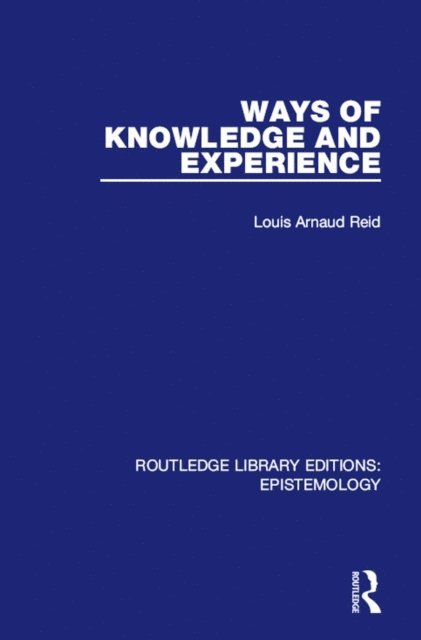
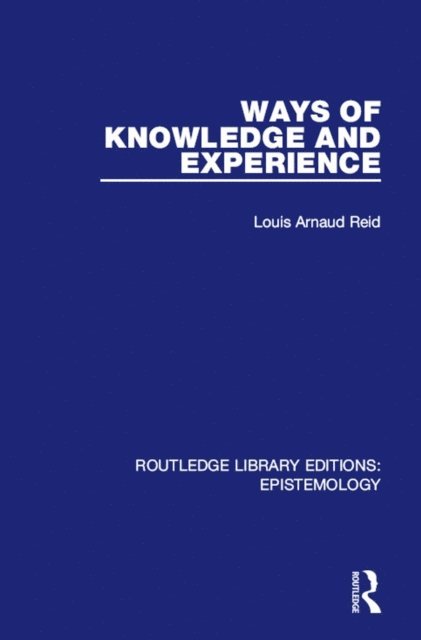
Originally published in 1961. This book is a study of some important ways of knowledge and experience and of the symbols through which they become articulate. Both ‘knowledge’ and ‘experience’ are interpreted in wide senses which are sanctioned by common use – though not always by the usage of philosophers and scientists. The four main fields considered are: the arts, religion, moral knowledge, and our knowledge of one another. These fields, though distinguishable, are nevertheless found to be interrelated in subtle and interesting ways, and it is contended that increase of ‘wisdom’, or ‘educated understanding’, can be achieved only through acceptance and assimilation of all their many-sided disciplines into personal insight. The book deals in a new way with questions of perennial interest which, because they are fundamental, are difficult. Nevertheless, the writing is lucid and untechnical and addressed to a wide range of readers.
671 kr
Skickas inom 10-15 vardagar
Originally published in 1961. This book is a study of some important ways of knowledge and experience and of the symbols through which they become articulate. Both ‘knowledge’ and ‘experience’ are interpreted in wide senses which are sanctioned by common use – though not always by the usage of philosophers and scientists. The four main fields considered are: the arts, religion, moral knowledge, and our knowledge of one another. These fields, though distinguishable, are nevertheless found to be interrelated in subtle and interesting ways, and it is contended that increase of ‘wisdom’, or ‘educated understanding’, can be achieved only through acceptance and assimilation of all their many-sided disciplines into personal insight. The book deals in a new way with questions of perennial interest which, because they are fundamental, are difficult. Nevertheless, the writing is lucid and untechnical and addressed to a wide range of readers.