Louis D. Brandeis – författare
Visar alla böcker från författaren Louis D. Brandeis. Handla med fri frakt och snabb leverans.
20 produkter
20 produkter
Engelska, 1995
338 kr
Skickas inom 10-15 vardagar
Philippa Strum, our foremost authority on Louis Brandeis, gathers together for the first time a sterling selection from his most provocative and profound writings. A kind of "Portable Brandeis," this book provides a concise and readable guide to the thought of a truly great American.Brandeis, the Ralph Nader of the early twentieth century, was known as the "People's Attorney" for his continuous crusades on behalf of the public. He spoke before citizens' groups and legislative bodies, wrote articles for popular magazines, put his ideas about industrial democracy in the briefs he submitted as a lawyer and later in the opinions he wrote as a Supreme Court justice (1916-1938), and advised presidents Woodrow Wilson and Franklin Roosevelt.The problems Brandeis faced and the answers he fashioned could have leaped from today's newspapers: corruption in government, conflicts between majority rule and minority rights, movements to limit free speech and the right to privacy, gender equality, the importance of education, the causes of and possible solutions for poverty, the social costs of excessive political or corporate power, the uneasy relationship between lawyers and the public, efficiency and justice in the workplace, the tension between Federal power and states' autonomy, and the responsibility of citizens to their community.In all his endeavors, Brandeis emphasized both political and economic democracy, citizen participation, and a balance between rights and responsibilities. As leader of the American Zionist movement from 1914 through the 1930s, he dreamed of a democratic Jewish homeland in Palestine founded on Jeffersonian principles. And there were similar echoes of the Founding Fathers in his campaign against the corporate trusts in the United States.These selections from Brandeis's speeches, letters to family and colleagues, newspaper interviews, articles, and judicial opinions offer us the essence of Brandeis's genius and allow us to appreciate the range and relevance of his ideas for America today.
Inbunden, Engelska, 2022
335 kr
Skickas inom 5-8 vardagar
Häftad, Engelska, 2022
189 kr
Skickas inom 5-8 vardagar
438 kr
Skickas inom 3-6 vardagar
Häftad, Engelska
481 kr
Skickas inom 3-6 vardagar
239 kr
Skickas inom 3-6 vardagar
Häftad, Engelska, 2012
333 kr
Skickas inom 3-6 vardagar
Inbunden, Engelska, 2018
346 kr
Skickas inom 5-8 vardagar
Häftad, Engelska, 2018
125 kr
Skickas inom 5-8 vardagar
Häftad, Engelska, 2009
212 kr
Skickas inom 5-8 vardagar
Inbunden, Engelska, 2009
422 kr
Skickas inom 3-6 vardagar
Inbunden, Engelska, 2015
224 kr
Skickas inom 5-8 vardagar
Inbunden, Engelska, 1914
238 kr
Skickas inom 5-8 vardagar
Inbunden, Engelska, 2022
533 kr
Skickas inom 5-8 vardagar
Häftad, Engelska, 1914
154 kr
Skickas inom 5-8 vardagar
Inbunden, Engelska, 1914
547 kr
Skickas inom 5-8 vardagar
Häftad, Engelska, 2020
314 kr
Skickas inom 5-8 vardagar
Inbunden, Engelska, 1972
959 kr
Tillfälligt slut
The letters in this volume record an important transition in Brandeis's life. In July 1907, when the letters begin, Louis D. Brandeis was merely an unusually successful local reformer. His earlier victories against the Boston Elevated and the Boston Consolidated Gas Company, even his stunning success in the achievement of the Savings Bank Life Insurance law in Massachusetts, all centered exclusively upon Boston or Massachusetts problems. But by December 1912, when this book ends, Brandeis was one of the best known social activists in the United States.He received regular national attention in popular periodicals and advised the newly elected President of the United States. As these letters show, Brandeis always kept one eye on Massachusetts affairs-supervising the inauguration of the insurance reform, continuing to oppose long-term franchises for the subway, and advising Massachusetts governors on proposed bills and prospective appointments. But he devoted the major part of his energy in this five-and-a-half-year period to a series of crusades of crucial national importance.He attacked the attempt of Mellen and Morgan to gain a monopoly hold over new England transportation as he strenuously and doggedly opposed the merger of the Boston & Maine with the New Haven railroad. He entered, in a leading role, the most celebrated conservation battle of his generation, the Pinchot-Ballinger controversy, and he emerged as a major spokesman for the preservation and orderly development of natural resources. He helped to hammer together an arbitration mechanism to maintain industrial peace within the New York garment trades, a mechanism he believed would have broad implications for the future of industrial democracy in America. He battled the demands of the railroads for increased rates; he joined the crusade for efficiency and scientific management; and he directed repeated blows against the huge concentrations of economic power within the national economy.It should not be surprising that Brandeis and Robert M. LaFollette were drawn together, and these letters will show both the extent of that relationship and the way in which Brandeis's influence spread to other progressives in Congress. Other matters-his earliest Zionist activities, his achievement in defending progressive state legislation before the Supreme Court, his interest in Alaskan development along conservationist lines, his plan for the regularity of employment, his role in the Presidential campaign of 1912-are all part of his work during these turbulent years and are all touched upon in greater or lesser detail in these letters.
Inbunden, Engelska, 1973
959 kr
Tillfälligt slut
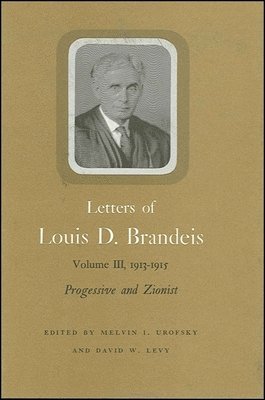
With the election of Woodrow Wilson in 1912, Louis D. Brandeis emerged as the undisputed intellectual leader of those reformers who were trying to recreate a democratic society free from the economic and political depradations of monopolistic enterprise. But now these reformers had a champion in the White House, and direct access to him through one of his most trusted advisers. In this volume we see what was probably the high point of progressive reform-the first three years of the Wilson Administration. During these years Brandeis was considered for a Cabinet position, consulted frequently on matters of patronage, and called in at key junctures to determine policy.But he still kept up his many obligations to different reform groups: arguing cases before the Supreme Court, acting as public counsel in rate hearings, writing Other People's Money, one of the key exposés of the era, as well as advising his good friend Robert M. LaFollette and other reform leaders.Yet at the height of his career as a reformer, Brandeis suddenly took on another heavy obligation, the leadership of the American Zionist movement, and helped marshal Jews in this country to aid their brethren in war-ravaged Europe and Palestine. Carrying over his democratic ideals, he challenged the established American Jewish aristocracy in the Congress movement, in order to broaden the base of Jewish participation in important issues. At the end of 1915, Brandeis was an important figure not only in domestic reform and Jewish affairs, but on the international scene as well. And although no one knew it at the time, he stood at the brink of nomination to the nation's highest court.As in the earlier volumes, these letters indicate the inner workings of American reform, and they also show how American Zionism, under the leadership of Brandeis and his lieutenants, assumed those characteristics that would make it a unique and powerful instrument in world politics.
Inbunden, Engelska, 1978
959 kr
Tillfälligt slut
Covers the later years of his life, closing with his death.This volume, which opens after the great schism in the Zionist movement and closes with Brandeis's death, depicts him trying, in a variety of ways, to make the world a better place. Once again, the scope of his interests and the intensity of his involvement is astounding. He writes on Zionism, Palestine, the liberal press, economics, the University of Louisville, family affairs, Savings Bank Life Insurance, the Harvard Law School, unemployment compensation, prohibition enforcement, civil liberties, and much more. The book also includes a cumulative index to all five volumes that will make it easier for students and scholars to trace the various threads that were woven together in the quite remarkable life of this one man.