Louis J. Gross – Författare
Visar alla böcker från författaren Louis J. Gross. Handla med fri frakt och snabb leverans.
3 produkter
3 produkter
797 kr
Skickas inom 7-10 vardagar
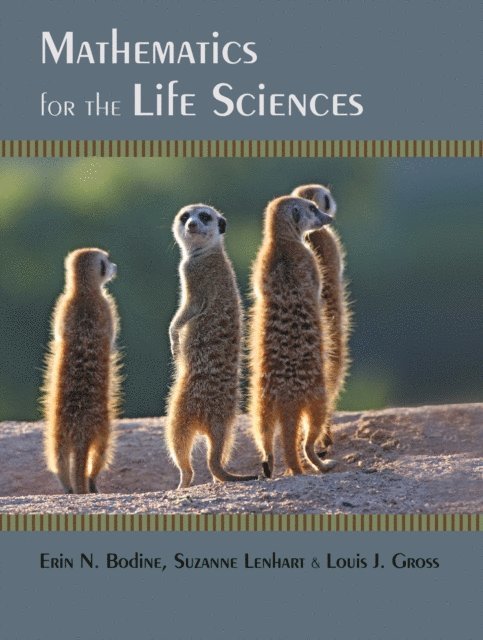
The life sciences deal with a vast array of problems at different spatial, temporal, and organizational scales. The mathematics necessary to describe, model, and analyze these problems is similarly diverse, incorporating quantitative techniques that are rarely taught in standard undergraduate courses. This textbook provides an accessible introduction to these critical mathematical concepts, linking them to biological observation and theory while also presenting the computational tools needed to address problems not readily investigated using mathematics alone. Proven in the classroom and requiring only a background in high school math, Mathematics for the Life Sciences doesn't just focus on calculus as do most other textbooks on the subject. It covers deterministic methods and those that incorporate uncertainty, problems in discrete and continuous time, probability, graphing and data analysis, matrix modeling, difference equations, differential equations, and much more. The book uses MATLAB throughout, explaining how to use it, write code, and connect models to data in examples chosen from across the life sciences.* Provides undergraduate life science students with a succinct overview of major mathematical concepts that are essential for modern biology* Covers all the major quantitative concepts that national reports have identified as the ideal components of an entry-level course for life science students* Provides good background for the MCAT, which now includes data-based and statistical reasoning* Explicitly links data and math modeling* Includes end-of-chapter homework problems, end-of-unit student projects, and select answers to homework problems* Uses MATLAB throughout, and MATLAB m-files with an R supplement are available online* Prepares students to read with comprehension the growing quantitative literature across the life sciences* A solutions manual for professors and an illustration package is available

849 kr
Skickas inom 11-20 vardagar
Distinguishing itself among other books on mathematics in plant biology, this book is unique in that it presents a broad overview of how plant biologists are currently utilizing mathematics in their research, and the only one to particularly emphasize plant ecology. Each article is unified by an attempt to tie models at one level of organization to an understanding at other levels. This approach strengthens the connections between theoretical development and observable biology, facilitating the testing of new predictions. Intended for mathematicians, plant biologists and ecologists alike, this book requires only a basic knowledge of differential equations, linear algebra and mathematical modeling; a knowledge of plant biology is helpful. Readers will gain a perspective on what types of biological systems can benefit from mathematical treatment and an appreciation of the current important problems in plant biology.
550 kr
Skickas inom 10-15 vardagar
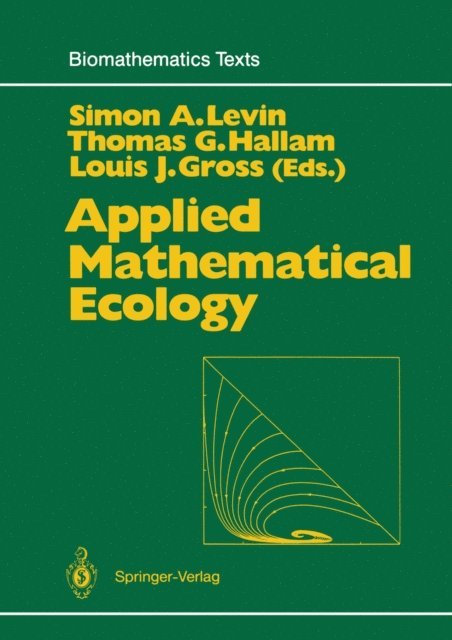
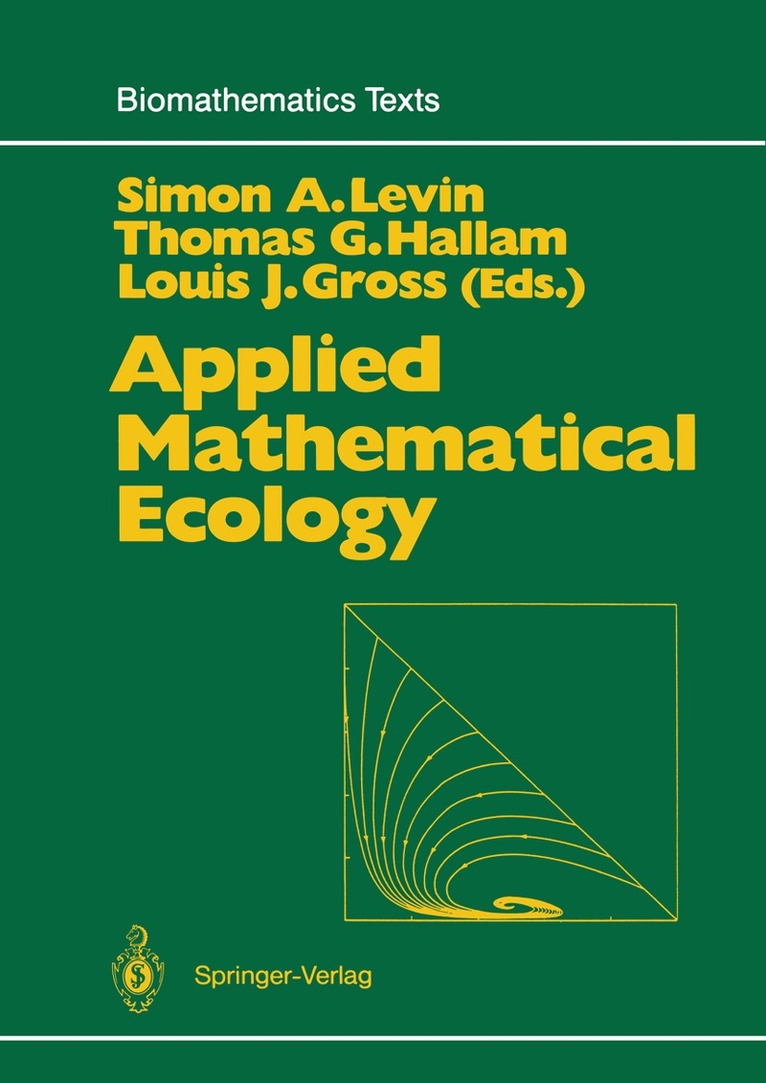
The Second Autumn Course on Mathematical Ecology was held at the Intern ational Centre for Theoretical Physics in Trieste, Italy in November and December of 1986. During the four year period that had elapsed since the First Autumn Course on Mathematical Ecology, sufficient progress had been made in applied mathemat ical ecology to merit tilting the balance maintained between theoretical aspects and applications in the 1982 Course toward applications. The course format, while similar to that of the first Autumn Course on Mathematical Ecology, consequently focused upon applications of mathematical ecology. Current areas of application are almost as diverse as the spectrum covered by ecology. The topiys of this book reflect this diversity and were chosen because of perceived interest and utility to developing countries. Topical lectures began with foundational material mostly derived from Math ematical Ecology: An Introduction (a compilation of the lectures of the 1982 course published by Springer-Verlag in this series, Volume 17) and, when possible, progressed to the frontiers of research. In addition to the course lectures, workshops were arranged for small groups to supplement and enhance the learning experience. Other perspectives were provided through presentations by course participants and speakers at the associated Research Conference. Many of the research papers are in a companion volume, Mathematical Ecology: Proceedings Trieste 1986, published by World Scientific Press in 1988. This book is structured primarily by application area. Part II provides an introduction to mathematical and statistical applications in resource management.