Louis L. Snyder - Böcker
Visar alla böcker från författaren Louis L. Snyder. Handla med fri frakt och snabb leverans.
6 produkter
6 produkter
1 572 kr
Skickas inom 10-15 vardagar
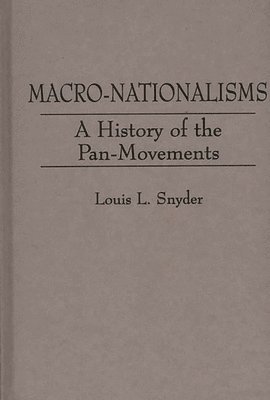
This book is a comparative study of the meaning, characteristics, and development of pan-movements, a synonym for macro-nationalisms, in the last century. It seeks to clarify the origins and developments of all the important pan-movements as historical phenomena. Beginning with an introductory chapter defining the characteristics of nationalism per se, Professor Snyder, in this companion volume to his Global Mini-Nationalisms: Autonomy or Independence, considers specific pan-movements which have sought to combine existing nationalisms into a larger entity: Pan-Slavism, Pan-Germanism, Pan-Europeanism, the pan-movements of Turkey, Pan-Islamism, Pan-Arabism, Zionism, Pan-Asianism, Pan-Africanism, et al. Although studies of these pan-movements exist individually, this is the first comparative study of macronationalisms.
1 009 kr
Skickas inom 10-15 vardagar
Many nations--groups sharing linguistic and cultural bonds--still have not found a true homeland. This phenomenon is examined in a scholarly study: Global Mini-Nationalisms. This book--the work of noted historian Louis L. Snyder--provides a comparative examination of the forces of mini-nationalism at work all over the world. Several sections consider the resurgence of nationalist tendencies in the various republics of the Soviet Union, nationalist movements within African countries, and those in the Middle East.
1 108 kr
Skickas inom 10-15 vardagar
Product information not available.
670 kr
Skickas inom 10-15 vardagar
Nationalism, the state of mind in which the individual's supreme loyalty is owed to the nation-state, remains the strongest of political emotions. As a historical phenomenon, it is always in flux, changing according to no preconceived pattern. In The New Nationalism, Louis Snyder sees various forms of nationalism, and categorizes them as a force for unity; a force for the status quo; a force for independence; a force for fraternity; a force for colonial expansion; a force for aggression; a force for economic expansion; and a force for anti-colonialism.In Snyder's opinion, nationalism should be differentiated from Theodore Roosevelt's "New Nationalism," a phrase he borrowed from Herbert D. Croly's The Promise of American Life. Croly warned that giving too much power to big industry and finance would lead to the degradation of the masses, and that state and federal intervention must be pursued on all economic fronts. Roosevelt expanded upon this concept, and saw the flourishing of democratic government as a means of reviving the old pioneer sense of individualism and opportunity. Snyder, in contrast, extends the work of the two major pioneers in the study of modern nationalism, Carlton J. H. Hayes and Hans Kohn, in exploring this most powerful sentiment of modern times, and showing how it relates to the political, economic, and psychological tendencies of historical development.
2 088 kr
Skickas inom 10-15 vardagar
Nationalism, the state of mind in which the individual's supreme loyalty is owed to the nation-state, remains the strongest of political emotions. As a historical phenomenon, it is always in flux, changing according to no preconceived pattern. In The New Nationalism, Louis Snyder sees various forms of nationalism, and categorizes them as a force for unity; a force for the status quo; a force for independence; a force for fraternity; a force for colonial expansion; a force for aggression; a force for economic expansion; and a force for anti-colonialism.In Snyder's opinion, nationalism should be differentiated from Theodore Roosevelt's "New Nationalism," a phrase he borrowed from Herbert D. Croly's The Promise of American Life. Croly warned that giving too much power to big industry and finance would lead to the degradation of the masses, and that state and federal intervention must be pursued on all economic fronts. Roosevelt expanded upon this concept, and saw the flourishing of democratic government as a means of reviving the old pioneer sense of individualism and opportunity. Snyder, in contrast, extends the work of the two major pioneers in the study of modern nationalism, Carlton J. H. Hayes and Hans Kohn, in exploring this most powerful sentiment of modern times, and showing how it relates to the political, economic, and psychological tendencies of historical development.
432 kr
Skickas inom 3-6 vardagar