Louise Fawcett - Böcker
Visar alla böcker från författaren Louise Fawcett. Handla med fri frakt och snabb leverans.
5 produkter
5 produkter
766 kr
Skickas inom 5-8 vardagar
As the most authoritative and comprehensive overview of international relations in the Middle East, this highly respected textbook is designed to help students get to grips with this important and challenging subject area. A team of expert scholars combines a history of the region with analysis of key themes, actors, developments, and conflicts, to expose students to a wide range of perspectives and approaches and encourage them to think critically in order to draw their own conclusions.Throughout the text, a range of features support students' learning, including discussion questions and case studies, which demonstrate the relevance of international relations theory to the contemporary Middle East and help students to apply their learning to real-world situations and developments.This text is supported by online resources to help students take their learning further.For students: - Expand your knowledge with an interactive map of the Middle East which provides key information about each state.- Build on themes covered in each chapter with extended chapter exercises.- Revise key dates and developments with an interactive timeline.- Access further reading from reliable sources with a bank of relevant web links.For registered lecturers:- Use adaptable PowerPoint slides as the basis for lecture presentations or as hand-outs in class.
677 kr
Skickas inom 5-8 vardagar
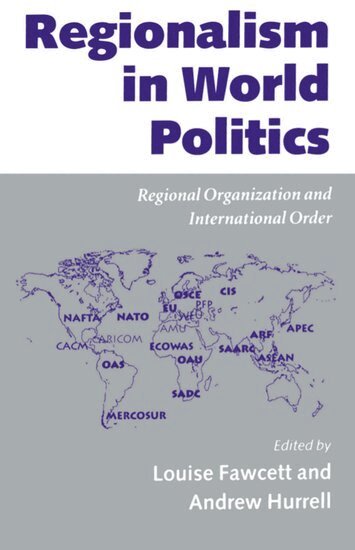
The past five years have witnessed resurgence of regionalism in world politics. Old regionalist organizations have been revived, new organizations formed, and regionalism and the call for strengthened regionalist arrangements have been central to many of the debates about the nature of the post-Cold War international order.This book brings together the many different institutions and ideas to be found under the label of 'regionalism'; it places the revival of regionalism in a broader historical perspective; it asks whether there are common factors behind the revival of regionalism in so many different parts of the world; and it analyses the cumulative impact of different brands of regionalism on international order.Leading specialists examine recent developments in regional co-operation in different parts of the world. They take a critical look at recent trends towards the new regionalism and regionalization, assessing their origins, their present and future prospects, and their place in the evolving international order. As well as concentrating on specific regions, including Pacific-Asia, the Americas, Europe and the Middle-East, the book looks at theories of regionalism, the balance between regionalization and globalization in the world economy,the relationship between regional organizations and the United Nations, and the relationship between the revival of regionalism and questions of identity and nationalism.
1 025 kr
Skickas inom 5-8 vardagar
The Third World Beyond the Cold War presents an overview of the changes brought about in Third World countries since the end of the cold war. The book does so in two ways: by highlighting major areas of change in the Third World, and using regional case-studies as a meas of islating changes specific to certain regions.The themes chosen by the editors--economics, politics, security--are not, of course, exhaustive, but are broadly interpreted so as to encompass the major areas of change among Third World countries. The regional case-studies--Asia-Pacific, Latin America, South Asia, Africa, the Middle East--were selected to bring out both the themes and the diversity of experience. The essays, written by leading scholars in the field of International Relations, caters for a variety of constituencies: those who seek the `big picture' in understanding the Third World in International Relations, those who look for general patterns, explanations, and trends in Third World politics, and those who seek up-to-date information and analysis on the progress of different regions.
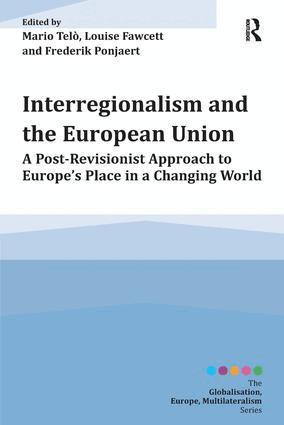
Interregionalism and the European Union
A Post-Revisionist Approach to Europe's Place in a Changing World
Inbunden, Engelska, 2015
1 994 kr
Skickas inom 10-15 vardagar
Is the EU isolated within the emergent multipolar world? Concentrating on interregional relations and focussing on the European Union’s (EU) evolving international role with regards to regional cooperation, this innovative book collects a set of fresh empirical analyses of interregional ties binding the EU with its Eastern and Southern neighbourhood, as well as with Asia, Africa and the Americas. The 25 leading authors from 5 continents have contributed original and diverse chapters and the book advances a novel theoretical ‘post-revisionist’ approach beyond both the Eurocentrism of ‘Europe First’ perspectives as well as the Euroscepticism of those advocating to simply move ’Beyond Europe’. After a Foreword by A. Acharya, the book’s five sections reflect the main drivers of EU interregional policies: The European Union as a Sophisticated Laboratory of Regional and Interregional Cooperation (with chapters by M. Telò, L. Fawcett and T. Risse), De Facto Drivers of Regionalism (F. Ponjaert, M. Shu, A. Valladão and C. Jakobeit), De Jure Drivers of Regionalism (S. Lavenex, G. Finizio, C. Jakobeit, R. Coman, C. Cocq & S. Teo L-Shah), Cognitive Drivers of Regionalism (J. Rüland, E. Fitriani, S. Stavridis & S. Kingah, P. Bacon), and Instrumental Drivers of Regionalism (B. Delcourt, C. Olsson & G. Müller, A. Malamud & P. Seabra and L. Fioramonti & J. Kostopoulos).
Interregionalism and the European Union
A Post-Revisionist Approach to Europe's Place in a Changing World
Häftad, Engelska, 2015
739 kr
Skickas inom 10-15 vardagar
Is the EU isolated within the emergent multipolar world? Concentrating on interregional relations and focussing on the European Union’s (EU) evolving international role with regards to regional cooperation, this innovative book collects a set of fresh empirical analyses of interregional ties binding the EU with its Eastern and Southern neighbourhood, as well as with Asia, Africa and the Americas. The 25 leading authors from 5 continents have contributed original and diverse chapters and the book advances a novel theoretical ‘post-revisionist’ approach beyond both the Eurocentrism of ‘Europe First’ perspectives as well as the Euroscepticism of those advocating to simply move ’Beyond Europe’. After a Foreword by A. Acharya, the book’s five sections reflect the main drivers of EU interregional policies: The European Union as a Sophisticated Laboratory of Regional and Interregional Cooperation (with chapters by M. Telò, L. Fawcett and T. Risse), De Facto Drivers of Regionalism (F. Ponjaert, M. Shu, A. Valladão and C. Jakobeit), De Jure Drivers of Regionalism (S. Lavenex, G. Finizio, C. Jakobeit, R. Coman, C. Cocq & S. Teo L-Shah), Cognitive Drivers of Regionalism (J. Rüland, E. Fitriani, S. Stavridis & S. Kingah, P. Bacon), and Instrumental Drivers of Regionalism (B. Delcourt, C. Olsson & G. Müller, A. Malamud & P. Seabra and L. Fioramonti & J. Kostopoulos).