L.R. Morss - Böcker
Visar alla böcker från författaren L.R. Morss. Handla med fri frakt och snabb leverans.
8 produkter
8 produkter
6 226 kr
Skickas inom 10-15 vardagar
The. first edition of this work appeared almost thirty years ago, when, as we can see in retrospect, the study of the actinide elements was in its first bloom. Although the broad features of the chemistry of the actinide elements were by then quite weil delineated, the treatment of the subject in the first edition was of necessity largely descriptive in nature. A detailed understanding ofthe chemical consequences of the characteristic presence of 5f electrons in most of the members ofthe actinide se ries was still for the future, and many ofthe systematic features ofthe actinide elements were only dimly apprehended. In the past thirty years all this has changed. The application of new spectroscopic techniques, which came into general use during this period, and new theoretical insights, which came from a better understanding of chemical bonding, inorganic chemistry, and solid state phenomena, were among the important factors that led to a great expansion and maturation in actinide element research and a large number of new and important findings. The first edition consisted of aserial description of the individual actinide elements, with a single chapter devoted to the six heaviest elements (lawrencium, the heaviest actinide, was yet to be discovered). Less than 15 % of the text was devoted to a consideration of the systematics of the actinide elements.
5 190 kr
Skickas inom 10-15 vardagar
This book should be of interest to advanced undergraduates, graduates, researchers in chemistry, physics and physical sciences.
2 100 kr
Skickas inom 10-15 vardagar
The history of the rare earths has entered its third century; trans uranium elements are now a half century old. Both the lanthanide and actinide ele- ments, 30 elements altogether, are f elements, meaninj that their metallic 2 1 1 electronic configurations are typically 6s 5d 4f" and 7s 6d 5f" respectively. To an elementary approximation as summarized in the 'average inorganic chemistry textbook, these configurations cause their chemistry to be described by the trivalent state accompanied by less interesting effects such as the lanthanide contraction. However, the discovery of divalent and tetravalent lanthanides and di- to seven-valent actinides hinted at the existence of more interesting although still classic solid-state and coor- dination chemistry. Metallic halides and chalcogenides and electron-poor cluster compounds have been the outgrowth of many synthetic efforts during the past 25 years or so. These days, one can say that the lan- thanides and actinides are not at all boring; the fascination arises from every element being an individual, having its own chemistry.
7 342 kr
Skickas inom 10-15 vardagar
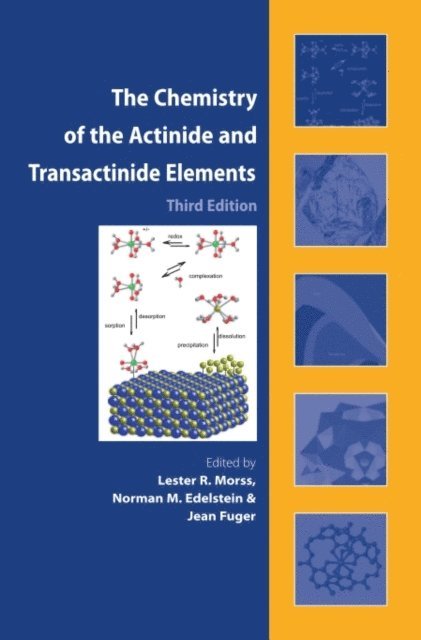
The fourth edition of "The Chemistry of the Actinide and Transactinide Elements" comprises all chapters in volumes 1 through 5 of the third edition (published in 2006) plus a new volume 6. To remain consistent with the plan of the first edition, “ … to provide a comprehensive and uniform treatment of the chemistry of the actinide [and transactinide] elements for both the nuclear technologist and the inorganic and physical chemist,” and to be consistent with the maturity of the field, the fourth edition is organized in three parts.The first group of chapters follows the format of the first and second editions with chapters on individual elements or groups of elements that describe and interpret their chemical properties. A chapter on the chemical properties of the transactinide elements follows. The second group, chapters 15-26, summarizes and correlates physical and chemical properties that are in general unique to the actinide elements, because most of these elements containpartially-filled shells of 5f electrons whether present as isolated atoms or ions, as metals, as compounds, or as ions in solution. The third group, chapters 27-39, focuses on specialized topics that encompass contemporary fields related to actinides in the environment, in the human body, and in storage or wastes. Two appendices at the end of volume 5 tabulate important nuclear properties of all actinide and transactinide isotopes. Volume 6 (Chapters 32 through 39) consists of new chapters that focus on actinide species in the environment, actinide waste forms, nuclear fuels, analytical chemistry of plutonium, actinide chalcogenide and hydrothermal synthesis of actinide compounds. The subject and author indices and list of contributors encompass all six volumes.
2 100 kr
Skickas inom 10-15 vardagar
The history of the rare earths has entered its third century; trans uranium elements are now a half century old. Both the lanthanide and actinide ele- ments, 30 elements altogether, are f elements, meaninj that their metallic 2 1 1 electronic configurations are typically 6s 5d 4f" and 7s 6d 5f" respectively. To an elementary approximation as summarized in the 'average inorganic chemistry textbook, these configurations cause their chemistry to be described by the trivalent state accompanied by less interesting effects such as the lanthanide contraction. However, the discovery of divalent and tetravalent lanthanides and di- to seven-valent actinides hinted at the existence of more interesting although still classic solid-state and coor- dination chemistry. Metallic halides and chalcogenides and electron-poor cluster compounds have been the outgrowth of many synthetic efforts during the past 25 years or so. These days, one can say that the lan- thanides and actinides are not at all boring; the fascination arises from every element being an individual, having its own chemistry.
5 190 kr
Skickas inom 10-15 vardagar
The first edition of this work appeared almost thirty years ago, when, as we can see in retrospect, the study of the actinide elements was in its first bloom. Although the broad features of the chemistry of the actinide elements were by then quite well delineated, the treatment of the subject in the first edition was of necessity largely descriptive in nature. A detailed understanding of the chemical consequences of the characteristic presence of Sf electrons in most of the members of the actinide series was still for the future, and many of the systematic features of the actinide elements were only dimly apprehended. In the past thirty years all this has changed. The application of new spectroscopic techniques, which came into general use during this period, and new theoretical insights, which came from a better understanding of chemical bonding, inorganic chemistry, and solid state phenomena, were among the important factors that led to a great expansion and maturation in actinide element research and a large number of new and important findings. The first edition consisted of a serial description of the individual actinide elements, with a single chapter devoted to the six heaviest elements (lawrencium, the heaviest actinide, was yet to be discovered). Less than 15 % of the text was devoted to a consideration of the systematics of the actinide elements.
6 226 kr
Skickas inom 10-15 vardagar
The. first edition of this work appeared almost thirty years ago, when, as we can see in retrospect, the study of the actinide elements was in its first bloom. Although the broad features of the chemistry of the actinide elements were by then quite weil delineated, the treatment of the subject in the first edition was of necessity largely descriptive in nature. A detailed understanding ofthe chemical consequences of the characteristic presence of 5f electrons in most of the members ofthe actinide se ries was still for the future, and many ofthe systematic features ofthe actinide elements were only dimly apprehended. In the past thirty years all this has changed. The application of new spectroscopic techniques, which came into general use during this period, and new theoretical insights, which came from a better understanding of chemical bonding, inorganic chemistry, and solid state phenomena, were among the important factors that led to a great expansion and maturation in actinide element research and a large number of new and important findings. The first edition consisted of aserial description of the individual actinide elements, with a single chapter devoted to the six heaviest elements (lawrencium, the heaviest actinide, was yet to be discovered). Less than 15 % of the text was devoted to a consideration of the systematics of the actinide elements.
7 342 kr
Skickas inom 10-15 vardagar
The fourth edition of "The Chemistry of the Actinide and Transactinide Elements" comprises all chapters in volumes 1 through 5 of the third edition (published in 2006) plus a new volume 6. To remain consistent with the plan of the first edition, “ … to provide a comprehensive and uniform treatment of the chemistry of the actinide [and transactinide] elements for both the nuclear technologist and the inorganic and physical chemist,” and to be consistent with the maturity of the field, the fourth edition is organized in three parts.The first group of chapters follows the format of the first and second editions with chapters on individual elements or groups of elements that describe and interpret their chemical properties. A chapter on the chemical properties of the transactinide elements follows. The second group, chapters 15-26, summarizes and correlates physical and chemical properties that are in general unique to the actinide elements, because most of these elements containpartially-filled shells of 5f electrons whether present as isolated atoms or ions, as metals, as compounds, or as ions in solution. The third group, chapters 27-39, focuses on specialized topics that encompass contemporary fields related to actinides in the environment, in the human body, and in storage or wastes. Two appendices at the end of volume 5 tabulate important nuclear properties of all actinide and transactinide isotopes. Volume 6 (Chapters 32 through 39) consists of new chapters that focus on actinide species in the environment, actinide waste forms, nuclear fuels, analytical chemistry of plutonium, actinide chalcogenide and hydrothermal synthesis of actinide compounds. The subject and author indices and list of contributors encompass all six volumes.