
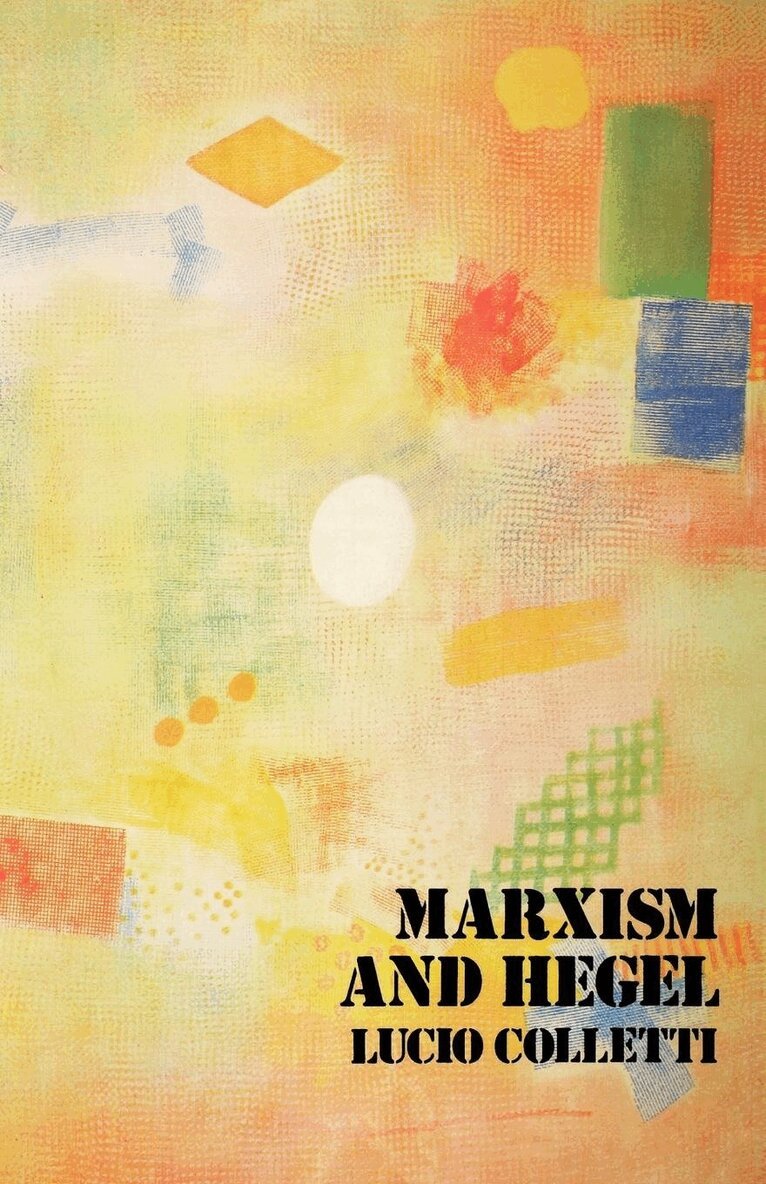
The interpretation of Hegel has been a focal point of philosophical controversy ever since the beginning of the twentieth century, both among Marxists and in the major European philosophical schools. Yet despite wide differences of emphasis most interpretations of Hegel share important similarities. They link his idea of Reason to the revolutionary and rationalist tradition which led to the French Revolution, and they interpret his dialectic as implying a latently atheist and even materialist world outlook.Lucio Colletti directly challenges this picture of Hegel. He argues that Hegel was an essentially Christian philosopher, and that his dialectic was explicitly anti-materialist in both intention and effect. In contrast to earlier views, Colletti maintains that there is no contradiction between Hegel's method and his system, once it is accepted that his thought is an exercise in Absolute Idealism stemming from a long Christian humanist tradition. He claims, on the contrary, that intellectual inconsistency is rather to be found in the works of Engels, Lenin, Lukás, Kojève and others, who have attempted to adapt Hegel to their own philosophical priorities.Colletti places his argument in the context of a broad re-examination of the whole relationship between Marxism and the Enlightenment, giving novel emphasis to the relationship between Marxism and Kant. He concludes by re-asserting the importance in Marxism of empirical science against the claim of "infinite reason," while at the same time showing how Marx did transform key ideas in Hegelian thought to construct a consistently materialist dialectic.
This is the first of Lucio Colletti''s books to be translated into English, in which he considers the scientific character of Marxism. In contrast to the pre-occupation with Hegel and his contribution to the formation of Marx''s thought, Colletti goes back on the one hand to the founders of political economy and on the other to Rousseau. In Rousseau''s critique of ''civil society'' Colletti isolates a crucial watershed in the development of a counter-theory to modern bourgeois society.The second of Colletti''s central concerns is with the unity of Marxism. For him it is an integral science of history and of society which denies the pretensions of bourgeois sociology to any scientific status. His attack is concentrated on Max Weber and his epigone Karl Mannheim, but has wider implications for sociology in general. This is followed by a devastating critique of Bernstein''s evolutionist ''revision'' of Marx.From Rousseau to Lenin also contains a polemical study of Marcuse''s ''neo-romantic utopianism'', and the masterly statements of the contemporary relevance of Lenin''s State and Revolution and Marx''s Capital to the struggle for the overthrow of capitalism.
The interpretation of Hegel has been a focal point of philosophical controversy ever since the beginning of the twentieth century, both among Marxists and in the major European philosophical schools. Yet despite wide differences of emphasis most interpretations of Hegel share important similarities. They link his idea of Reason to the revolutionary and rationalist tradition which led to the French Revolution, and they interpret his dialectic as implying a latently atheist and even materialist world outlook.Lucio Colletti directly challenges this picture of Hegel. He argues that Hegel was an essentially Christian philosopher, and that his dialectic was explicitly anti-materialist in both intention and effect. In contrast to earlier views, Colletti maintains that there is no contradiction between Hegel's method and his system, once it is accepted that his thought is an exercise in Absolute Idealism stemming from a long Christian humanist tradition. He claims, on the contrary, that intellectual inconsistency is rather to be found in the works of Engels, Lenin, Lukás, Kojève and others, who have attempted to adapt Hegel to their own philosophical priorities.Colletti places his argument in the context of a broad re-examination of the whole relationship between Marxism and the Enlightenment, giving novel emphasis to the relationship between Marxism and Kant. He concludes by re-asserting the importance in Marxism of empirical science against the claim of "infinite reason," while at the same time showing how Marx did transform key ideas in Hegelian thought to construct a consistently materialist dialectic.
This is the first of Lucio Colletti''s books to be translated into English, in which he considers the scientific character of Marxism. In contrast to the pre-occupation with Hegel and his contribution to the formation of Marx''s thought, Colletti goes back on the one hand to the founders of political economy and on the other to Rousseau. In Rousseau''s critique of ''civil society'' Colletti isolates a crucial watershed in the development of a counter-theory to modern bourgeois society.The second of Colletti''s central concerns is with the unity of Marxism. For him it is an integral science of history and of society which denies the pretensions of bourgeois sociology to any scientific status. His attack is concentrated on Max Weber and his epigone Karl Mannheim, but has wider implications for sociology in general. This is followed by a devastating critique of Bernstein''s evolutionist ''revision'' of Marx.From Rousseau to Lenin also contains a polemical study of Marcuse''s ''neo-romantic utopianism'', and the masterly statements of the contemporary relevance of Lenin''s State and Revolution and Marx''s Capital to the struggle for the overthrow of capitalism.