Luiz Drude de Lacerda – författare
Visar alla böcker från författaren Luiz Drude de Lacerda. Handla med fri frakt och snabb leverans.
7 produkter
7 produkter
Häftad, Engelska, 2026
1 477 kr
Kommande
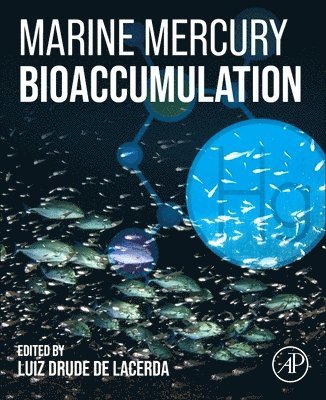
Marine Mercury Bioaccumulation presents state-of-the-art research on mercury bioaccumulation in marine life. Written by leading experts in marine toxicology, this book delivers the latest information on monitoring and modeling mercury biomagnification in key marine taxa. Early chapters introduce the basic biology and ecology of how mercury travels through marine organisms and accumulates within marine food webs. Central chapters discuss the current status and exposure risks of key taxa, including marine vegetation, invertebrates, fishes, mammals, and birds. The book concludes with an assessment of human exposure to mercury through seafood products and novel modeling tools to assess environmental exposure risks and bioaccumulation.Users will find this to be a great resource for a global assessment of mercury contamination in the ocean, including biological resources, monitoring and modeling, current tools, existing research gaps, and suggestions on how to improve our monitoring and policy tools for improved safety of marine life and human consumption. This is an indispensable tool for researchers, resource managers, fisheries stakeholders, and students alike.Summarizes state-of-the-art research on mercury accumulation in marine biotaProvides a worldwide database on mercury concentrations and distribution in key marine taxaFeatures insights from global experts on current practices for mercury monitoring and pollution assessment
Inbunden, Engelska, 2002
1 623 kr
Skickas inom 10-15 vardagar
Protection of the environment has nowadays become a major challenge and a condi tion for survival of future human generations and life on Earth in general. Yet it is still far too much of a dream or hope rather than a reality in the policy of our societies. Presently we are experiencing an unprecedented exponential growth of demography combined with a race for profit, resulting in excessive consumption particularly of en ergy, and a serious impact on the world ecosystems. Various types of pollutants and emerging new diseases not only disrupt the normal course of life, but also above this some of the atmospheric pollutants are most likely involved in the changing climate. We fear and literally shiver at the thought that the "changing climate" would ultimately disrupt the fragile thermodynamic equilibrium between the atmosphere and the oceans. Are we insensitive to these facts to the point of pushing our descendants, some genera tions ahead, into a new glacial period after a first period of warming up, at least, in northern Europe, like the one that took place 13 to 14 millennia ago? Surely the planet's nature is not prepared to be dominated by man and will go its way, whether humanity will be alive or dead.
Inbunden, Engelska, 2004
1 623 kr
Skickas inom 10-15 vardagar
Twenty contributions on diverse aspects of the environmental geochemistry in tropical and sub-tropical environments make up this monograph. They summarize original research not readily available elsewhere in the literature. Most of the chapters include extensive original data that will be very useful to researchers interested in the tropics and sub-tropics. A group of papers on methods and their applications is aimed directly at scientists involved in environmental research in the tropics. There are also some interesting intercontinental comparisons drawn on paleoclimatology, environmental impacts of mining and geochemistry of continetal shelf sediments.
Häftad, Engelska, 2010
1 623 kr
Skickas inom 10-15 vardagar
Protection of the environment has nowadays become a major challenge and a condi tion for survival of future human generations and life on Earth in general. Yet it is still far too much of a dream or hope rather than a reality in the policy of our societies. Presently we are experiencing an unprecedented exponential growth of demography combined with a race for profit, resulting in excessive consumption particularly of en ergy, and a serious impact on the world ecosystems. Various types of pollutants and emerging new diseases not only disrupt the normal course of life, but also above this some of the atmospheric pollutants are most likely involved in the changing climate. We fear and literally shiver at the thought that the "changing climate" would ultimately disrupt the fragile thermodynamic equilibrium between the atmosphere and the oceans. Are we insensitive to these facts to the point of pushing our descendants, some genera tions ahead, into a new glacial period after a first period of warming up, at least, in northern Europe, like the one that took place 13 to 14 millennia ago? Surely the planet's nature is not prepared to be dominated by man and will go its way, whether humanity will be alive or dead.
Häftad, Engelska, 2011
1 623 kr
Skickas inom 10-15 vardagar
Three symposia on environmental geochemistry in tropical countries, held in Niter6i, Brazil (1993), in Cartagena, Colombia (1996) and in Nova Friburgo, Brazil (1999), made it very clear that tropical geochemistry is of world standard and fast increasing in multi disciplinarily and impact on important geochemical paradigms. It has additionally strong links with the economy of tropical countries, such as mining and industrialisa tion and is in full development for treating environmental problems caused by human activities of urban or industrial origin. We must compliment Prof. Jorge Abriio and his colleagues in Brazil and Dr. Gloria Prieto and her colleagues in Colombia for these ini tiatives. The participation of respectively 180 and 150 scientists, coming from 15 different countries for the first and second symposia, has shown that a large interest exists for tropical environmental geochemistry. It also demonstrates the necessity to understand tropical environmental problems. The organisation of a large international symposium is not possible without the assistance of state and federal authorities, for which those of Brazil and Colombia have to be complimented. The 3rd Symposium on Environmental Geochemistry in Tropical Countries was the last of the series and was attended by 22 countries and 170 participants and treated a number of related environmental and economic problems.
E-bok
PDF, Engelska, 20131 995 kr
Läs direkt efter köp
Protection of the environment has nowadays become a major challenge and a condi tion for survival of future human generations and life on Earth in general. Yet it is still far too much of a dream or hope rather than a reality in the policy of our societies. Presently we are experiencing an unprecedented exponential growth of demography combined with a race for profit, resulting in excessive consumption particularly of en ergy, and a serious impact on the world ecosystems. Various types of pollutants and emerging new diseases not only disrupt the normal course of life, but also above this some of the atmospheric pollutants are most likely involved in the changing climate. We fear and literally shiver at the thought that the "changing climate" would ultimately disrupt the fragile thermodynamic equilibrium between the atmosphere and the oceans. Are we insensitive to these facts to the point of pushing our descendants, some genera tions ahead, into a new glacial period after a first period of warming up, at least, in northern Europe, like the one that took place 13 to 14 millennia ago? Surely the planet''s nature is not prepared to be dominated by man and will go its way, whether humanity will be alive or dead.
E-bok
PDF, Engelska, 20131 977 kr
Läs direkt efter köp
Three symposia on environmental geochemistry in tropical countries, held in Niter6i, Brazil (1993), in Cartagena, Colombia (1996) and in Nova Friburgo, Brazil (1999), made it very clear that tropical geochemistry is of world standard and fast increasing in multi disciplinarily and impact on important geochemical paradigms. It has additionally strong links with the economy of tropical countries, such as mining and industrialisa tion and is in full development for treating environmental problems caused by human activities of urban or industrial origin. We must compliment Prof. Jorge Abriio and his colleagues in Brazil and Dr. Gloria Prieto and her colleagues in Colombia for these ini tiatives. The participation of respectively 180 and 150 scientists, coming from 15 different countries for the first and second symposia, has shown that a large interest exists for tropical environmental geochemistry. It also demonstrates the necessity to understand tropical environmental problems. The organisation of a large international symposium is not possible without the assistance of state and federal authorities, for which those of Brazil and Colombia have to be complimented. The 3rd Symposium on Environmental Geochemistry in Tropical Countries was the last of the series and was attended by 22 countries and 170 participants and treated a number of related environmental and economic problems.