Luke Munn - Böcker
Visar alla böcker från författaren Luke Munn. Handla med fri frakt och snabb leverans.
9 produkter
9 produkter
360 kr
Skickas inom 7-10 vardagar
Territory is shifting. No longer defined by the dotted line of the border or the national footprint of soil, today’s territories are enacted through data infrastructures. From subsea cables to server halls, these infrastructures underpin new forms of governance, shaping subjects and their everyday lives. Technical Territories moves from masked protestors in Hong Kong to asylum-seekers in Christmas Island and sand miners in Singapore, exploring how these territories are both political and visceral, altering the experience of their inhabitants.Infrastructures have now become geopolitical, strategic investments that advance national visions, extend influence, and trigger trade wars. Yet at the same time, these technologies also challenge sovereignty as a bounded container, enacting a more distributed and decoupled form of governance. Such “technical territories” construct new zones where subjects are assembled, rights are undermined, labor is coordinated, and capital is extracted. The stable line of the border is replaced by more fluid configurations of power. Luke Munn stages an interdisciplinary intervention over six chapters, drawing upon a wide range of literature from technical documents and activist accounts, and bringing insights from media studies, migration studies, political theory, and cultural and social studies to bear on these new sociotechnical conditions.
993 kr
Skickas inom 7-10 vardagar
Territory is shifting. No longer defined by the dotted line of the border or the national footprint of soil, today’s territories are enacted through data infrastructures. From subsea cables to server halls, these infrastructures underpin new forms of governance, shaping subjects and their everyday lives. Technical Territories moves from masked protestors in Hong Kong to asylum-seekers in Christmas Island and sand miners in Singapore, exploring how these territories are both political and visceral, altering the experience of their inhabitants.Infrastructures have now become geopolitical, strategic investments that advance national visions, extend influence, and trigger trade wars. Yet at the same time, these technologies also challenge sovereignty as a bounded container, enacting a more distributed and decoupled form of governance. Such “technical territories” construct new zones where subjects are assembled, rights are undermined, labor is coordinated, and capital is extracted. The stable line of the border is replaced by more fluid configurations of power. Luke Munn stages an interdisciplinary intervention over six chapters, drawing upon a wide range of literature from technical documents and activist accounts, and bringing insights from media studies, migration studies, political theory, and cultural and social studies to bear on these new sociotechnical conditions.
698 kr
Skickas inom 10-15 vardagar
How do cables and data centers think? This book investigates how information infrastructures enact particular forms of knowledge. It juxtaposes the pervasive logics of speed, efficiency, and resilience with more communal and ecological ways of thinking and being, turning technical “solutions” back into open questions about what society wants and what infrastructures should do.Moving from data centers in Hong Kong to undersea cables in Singapore and server clusters in China, Munn combines rich empirical material with insights drawn from media and cultural studies, sociology, and philosophy. This critical analysis stresses that infrastructures are not just technical but deeply epistemological, privileging some actions and actors while sidelining others.This innovative exploration of the values and visions at the heart of our technologies will interest students, scholars, and researchers in the areas of communication studies, digital media, technology studies, sociology, philosophy of technology, information studies, and geography.
292 kr
Skickas inom 10-15 vardagar
How do cables and data centers think? This book investigates how information infrastructures enact particular forms of knowledge. It juxtaposes the pervasive logics of speed, efficiency, and resilience with more communal and ecological ways of thinking and being, turning technical “solutions” back into open questions about what society wants and what infrastructures should do.Moving from data centers in Hong Kong to undersea cables in Singapore and server clusters in China, Munn combines rich empirical material with insights drawn from media and cultural studies, sociology, and philosophy. This critical analysis stresses that infrastructures are not just technical but deeply epistemological, privileging some actions and actors while sidelining others.This innovative exploration of the values and visions at the heart of our technologies will interest students, scholars, and researchers in the areas of communication studies, digital media, technology studies, sociology, philosophy of technology, information studies, and geography.
1 006 kr
Skickas inom 7-10 vardagar
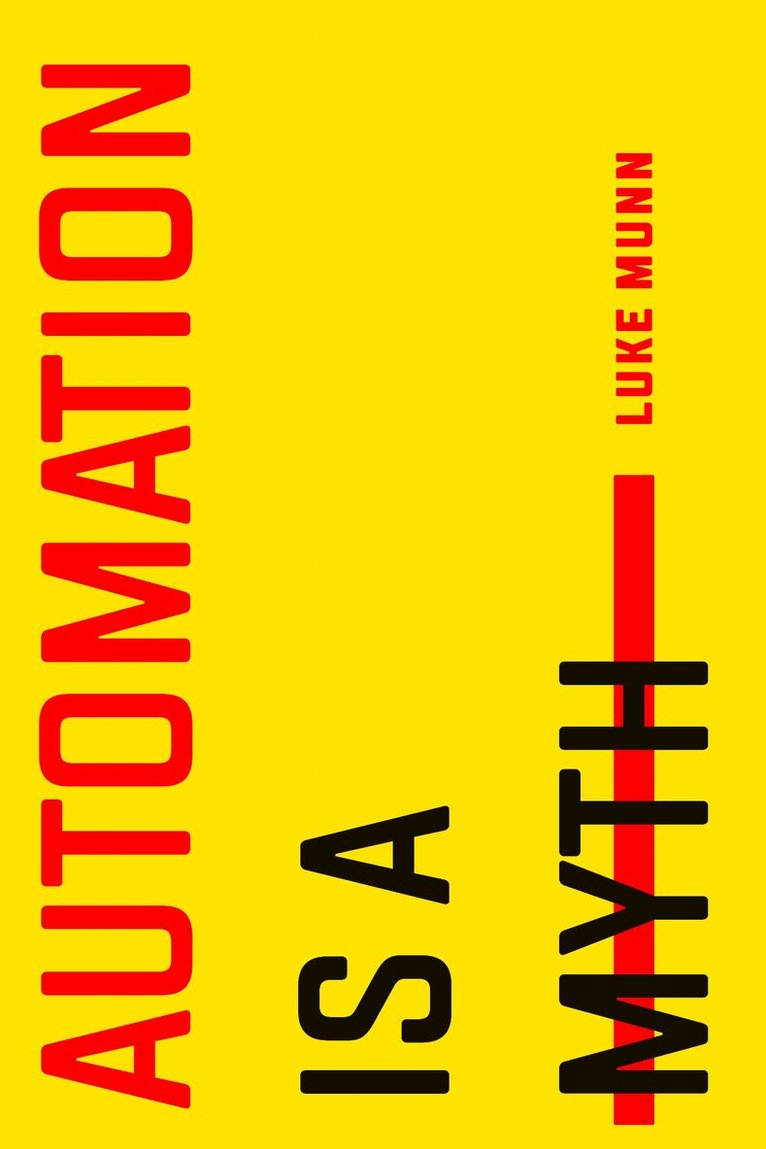
For some, automation will usher in a labor-free utopia; for others, it signals a disastrous age-to-come. Yet whether seen as dream or nightmare, automation, argues Munn, is ultimately a fable that rests on a set of triple fictions. There is the myth of full autonomy, claiming that machines will take over production and supplant humans. But far from being self-acting, technical solutions are piecemeal; their support and maintenance reveals the immense human labor behind "autonomous" processes. There is the myth of universal automation, with technologies framed as a desituated force sweeping the globe. But this fiction ignores the social, cultural, and geographical forces that shape technologies at a local level. And, there is the myth of automating everyone, the generic figure of "the human" at the heart of automation claims. But labor is socially stratified and so automation's fallout will be highly uneven, falling heavier on some (immigrants, people of color, women) than others. Munn moves from machine minders in China to warehouse pickers in the United States to explore the ways that new technologies do (and don't) reconfigure labor. Combining this rich array of human stories with insights from media and cultural studies, Munn points to a more nuanced, localized, and racialized understanding of the "future of work."
244 kr
Skickas inom 7-10 vardagar
For some, automation will usher in a labor-free utopia; for others, it signals a disastrous age-to-come. Yet whether seen as dream or nightmare, automation, argues Munn, is ultimately a fable that rests on a set of triple fictions. There is the myth of full autonomy, claiming that machines will take over production and supplant humans. But far from being self-acting, technical solutions are piecemeal; their support and maintenance reveals the immense human labor behind "autonomous" processes. There is the myth of universal automation, with technologies framed as a desituated force sweeping the globe. But this fiction ignores the social, cultural, and geographical forces that shape technologies at a local level. And, there is the myth of automating everyone, the generic figure of "the human" at the heart of automation claims. But labor is socially stratified and so automation's fallout will be highly uneven, falling heavier on some (immigrants, people of color, women) than others. Munn moves from machine minders in China to warehouse pickers in the United States to explore the ways that new technologies do (and don't) reconfigure labor. Combining this rich array of human stories with insights from media and cultural studies, Munn points to a more nuanced, localized, and racialized understanding of the "future of work."
1 209 kr
Skickas inom 10-15 vardagar
From the virulence of fake news to the rise of psychographic profiling, emotion has become ascendant. The new frontier of capitalization is not outward, but inward—the inner life of affect and emotion, desire and disposition. This book lays that new reality out with a series of close case studies.A new set of technologies are emerging, from facial coding to affective computing, that attempt to render the emotional into the machine-readable. At the same time, social media and smart home devices are becoming empathic, attempting to draw out our affective participation and elicit our emotional expression. In these encounters with the medial and the technical, the emotional is remade.Combining a close analysis of contemporary technologies such as Affectiva, Facebook, andAlexa with critical media theory, Logic of Feeling: Technology’s Quest to Capitalize Emotion examines how the quest to operationalize this inner life begins to reconfigure feeling itself.
665 kr
Skickas inom 3-6 vardagar
Hate is being reinvented. Over the last two decades, online platforms have been used to repackage racist, sexist and xenophobic ideologies into new sociotechnical forms. Digital hate is ancient but novel, deploying the Internet to boost its allure and broaden its appeal. To understand the logic of hate, Luke Munn investigates four objects: 8chan, the cesspool of the Internet, QAnon, the popular meta-conspiracy, Parler, a social media site, and Gab, the »platform for the people.« Drawing together powerful human stories with insights from media studies, psychology, political science, and race and cultural studies, he portrays how digital hate infiltrates hearts and minds.
246 kr
Skickas inom 5-8 vardagar