Lynda Walsh - Böcker
Visar alla böcker från författaren Lynda Walsh. Handla med fri frakt och snabb leverans.
6 produkter
6 produkter
1 600 kr
Skickas inom 7-10 vardagar
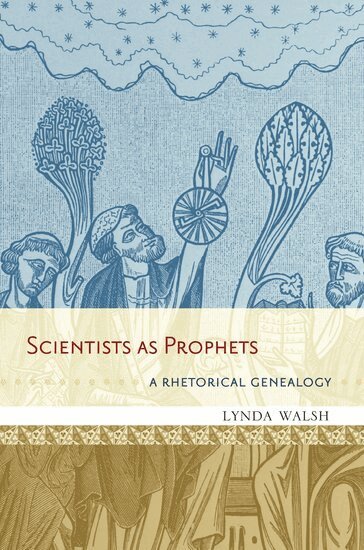
Why did an atheist like Carl Sagan talk so much about God? Why does NASA climatologist James Hansen plead with us in his recent book not to waste "Our Last Chance to Save Humanity"? Because science advisors are our new prophets, Lynda Walsh argues in Scientists as Prophets: A Rhetorical Genealogy. She does not claim, as some scholars have, that these public scientists push scientism as a replacement for religion. Rather, she puts forth the provocative argument that prophetic ethos is a flexible type of charismatic authority whose function is to manufacture certainty. Scientists aren't our only prophets, Walsh contents, but science advisors predictably perform prophetic ethos whenever they need to persuade their publics to take action or fund basic research. Walsh first charts the genealogy of this hybrid scientific-prophetic ethos back to its roots in ancient oracles before exploring its flourishing in 17th century Europe. She then tracks its performances and mutations through several important late-modern events in America: Robert Oppenheimer's role in the opening of the atomic age; Rachel Carson's interventions in pesticide use; the mass-media polemics of science popularizers such as Carl Sagan, Stephen Hawking, and Stephen Jay Gould; and finally the UN's climate change panel and their role in Climategate. Along the way, Walsh highlights the special ethical and political defects embedded in the genealogy of the scientist-prophet, and she finishes by evaluating proposed remedies. She concludes that without a radical shift in our style of deliberative policy-making, there is little chance of remedying the dysfunctions in our current science-advising system. A cogent rhetorical analysis of over 1,000 archival documents from 10 historic cases, Scientists as Prophets engages scholars of scientific rhetoric, history, and literacy, but is also accessible to readers interested in the roots of current political debates about the environment, nuclear energy, and science education.
518 kr
Skickas inom 5-8 vardagar
Why did an atheist like Carl Sagan talk so much about God? Why does NASA climatologist James Hansen plead with us in his recent book not to waste "Our Last Chance to Save Humanity"? Because science advisors are our new prophets, Lynda Walsh argues in Scientists as Prophets: A Rhetorical Genealogy. She does not claim, as some scholars have, that these public scientists push scientism as a replacement for religion. Rather, she puts forth the provocative argument that prophetic ethos is a flexible type of charismatic authority whose function is to manufacture certainty. Scientists aren't our only prophets, Walsh contents, but science advisors predictably perform prophetic ethos whenever they need to persuade their publics to take action or fund basic research. Walsh first charts the genealogy of this hybrid scientific-prophetic ethos back to its roots in ancient oracles before exploring its flourishing in 17th century Europe. She then tracks its performances and mutations through several important late-modern events in America: Robert Oppenheimer's role in the opening of the atomic age; Rachel Carson's interventions in pesticide use; the mass-media polemics of science popularizers such as Carl Sagan, Stephen Hawking, and Stephen Jay Gould; and finally the UN's climate change panel and their role in Climategate. Along the way, Walsh highlights the special ethical and political defects embedded in the genealogy of the scientist-prophet, and she finishes by evaluating proposed remedies. She concludes that without a radical shift in our style of deliberative policy-making, there is little chance of remedying the dysfunctions in our current science-advising system. A cogent rhetorical analysis of over 1,000 archival documents from 10 historic cases, Scientists as Prophets engages scholars of scientific rhetoric, history, and literacy, but is also accessible to readers interested in the roots of current political debates about the environment, nuclear energy, and science education.
1 057 kr
Tillfälligt slut
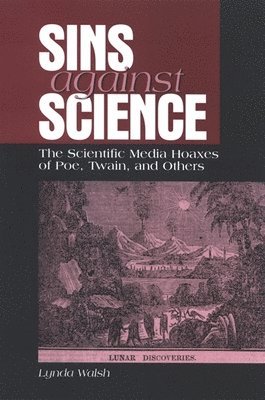
Recounts the fake news stories, written from 1830 to 1880, about scientific and technological discoveries, and the effect these hoaxes had on readers and their trust in science.Lynda Walsh explores a provocative era in American history-the proliferation of fake news stories about scientific and technological discoveries from 1830 to 1880. These hoaxes, which fooled thousands of readers, offer a first-hand look at an intriguing guerilla tactic in the historical struggle between arts and sciences in America. Focusing on the hoaxes of Richard Adams Locke, Edgar Allan Poe, Mark Twain, and Dan De Quille, the author combines rhetorical hermeneutics, linguistic pragmatics, and reader-response theory to answer three primary questions: How did the hoaxes work? What were the hoaxers trying to accomplish? And-what is a hoax?
414 kr
Tillfälligt slut
Recounts the fake news stories, written from 1830 to 1880, about scientific and technological discoveries, and the effect these hoaxes had on readers and their trust in science.Lynda Walsh explores a provocative era in American history-the proliferation of fake news stories about scientific and technological discoveries from 1830 to 1880. These hoaxes, which fooled thousands of readers, offer a first-hand look at an intriguing guerilla tactic in the historical struggle between arts and sciences in America. Focusing on the hoaxes of Richard Adams Locke, Edgar Allan Poe, Mark Twain, and Dan De Quille, the author combines rhetorical hermeneutics, linguistic pragmatics, and reader-response theory to answer three primary questions: How did the hoaxes work? What were the hoaxers trying to accomplish? And-what is a hoax?
1 377 kr
Skickas inom 10-15 vardagar
This book restores the concept of topology to its rhetorical roots to assist scholars who wish not just to criticize power dynamics, but also to invent alternatives.
1 377 kr
Skickas inom 10-15 vardagar
This book restores the concept of topology to its rhetorical roots to assist scholars who wish not just to criticize power dynamics, but also to invent alternatives.