Lyne Bansat-Boudon – författare
Visar alla böcker från författaren Lyne Bansat-Boudon. Handla med fri frakt och snabb leverans.
4 produkter
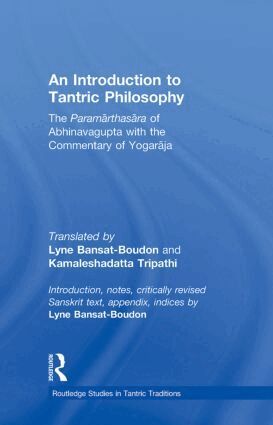
Introduction to Tantric Philosophy
The Paramarthasara of Abhinavagupta with the Commentary of Yogaraja
Av Lyne Bansat-Boudon, Kamalesha Datta Tripathi
Inbunden, 2010
2504 kr
Lägg i varukorg
The Paramārthasāra, or ‘Essence of Ultimate Reality’, is a work of the Kashmirian polymath Abhinavagupta (tenth–eleventh centuries). It is a brief treatise in which the author outlines the doctrine of which he is a notable exponent, namely nondualistic Śaivism, which he designates in his works as …
Introduction to Tantric Philosophy
The Paramarthasara of Abhinavagupta with the Commentary of Yogaraja
Av Lyne Bansat-Boudon, Kamalesha Datta Tripathi
Häftad, 2013
646 kr
Lägg i varukorg
The Paramārthasāra, or ‘Essence of Ultimate Reality’, is a work of the Kashmirian polymath Abhinavagupta (tenth–eleventh centuries). It is a brief treatise in which the author outlines the doctrine of which he is a notable exponent, namely nondualistic Śaivism, which he designates in his works as …
Introduction to Tantric Philosophy
The Paramarthasara of Abhinavagupta with the Commentary of Yogaraja
Av Lyne Bansat-Boudon, Kamalesha Datta Tripathi
E-bok, 2014
676 kr
Lägg i varukorg
The Paramārthasāra, or ‘Essence of Ultimate Reality’, is a work of the Kashmirian polymath Abhinavagupta (tenth–eleventh centuries). It is a brief treatise in which the author outlines the doctrine of which he is a notable exponent, namely nondualistic Śaivism, which he designates in his works as …
Introduction to Tantric Philosophy
The Paramarthasara of Abhinavagupta with the Commentary of Yogaraja
Av Lyne Bansat-Boudon, Kamalesha Datta Tripathi
E-bok, 2014
676 kr
Lägg i varukorg
The Paramārthasāra, or ‘Essence of Ultimate Reality’, is a work of the Kashmirian polymath Abhinavagupta (tenth–eleventh centuries). It is a brief treatise in which the author outlines the doctrine of which he is a notable exponent, namely nondualistic Śaivism, which he designates in his works as …