Lynne Billard - Böcker
Visar alla böcker från författaren Lynne Billard. Handla med fri frakt och snabb leverans.
5 produkter
5 produkter
Del 636 - Wiley Series in Computational Statistics
Symbolic Data Analysis
Conceptual Statistics and Data Mining
Inbunden, Engelska, 2006
1 171 kr
Skickas inom 7-10 vardagar
With the advent of computers, very large datasets have become routine. Standard statistical methods don’t have the power or flexibility to analyse these efficiently, and extract the required knowledge. An alternative approach is to summarize a large dataset in such a way that the resulting summary dataset is of a manageable size and yet retains as much of the knowledge in the original dataset as possible. One consequence of this is that the data may no longer be formatted as single values, but be represented by lists, intervals, distributions, etc. The summarized data have their own internal structure, which must be taken into account in any analysis. This text presents a unified account of symbolic data, how they arise, and how they are structured. The reader is introduced to symbolic analytic methods described in the consistent statistical framework required to carry out such a summary and subsequent analysis. Presents a detailed overview of the methods and applications of symbolic data analysis.Includes numerous real examples, taken from a variety of application areas, ranging from health and social sciences, to economics and computing.Features exercises at the end of each chapter, enabling the reader to develop their understanding of the theory.Provides a supplementary website featuring links to download the SODAS software developed exclusively for symbolic data analysis, data sets, and further material.Primarily aimed at statisticians and data analysts, Symbolic Data Analysis is also ideal for scientists working on problems involving large volumes of data from a range of disciplines, including computer science, health and the social sciences. There is also much of use to graduate students of statistical data analysis courses.

878 kr
Skickas inom 7-10 vardagar
Covers everything readers need to know about clustering methodology for symbolic data—including new methods and headings—while providing a focus on multi-valued list data, interval data and histogram dataThis book presents all of the latest developments in the field of clustering methodology for symbolic data—paying special attention to the classification methodology for multi-valued list, interval-valued and histogram-valued data methodology, along with numerous worked examples. The book also offers an expansive discussion of data management techniques showing how to manage the large complex dataset into more manageable datasets ready for analyses.Filled with examples, tables, figures, and case studies, Clustering Methodology for Symbolic Data begins by offering chapters on data management, distance measures, general clustering techniques, partitioning, divisive clustering, and agglomerative and pyramid clustering. Provides new classification methodologies for histogram valued data reaching across many fields in data scienceDemonstrates how to manage a large complex dataset into manageable datasets ready for analysisFeatures very large contemporary datasets such as multi-valued list data, interval-valued data, and histogram-valued dataConsiders classification models by dynamical clusteringFeatures a supporting website hosting relevant data sets Clustering Methodology for Symbolic Data will appeal to practitioners of symbolic data analysis, such as statisticians and economists within the public sectors. It will also be of interest to postgraduate students of, and researchers within, web mining, text mining and bioengineering.
Del 270 - Wiley Series in Probability and Statistics
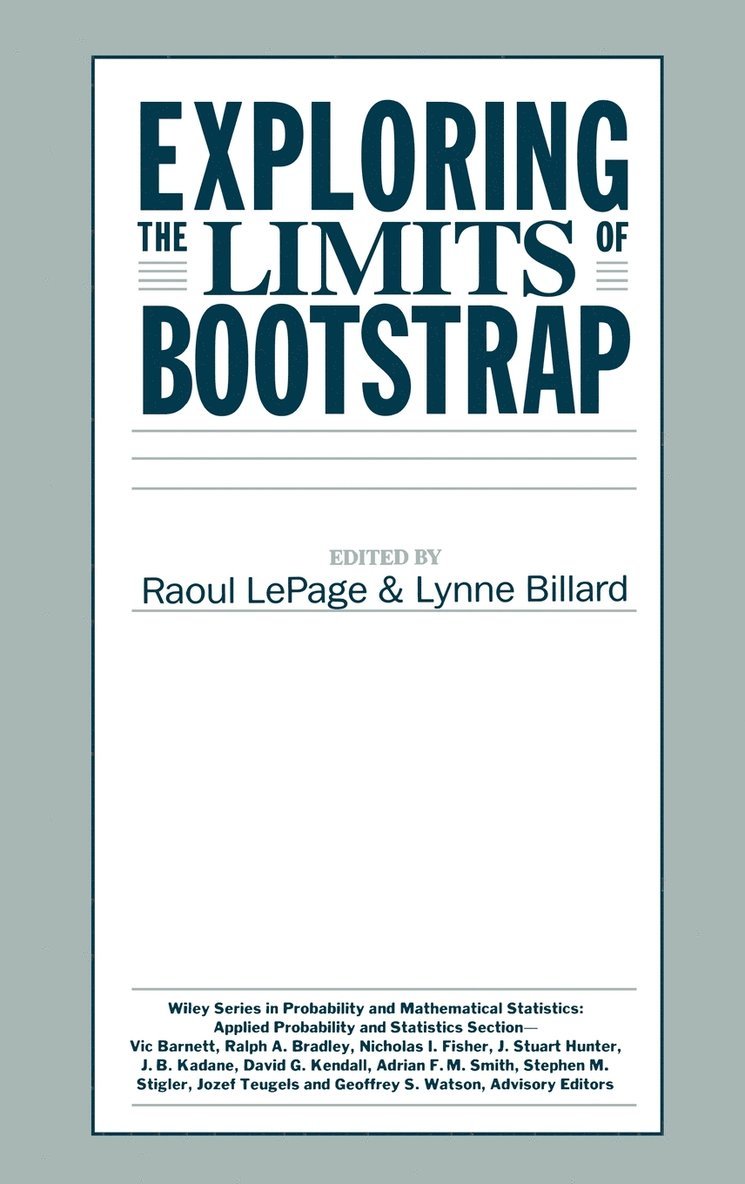
Exploring the Limits of Bootstrap
Inbunden, Engelska, 1992
2 565 kr
Skickas inom 7-10 vardagar
Explores the application of bootstrap to problems that place unusual demands on the method. The bootstrap method, introduced by Bradley Efron in 1973, is a nonparametric technique for inferring the distribution of a statistic derived from a sample. Most of the papers were presented at a special meeting sponsored by the Institute of Mathematical Statistics and the Interface Foundation in May, 1990.
2 098 kr
Skickas inom 10-15 vardagar
The International Biometric Society (IBS) was formed at the First International Biometric Conference at Woods Hole on September 6, 1947. The History of the International Biometric Society presents a deep dive into the voluminous archival records, with primary focus on IBS’s first fifty years. It contains numerous photos and extracts from the archival materials, and features many photos of important leaders who served IBS across the decades.Features:Describes events leading up to and at Woods Hole on September 6, 1947 that led to the formation of IBSOutlines key markers that shaped IBS after the 1947 formation through to the modern dayDescribes the regional and national group structure, and the formation of regions and national groupsDescribes events surrounding the key scientific journal of IBS, Biometrics, including the transfer of ownership to IBS, content, editors, policies, management, and importanceDescribes the other key IBS publications – Biometric Bulletin, Journal of Agricultural Biological and Environmental Statistics, and regional publicationsProvides details of International Biometric Conferences and key early symposiaDescribes IBS constitution and by-laws processes, and the evolution of business arrangementsProvides a record of international officers, including regional presidents, national group secretaries, journal editors, and the locations of meetingsIncludes a gallery of international Presidents, and a gallery of Secretaries and TreasurersThe History of the International Biometric Society will appeal to anyone interested in the activities of our statistical and biometrical forebearers. The focus is on issues and events that engaged the attention of the officers of IBS. Some of these records are riveting, some entertaining, some intriguing, and some colorful. Some of the issues covered were difficult to handle, but even these often resulted in changes that benefited IBS.
701 kr
Skickas inom 10-15 vardagar
The International Biometric Society (IBS) was formed at the First International Biometric Conference at Woods Hole on September 6, 1947. The History of the International Biometric Society presents a deep dive into the voluminous archival records, with primary focus on IBS’s first fifty years. It contains numerous photos and extracts from the archival materials, and features many photos of important leaders who served IBS across the decades.Features:Describes events leading up to and at Woods Hole on September 6, 1947 that led to the formation of IBSOutlines key markers that shaped IBS after the 1947 formation through to the modern dayDescribes the regional and national group structure, and the formation of regions and national groupsDescribes events surrounding the key scientific journal of IBS, Biometrics, including the transfer of ownership to IBS, content, editors, policies, management, and importanceDescribes the other key IBS publications – Biometric Bulletin, Journal of Agricultural Biological and Environmental Statistics, and regional publicationsProvides details of International Biometric Conferences and key early symposiaDescribes IBS constitution and by-laws processes, and the evolution of business arrangementsProvides a record of international officers, including regional presidents, national group secretaries, journal editors, and the locations of meetingsIncludes a gallery of international Presidents, and a gallery of Secretaries and TreasurersThe History of the International Biometric Society will appeal to anyone interested in the activities of our statistical and biometrical forebearers. The focus is on issues and events that engaged the attention of the officers of IBS. Some of these records are riveting, some entertaining, some intriguing, and some colorful. Some of the issues covered were difficult to handle, but even these often resulted in changes that benefited IBS.