M. Ausloos – författare
Visar alla böcker från författaren M. Ausloos. Handla med fri frakt och snabb leverans.
13 produkter
13 produkter
Del 63 - NATO Science Partnership Subseries: 3
Symmetry and Pairing in Superconductors
Inbunden, Engelska, 1999
1 082 kr
Skickas inom 10-15 vardagar
This text contains the findings of some of the world's leading researchers on high Tc superconductivity, including considerations of the order parameter and the pairing conditions. Both theoretical and advanced experimental results are outlined. Considerations of d-, s-, or more complicated order parameter symmetry are discussed at length, serving as a benchmark for an overall view of the field as of April 1998. Many of the results presented are new and have neither appeared nor been discussed previously. Interesting experimental facts are given on junctions and fluctuations, both in the presence and absence of a magnetic field. Electronic, optical, magnetic and transport properties are discussed.
Häftad, Engelska, 1999
1 082 kr
Skickas inom 10-15 vardagar
This text contains the findings of some of the world's leading researchers on high Tc superconductivity, including considerations of the order parameter and the pairing conditions. Both theoretical and advanced experimental results are outlined. Considerations of d-, s-, or more complicated order parameter symmetry are discussed at length, serving as a benchmark for an overall view of the field as of April 1998. Many of the results presented are new and have neither appeared nor been discussed previously. Interesting experimental facts are given on junctions and fluctuations, both in the presence and absence of a magnetic field. Electronic, optical, magnetic and transport properties are discussed.
Del 72 - NATO Science Partnership Subseries: 3
Nano-Crystalline and Thin Film Magnetic Oxides
Proceedings of the NATO Advanced Research Workshop on Ferrimagnetic Nano-Crystalline and Thin Film Magnetooptical and Microwave Materials Sozopol, Bulgaria Sept. 27 – Oct. 3, 1998
Inbunden, Engelska, 1999
2 156 kr
Skickas inom 10-15 vardagar
The book contains the contributions presented at the NATO ARW on Ferrimagnetic Nano-crystalline and Thin Film Magnetooptical and Microwave Materials (short title: Nano-crystalline and Thin Film Magnetic Oxides) which took place in Sozopol, Bulgaria, Sept. 27 - Oct. 3, 1998. The program of the ARW was consistent with three main areas in the magnetic oxides for microwave and magnetooptical applications : thin films and nano-crystalline ferroxides; magnetic behaviour and applications of oxides with perovskite structures; and nano-sized materials and modeling. The development of planar devices for high-density magnetic and magneto- optical recording and microwave integral technologies has led to a substantial growth of the scientific interest in nano-crystallline and thin film magnetic oxides, such as ferrites, manganates and cuprates. The Workshop organizers embarked on the ambitious task to attract the scientists' attention to key problems related to the nano-crystalline state of magnetic oxides and their magnetic, electrical, and optical behaviour.The knowldege of interactions between charge carriers, with phonons, the spin and dipole magnetic moments and the role of the microstructure and magnetic anisotropy is much theoretically studied for magnetic oxides. The workshop program touched not only upon the theoretical aspects, but on the technology and experiments as well. A review of nano-particle technology and future trends was presented. The possibilities of investigating and modeling the domain structure of the magnetic oxide films were demonstrated and discussed. Microwave and magnetooptical applications of ferroxides were also explored, including a discussion on new types of components with nano-size structure.
2 156 kr
Skickas inom 10-15 vardagar
The book contains the contributions presented at the NATO ARW on Ferrimagnetic Nano-crystalline and Thin Film Magnetooptical and Microwave Materials (short title: Nano-crystalline and Thin Film Magnetic Oxides) which took place in Sozopol, Bulgaria, Sept. 27 - Oct. 3, 1998. The program of the ARW was consistent with three main areas in the magnetic oxides for microwave and magnetooptical applications : thin films and nano-crystalline ferroxides; magnetic behaviour and applications of oxides with perovskite structures; and nano-sized materials and modeling. The development of planar devices for high-density magnetic and magneto- optical recording and microwave integral technologies has led to a substantial growth of the scientific interest in nano-crystallline and thin film magnetic oxides, such as ferrites, manganates and cuprates. The Workshop organizers embarked on the ambitious task to attract the scientists' attention to key problems related to the nano-crystalline state of magnetic oxides and their magnetic, electrical, and optical behaviour.The knowldege of interactions between charge carriers, with phonons, the spin and dipole magnetic moments and the role of the microstructure and magnetic anisotropy is much theoretically studied for magnetic oxides. The workshop program touched not only upon the theoretical aspects, but on the technology and experiments as well. A review of nano-particle technology and future trends was presented. The possibilities of investigating and modeling the domain structure of the magnetic oxide films were demonstrated and discussed. Microwave and magnetooptical applications of ferroxides were also explored, including a discussion on new types of components with nano-size structure.
Del 8 - NATO Science Series II: Mathematics, Physics and Chemistry
Supermaterials
Inbunden, Engelska, 2001
1 082 kr
Skickas inom 10-15 vardagar
What is a supermaterial? A concise definition is by no means obvious, but a clue can be obtained from the topics discussed here.. In addition to superconductors, the reader will encounter magnetic effects of many kinds, including giant and even colossal ones, organic conductors, photoconductors, and even 400-year-old Japanese ceramics. Processing is a prominent pursuit in supermaterials research, especially but not exclusively of the superconductors. The papers on characterisation and theory break new ground, particularly in pursuit of new optoelectronic phenomena. The parade of new materials recently synthesised, often containing four or more elements, is surprising. But it is in it reporting of new applications that the book stands out: from circuits to sensors, supermaterials are making their impact on society.
Del 8 - NATO Science Series II: Mathematics, Physics and Chemistry
Supermaterials
Häftad, Engelska, 2001
1 082 kr
Skickas inom 10-15 vardagar
What is a supermaterial? A concise definition is by no means obvious, but a clue can be obtained from the topics discussed here.. In addition to superconductors, the reader will encounter magnetic effects of many kinds, including giant and even colossal ones, organic conductors, photoconductors, and even 400-year-old Japanese ceramics. Processing is a prominent pursuit in supermaterials research, especially but not exclusively of the superconductors. The papers on characterisation and theory break new ground, particularly in pursuit of new optoelectronic phenomena. The parade of new materials recently synthesised, often containing four or more elements, is surprising. But it is in it reporting of new applications that the book stands out: from circuits to sensors, supermaterials are making their impact on society.
E-bok
PDF, Engelska, 20121 367 kr
Läs direkt efter köp
The present volume contains the courses given at a Summer School on "Magne tic Phase Transitions" held at the Ettore Majorana Centre for Scientific Culture, at Erice (Trapani), Italy in July 1983 under the auspices of the Condensed Matter Division of the European Physical Society in their series on Materials Science and Technology. The student participants came from West Germany, Great Britain, Brazil, Greece, Switzerland, Sweden, Italy, USA and The Netherlands. The lecturers came from various European countries, Israel, USA and Canada. The atmosphere at the meeting was excellent and a good spirit of companion ship developed during two weeks of working together. The spread of interests among the lecturers and students was divers;jfied but balanced. The main lec turing contributions are reported in this volume. They represent up-to-date reviews in a pedagogical style. In addition, informal presentations on cur rent research interests were made which have not been included. The school attempted to summarize the current position on the properties of magnetic phase transitions from several points of view. The range and scope of the oretical techniques, and of particular aspects of materials or phenomena as observed experimentally were very well put forward by the lecturers. The grouping of manuscripts in chapters does not represent, however, the sched ule followed during the school. Contributions on mean-field approximations and renormalization-group methods either for static or dynamic phenomena can be found at various places in the following sections.
Häftad, Engelska, 2011
1 082 kr
Skickas inom 10-15 vardagar
The present volume contains the courses given at a Summer School on "Magne tic Phase Transitions" held at the Ettore Majorana Centre for Scientific Culture, at Erice (Trapani), Italy in July 1983 under the auspices of the Condensed Matter Division of the European Physical Society in their series on Materials Science and Technology. The student participants came from West Germany, Great Britain, Brazil, Greece, Switzerland, Sweden, Italy, USA and The Netherlands. The lecturers came from various European countries, Israel, USA and Canada. The atmosphere at the meeting was excellent and a good spirit of companion ship developed during two weeks of working together. The spread of interests among the lecturers and students was divers;jfied but balanced. The main lec turing contributions are reported in this volume. They represent up-to-date reviews in a pedagogical style. In addition, informal presentations on cur rent research interests were made which have not been included. The school attempted to summarize the current position on the properties of magnetic phase transitions from several points of view. The range and scope of the oretical techniques, and of particular aspects of materials or phenomena as observed experimentally were very well put forward by the lecturers. The grouping of manuscripts in chapters does not represent, however, the sched ule followed during the school. Contributions on mean-field approximations and renormalization-group methods either for static or dynamic phenomena can be found at various places in the following sections.
E-bok
PDF, Engelska, 20121 339 kr
Läs direkt efter köp
What is a supermaterial? A concise definition is by no means obvious, but a clue can be obtained from the topics discussed here.. In addition to superconductors, the reader will encounter magnetic effects of many kinds, including giant and even colossal ones, organic conductors, photoconductors, and even 400-year-old Japanese ceramics. Processing is a prominent pursuit in supermaterials research, especially but not exclusively of the superconductors. The papers on characterisation and theory break new ground, particularly in pursuit of new optoelectronic phenomena. The parade of new materials recently synthesised, often containing four or more elements, is surprising. But it is in it reporting of new applications that the book stands out: from circuits to sensors, supermaterials are making their impact on society.
Del 32 - NATO Science Partnership Subseries: 3
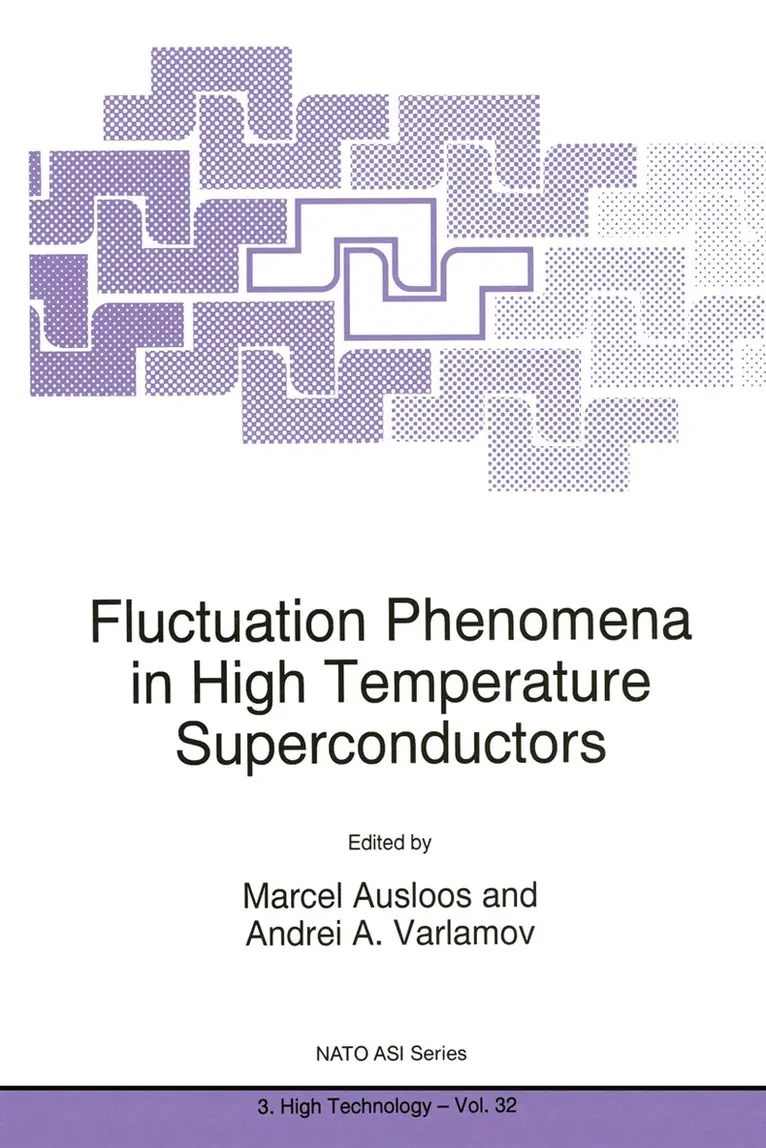
Fluctuation Phenomena in High Temperature Superconductors
Häftad, Engelska, 2012
540 kr
Skickas inom 10-15 vardagar
Proceedings of the NATO Advanced Research Workshop on Fluctuation Phenomena in High Critical Temperature Superconducting Ceramics, Trieste, Italy, 5-9 August 1996
E-bok
PDF, Engelska, 20121 367 kr
Läs direkt efter köp
These Proceedings of a NATO-ARW (HTECH ARW 97 1843) held at the Oreanda Hotel, Yalta, Ukraine from April 29 till May 2 , 1998 resulted from many discussions between various workers, concerning the need for a gathering of all (if possible) who were concerned with the subject of symmetry of the order parameter and pairing states for superconductivity. We applied ourselves in particular to High critical Temperature Superconductors (HTS), but also studied other unconventional superconductors. The study of HTS is one of the most prominent research subjects in solid state sciences. The understanding of the role of symmetry and pairing conditions are also thought to be necessary before technological applications since these features may be influenced by external fields. The workshop discussions have touched upon theoretical and experimental aspects, but also on related topics. These served as initiators for a very great amount of discussions with many comments from the audience. More than thirty "long lectures" and one on going "poster session" were held. Private discussions went unrecorded but obviously took place at many locations : lecture halls, staircases, cafes, bedrooms, bars, beach,bus, plane... Arguments openly reported for the first time were often quite sharp ones, -and this is an understatement.
E-bok
PDF, Engelska, 2012673 kr
Läs direkt efter köp
These Proceedings of a NATO-ARW (HTECH ARW 96 00 52) held at the International Center for Theoretical Physics, Trieste, Italy from Aug 5 till Aug 9, 1996 resulted from many discussions between various workers, concerning the need for a gathering of all (if possible) who were concerned about the subject of superconductivity fluctuations in High critical Temperature Superconductors (HTS). It appeared to many that the Skocpol-Tinkham work of 1975 had to be revitalized in view of the discovery of the new superconducting ceramics and the enormous amount of work having already taken place. The study of HTS is one of the most prominent research subject in solid state sciences. The understanding of the role of fluctuations is also thought to be necessary before technological applications since the fluctuations may destroy the superconducting state. The workshop discussions have touched upon (i) Superconducting fluctuations in the vicinity of the critical transition, (ii) Superconductivity fluctuations near the percolation transition, and (iii) Fluctuations of the vortex lattice at the lattice melting temperature. These topics served as initiators for a very great amount of discussions with many comments from the audience. More than forty "long lectures" and two "poster sessions" were held. Private discussions going unrecorded but obviously took place at many locations : lecture halls, staircases, cafetaria, bedrooms, bars, beach, . . .