M. Cherkaoui – författare
Visar alla böcker från författaren M. Cherkaoui. Handla med fri frakt och snabb leverans.
4 produkter
4 produkter
E-bok
PDF, Engelska, 20004 509 kr
Läs direkt efter köp
Since its inception in 1991, EUROMAT has been held each year on behalf of the Federation of European Materials Societies (FEMS), and alternates between general and topical prospectives.This year''s theme, Advances in Mechanical Behaviour, Plasticity and Damage, was proposed by the Societe Francaise de Metallurgie et de Materiaux (SF2M) to FEMS.This publication contains a selection of papers presented at the EUROMAT 2000 Conference, held in Tours, France on 7-9 November 2000. The aim of this Conference was to concentrate mainly on recent advances made in the investigation of the relationship between microstructures of materials and their mechanical behaviour; including, fundamentals, modelling and applications. Encompassed in the Conference''s aim is the nurturing of the synergistic effect between the theoretical and applied areas in this field. This was achieved by addressing important basic and practical aspects of the mechanical behaviour and damage of materials whilst also providing significant links between various complementary approaches. All kinds of materials are covered and topics that were covered include the mechanics of solid polymers, microstructurs and micromechanisms, and the collective behavior of defects which looks at the interaction of multiple defects in a system.
Inbunden, Engelska, 2004
1 620 kr
Skickas inom 10-15 vardagar
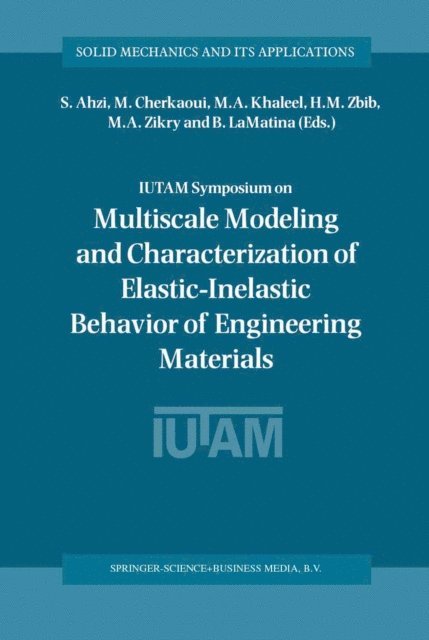
The papers in this proceeding are a collection of the works presented at the IUTAM symposium-Marrakech 2002 (October 20-25) which brought together scientists from various countries. These papers cover contemporary topics in multiscale modeling and characterization of materials behavior of engineering materials. They were selected to focus on topics related to deformation and failure in metals, alloys, intermetallics and polymers including: experimental techniques, deformation and failure mechanisms, dislocation-based modelling, microscopic-macroscopic averaging schemes, application to forming processes and to phase transformation, localization and failure phenomena, and computational advances. Key areas that are covered by some of the papers include modeling of material deformation at various scales. At the atomistic scale, results from MD simulations pertaining to deformation mechanisms in nano-crystalline materials as well as dislocation-defect interactions are presented. Advances in modeling of deformation in metals using discrete dislocation analyses are also presented, providing an insight into this emerging scientific technique that can be used to model deformation at the microscale. These papers address current engineering problems, including deformation of thin fIlms, dislocation behavior and strength during nanoindentation, strength in metal matrix composites, dislocation-crack interaction, development of textures in polycrystals, and problems involving twining and shape memory behavior. On Behalf of the organizing committee, I would like to thank Professor P.
Häftad, Engelska, 2010
1 620 kr
Skickas inom 10-15 vardagar
The papers in this proceeding are a collection of the works presented at the IUTAM symposium-Marrakech 2002 (October 20-25) which brought together scientists from various countries. These papers cover contemporary topics in multiscale modeling and characterization of materials behavior of engineering materials. They were selected to focus on topics related to deformation and failure in metals, alloys, intermetallics and polymers including: experimental techniques, deformation and failure mechanisms, dislocation-based modelling, microscopic-macroscopic averaging schemes, application to forming processes and to phase transformation, localization and failure phenomena, and computational advances. Key areas that are covered by some of the papers include modeling of material deformation at various scales. At the atomistic scale, results from MD simulations pertaining to deformation mechanisms in nano-crystalline materials as well as dislocation-defect interactions are presented. Advances in modeling of deformation in metals using discrete dislocation analyses are also presented, providing an insight into this emerging scientific technique that can be used to model deformation at the microscale. These papers address current engineering problems, including deformation of thin fIlms, dislocation behavior and strength during nanoindentation, strength in metal matrix composites, dislocation-crack interaction, development of textures in polycrystals, and problems involving twining and shape memory behavior. On Behalf of the organizing committee, I would like to thank Professor P.
E-bok
PDF, Engelska, 20131 995 kr
Läs direkt efter köp
The papers in this proceeding are a collection of the works presented at the IUTAM symposium-Marrakech 2002 (October 20-25) which brought together scientists from various countries. These papers cover contemporary topics in multiscale modeling and characterization of materials behavior of engineering materials. They were selected to focus on topics related to deformation and failure in metals, alloys, intermetallics and polymers including: experimental techniques, deformation and failure mechanisms, dislocation-based modelling, microscopic-macroscopic averaging schemes, application to forming processes and to phase transformation, localization and failure phenomena, and computational advances. Key areas that are covered by some of the papers include modeling of material deformation at various scales. At the atomistic scale, results from MD simulations pertaining to deformation mechanisms in nano-crystalline materials as well as dislocation-defect interactions are presented. Advances in modeling of deformation in metals using discrete dislocation analyses are also presented, providing an insight into this emerging scientific technique that can be used to model deformation at the microscale. These papers address current engineering problems, including deformation of thin fIlms, dislocation behavior and strength during nanoindentation, strength in metal matrix composites, dislocation-crack interaction, development of textures in polycrystals, and problems involving twining and shape memory behavior. On Behalf of the organizing committee, I would like to thank Professor P.