M. Silver - Böcker
Visar alla böcker från författaren . Handla med fri frakt och snabb leverans.
4 produkter
4 produkter
2 180 kr
Skickas inom 10-15 vardagar
5 by predations of the sea peoples. However, the weakening of Mycenean seapower, the destruction of the Hittite kingdom, and finally, the limitation on Philistine strength resulting from the alliance between David and the king of Tyre in the eleventh century, combined to open up "for the Phoenicians, in the first quarter of the first millennium B. C. E. vast overseas trading areas" (Oded 1979a, p. 228). By the end of the eleventh century, pottery from Cyprus, after a long absence could once again be found in Israelite-occupied sites (Albright 1960, p. 47). The expansion of the sea trade in the Mediterranean in which, judging by the song of Deborah (Judg. 5), the northern tribes of Asher and Dan (?) (see figure 1-2) would have parti cipated, was accompanied by the inauguration of camel caravans trans porting the goods of southern Arabia to and through Israel (see Bulliet 1975, especially p. 36). Military victories over the Philistines and Syrians, receipts of tribute, and the collection of tolls from the control of trade routes together with the general revival of trade all contributed to Israel's growing wealth. Indeed, the David-Solomon period (most of the tenth century) is often portrayed as the peak of Israelite economic development. In fact there is precious little extra biblical evidence supporting this portrayal. For example, in spite of the reported activity of David and Solomon's scribes, only one example of 6 "Hebrew" writing from this period, the Gezer Calendar, has been found.
318 kr
Skickas
"A design isn't dozens of little objects, or hungry-looking rectangular windowpanes: it is something that becomes a design by repeating, giving you something that a single pattern doesn't give you. " - (Phyllis Barron, Dartington 1964)During the 1920s and 1930s, Phyllis Barron (1890-1964) and Dorothy Larcher (1882-1952) were at the forefront of a revival in hand block-printing in Britain. As designer-makers they formed a unique partnership, producing innovative textiles and seeing the entire process through from beginning to end. Using whatever materials they could muster - fabric ranging from balloon cotton to prison sheets and velvet, and everyday items such as combs and car mats for printing - and pushing the boundaries of what could be achieved with predominantly natural dyes, these two remarkable women ran a successful business that lasted from 1923 until the outbreak of World War II. Nearly one hundred years on, another special collaboration between the Craft Studies Centre in Farnham, Christopher Farr Cloth and Ivo Prints, has brought a selection of Barron and Larcher's work back into production. The warm welcome they have received across the globe is a testament to the timeless quality of great design.
2 180 kr
Skickas inom 10-15 vardagar
5 by predations of the sea peoples. However, the weakening of Mycenean seapower, the destruction of the Hittite kingdom, and finally, the limitation on Philistine strength resulting from the alliance between David and the king of Tyre in the eleventh century, combined to open up "for the Phoenicians, in the first quarter of the first millennium B. C. E. vast overseas trading areas" (Oded 1979a, p. 228). By the end of the eleventh century, pottery from Cyprus, after a long absence could once again be found in Israelite-occupied sites (Albright 1960, p. 47). The expansion of the sea trade in the Mediterranean in which, judging by the song of Deborah (Judg. 5), the northern tribes of Asher and Dan (?) (see figure 1-2) would have parti cipated, was accompanied by the inauguration of camel caravans trans porting the goods of southern Arabia to and through Israel (see Bulliet 1975, especially p. 36). Military victories over the Philistines and Syrians, receipts of tribute, and the collection of tolls from the control of trade routes together with the general revival of trade all contributed to Israel's growing wealth. Indeed, the David-Solomon period (most of the tenth century) is often portrayed as the peak of Israelite economic development. In fact there is precious little extra biblical evidence supporting this portrayal. For example, in spite of the reported activity of David and Solomon's scribes, only one example of 6 "Hebrew" writing from this period, the Gezer Calendar, has been found.
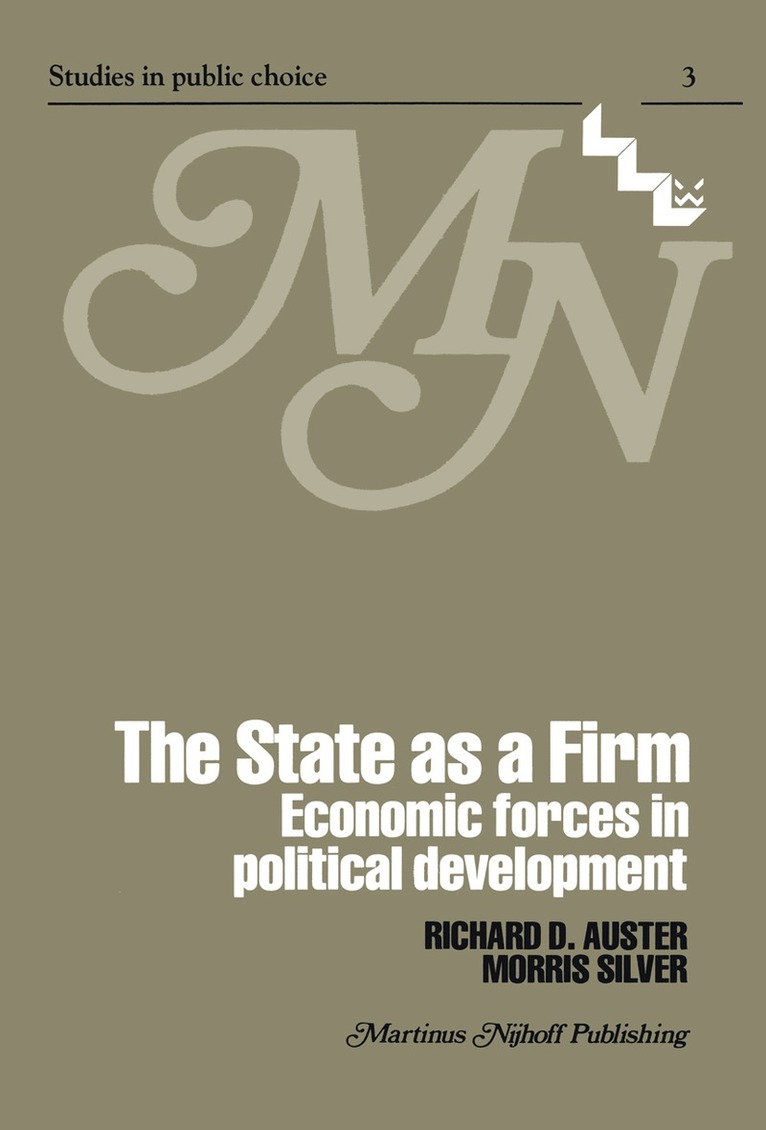
Del 3 - Studies in Public Choice
State as a Firm
Economic Forces in Political Development
Häftad, Engelska, 2012
534 kr
Skickas inom 10-15 vardagar
We seem to be witnessing the rebirth of the concept of an integrated social science, a complete theory of human action and interaction in all its ramifica tions and complications. What we call society is simply the totality of human exchange. Economics is a theory of human exchange of certain types. Although the qualities of what is being exchanged as well as the conditions of exchange may vary, economic theory has recently broadened its scope sufficiently to begin to be general enough to handle these problems as well. In the present work we attempt to see what insights are revealed by the application of economic categories to political history. We feel there are many. At this point Silver stops. ! Auster continues. A quick spin around the "policy" block in the new model so to speak, hence Chapter 8. For the rest, however, this is truly a joint work. The authors' names appear in alphabetical order. After 12 years of professional asso ciation, claims to precedence in origination could too clearly be self-deception. ! Silver is even more pessimistic than Auster, in particular about which types of reforms will be accepted. With the rise to affluence of most members of our society the mass itself has become concerned with political reform as almost a new form of entertainment. Unfor tunately, they have no idea how to improve matters.