M. Sterry – författare
Visar alla böcker från författaren M. Sterry. Handla med fri frakt och snabb leverans.
4 produkter
4 produkter
Inbunden, Engelska, 2017
1 758 kr
Skickas inom 7-10 vardagar
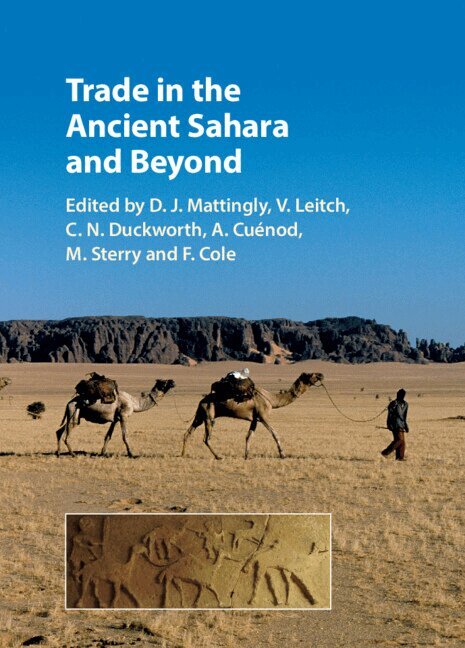
Saharan trade has been much debated in modern times, but the main focus of interest remains the medieval and early modern periods, for which more abundant written sources survive. The pre-Islamic origins of Trans-Saharan trade have been hotly contested over the years, mainly due to a lack of evidence. Many of the key commodities of trade are largely invisible archaeologically, being either of high value like gold and ivory, or organic like slaves and textiles or consumable commodities like salt. However, new research on the Libyan people known as the Garamantes and on their trading partners in the Sudan and Mediterranean Africa requires us to revise our views substantially. In this volume experts re-assess the evidence for a range of goods, including beads, textiles, metalwork and glass, and use it to paint a much more dynamic picture, demonstrating that the pre-Islamic Sahara was a more connected region than previously thought.
E-bok
Engelska, 20192 154 kr
Läs direkt efter köp
This ground-breaking volume explores a series of inter-related key themes in Saharan archaeology and history. Migration and identity formation can both be approached from the perspective of funerary archaeology, using the combined evidence of burial structures, specific rites and funerary material culture, and integrated methods of skeletal analysis including morphometrics, palaeopathology and isotopes. Burial traditions from various parts of the Sahara are compared and contrasted with those of the Nile Valley, the Maghreb and West Africa. Several chapters deal with the related evidence of human migration derived from linguistic study. The volume presents the state of the field of funerary archaeology in the Sahara and its neighbouring regions and sets the agenda for future research on mobility, migration and identity. It will be a seminal reference point for Mediterranean and African archaeologists, historians and anthropologists as well as archaeologists interested in burial and migration more broadly.
E-bok
PDF, Engelska, 20192 154 kr
Läs direkt efter köp
This ground-breaking volume explores a series of inter-related key themes in Saharan archaeology and history. Migration and identity formation can both be approached from the perspective of funerary archaeology, using the combined evidence of burial structures, specific rites and funerary material culture, and integrated methods of skeletal analysis including morphometrics, palaeopathology and isotopes. Burial traditions from various parts of the Sahara are compared and contrasted with those of the Nile Valley, the Maghreb and West Africa. Several chapters deal with the related evidence of human migration derived from linguistic study. The volume presents the state of the field of funerary archaeology in the Sahara and its neighbouring regions and sets the agenda for future research on mobility, migration and identity. It will be a seminal reference point for Mediterranean and African archaeologists, historians and anthropologists as well as archaeologists interested in burial and migration more broadly.
Inbunden, Engelska, 2019
1 838 kr
Tillfälligt slut
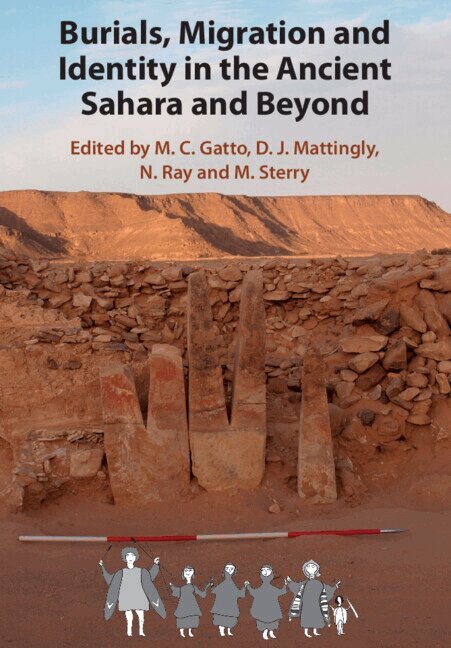
This ground-breaking volume explores a series of inter-related key themes in Saharan archaeology and history. Migration and identity formation can both be approached from the perspective of funerary archaeology, using the combined evidence of burial structures, specific rites and funerary material culture, and integrated methods of skeletal analysis including morphometrics, palaeopathology and isotopes. Burial traditions from various parts of the Sahara are compared and contrasted with those of the Nile Valley, the Maghreb and West Africa. Several chapters deal with the related evidence of human migration derived from linguistic study. The volume presents the state of the field of funerary archaeology in the Sahara and its neighbouring regions and sets the agenda for future research on mobility, migration and identity. It will be a seminal reference point for Mediterranean and African archaeologists, historians and anthropologists as well as archaeologists interested in burial and migration more broadly.