M. Suhail Zubairy - Böcker
Visar alla böcker från författaren M. Suhail Zubairy. Handla med fri frakt och snabb leverans.
9 produkter
9 produkter
923 kr
Skickas inom 10-15 vardagar
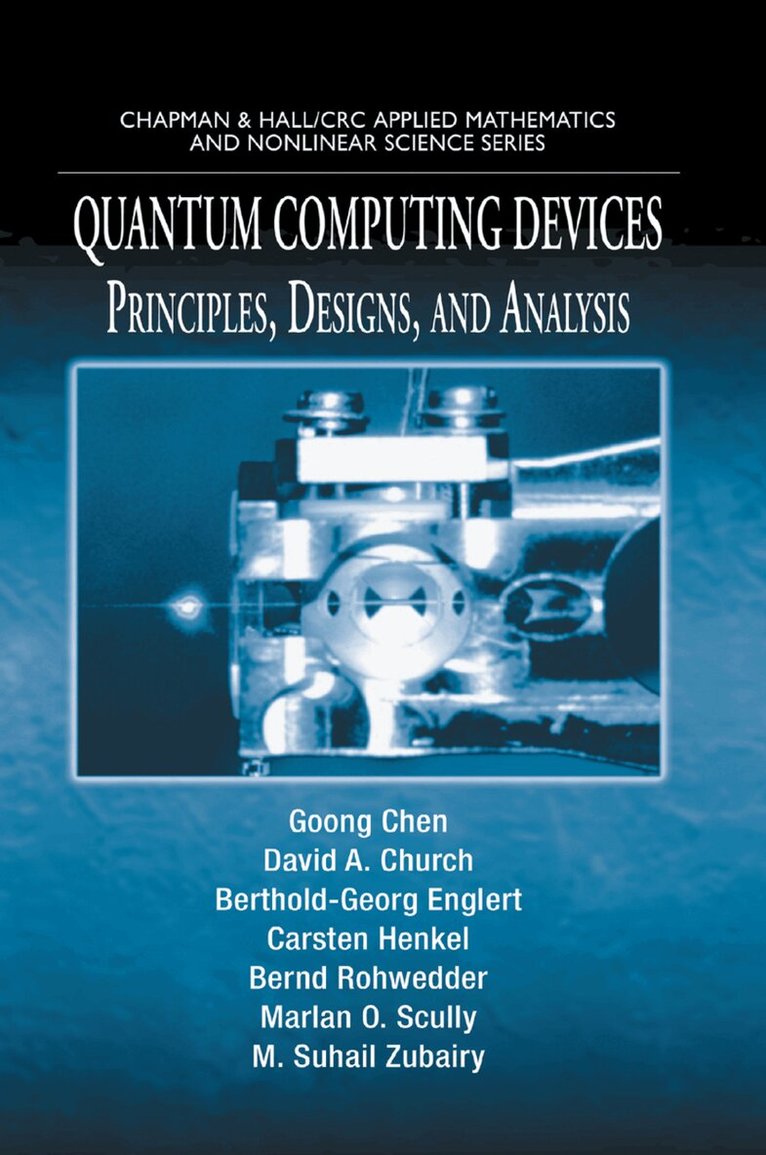
One of the first books to thoroughly examine the subject, Quantum Computing Devices: Principles, Designs, and Analysis covers the essential components in the design of a "real" quantum computer. It explores contemporary and important aspects of quantum computation, particularly focusing on the role of quantum electronic devices as quantum gates.Largely self-contained and written in a tutorial style, this reference presents the analysis, design, and modeling of the major types of quantum computing devices: ion traps, cavity quantum electrodynamics (QED), linear optics, quantum dots, nuclear magnetic resonance (NMR), superconducting quantum interference devices (SQUID), and neutral atom traps. It begins by explaining the fundamentals and algorithms of quantum computing, followed by the operations and formalisms of quantum systems. For each electronic device, the subsequent chapters discuss physical properties, the setup of qubits, control actions that produce the quantum gates that are universal for quantum computing, relevant measurements, and decoherence properties of the systems. The book also includes tables, diagrams, and figures that illustrate various data, uses, and designs of quantum computing.As nanoelectronics will inevitably replace microelectronics, the development of quantum information science and quantum computing technology is imperative to the future of information science and technology. Quantum Computing Devices: Principles, Designs, and Analysis helps fulfill this need by providing a comprehensive collection of the most promising devices for the future.
Quantum Mechanics for Beginners
With Applications to Quantum Communication and Quantum Computing
Inbunden, Engelska, 2020
1 153 kr
Skickas inom 7-10 vardagar
Quantum mechanics is a highly successful yet mysterious theory. Quantum Mechanics for Beginners provides an accessible introduction to this fascinating subject for those with only a high school background in physics and mathematics. This book is entirely algebra-based, except for the last chapter on the Schrodinger equation. A major advantage of this book is that it provides an introduction to the fields of quantum communication and quantum computing. Topics covered include wave-particle duality, Heisenberg uncertainty relation, Bohr's principle of complementarity, quantum superposition and entanglement, Schrodinger's cat, Einstein-Podolsky-Rosen paradox, Bell theorem, quantum no-cloning theorem and quantum copying, quantum eraser and delayed choice, quantum teleportation, quantum key distribution protocols such as BB-84 and B-92, counterfactual communication, quantum money, quantum Fourier transform, quantum computing protocols including Shor and Grover algorithms, quantum dense coding, and quantum tunneling. All these topics and more are explained fully, but using only elementary mathematics. Each chapter is followed by exercises and a short list of references. This book is meant for beginning college students as well as advanced high school students, and can be used as a text for a one-semester course at the undergraduate level. It can also be useful for those who want to learn some of the fascinating recent and ongoing developments in areas related to the foundations of quantum mechanics and its applications to areas like quantum communication and quantum computing.
Quantum Mechanics for Beginners
With Applications to Quantum Communication and Quantum Computing
Häftad, Engelska, 2020
580 kr
Skickas inom 7-10 vardagar
Quantum mechanics is a highly successful yet mysterious theory. Quantum Mechanics for Beginners provides an accessible introduction to this fascinating subject for those with only a high school background in physics and mathematics. This book is entirely algebra-based, except for the last chapter on the Schrodinger equation. A major advantage of this book is that it provides an introduction to the fields of quantum communication and quantum computing. Topics covered include wave-particle duality, Heisenberg uncertainty relation, Bohr's principle of complementarity, quantum superposition and entanglement, Schrodinger's cat, Einstein-Podolsky-Rosen paradox, Bell theorem, quantum no-cloning theorem and quantum copying, quantum eraser and delayed choice, quantum teleportation, quantum key distribution protocols such as BB-84 and B-92, counterfactual communication, quantum money, quantum Fourier transform, quantum computing protocols including Shor and Grover algorithms, quantum dense coding, and quantum tunneling. All these topics and more are explained fully, but using only elementary mathematics. Each chapter is followed by exercises and a short list of references. This book is meant for beginning college students as well as advanced high school students, and can be used as a text for a one-semester course at the undergraduate level. It can also be useful for those who want to learn some of the fascinating recent and ongoing developments in areas related to the foundations of quantum mechanics and its applications to areas like quantum communication and quantum computing.
A Mysterious Universe
Quantum Mechanics, Relativity, and Cosmology for Everyone
Inbunden, Engelska, 2023
302 kr
Skickas inom 5-8 vardagar
A Mysterious Universe introduces the fundamental laws of quantum mechanics, theory of relativity, and cosmology to a novice in simple language. This concise book deals with deep issues related to the mysteries of modern physics. Both quantum mechanics and relativity are highly mathematical subjects and are not easily accessible. In 2020, the author wrote a book Quantum Mechanics for Beginners with the aim of introducing the fundamentals of quantum theory to someone with elementary knowledge of physics and algebra. Here he goes one step further and introduces these ideas to someone with no prior knowledge of physics and mathematics. In the first part of the book, topics like the wave-particle duality, the probabilistic nature of the measurement, the possibility of multiple universes, and the nature of reality are discussed. In the second part, Einstein's special and general theories of relativity and their amazing and mind-boggling consequences are presented. The impact of the theory of relativity on cosmology is immense. The big bang model of the universe, black holes, and the current hot topics of dark matter and dark energy are explained and discussed. These fields that may hold the key to many unanswered questions about the universe are still evolving. This book is intended for readers, young and old, who would like to understand the incomprehensible laws that govern the universe without any prior background in physics and mathematics.
1 175 kr
Skickas inom 7-10 vardagar
The field of quantum optics has witnessed significant theoretical and experimental developments in recent years. This book provides an in-depth and wide-ranging introduction to the subject, emphasising throughout the basic principles and their applications. The book begins by developing the basic tools of quantum optics, and goes on to show the application of these tools in a variety of quantum optical systems, including lasing without inversion, squeezed states and atom optics. The final four chapters are devoted to a discussion of quantum optical tests of the foundations of quantum mechanics, and to particular aspects of measurement theory. Assuming only a background of standard quantum mechanics and electromagnetic theory, and containing many problems and references, this book will be invaluable to graduate students of quantum optics, as well as to researchers in this field.
2 644 kr
Skickas inom 10-15 vardagar
One of the first books to thoroughly examine the subject, Quantum Computing Devices: Principles, Designs, and Analysis covers the essential components in the design of a "real" quantum computer. It explores contemporary and important aspects of quantum computation, particularly focusing on the role of quantum electronic devices as quantum gates.Largely self-contained and written in a tutorial style, this reference presents the analysis, design, and modeling of the major types of quantum computing devices: ion traps, cavity quantum electrodynamics (QED), linear optics, quantum dots, nuclear magnetic resonance (NMR), superconducting quantum interference devices (SQUID), and neutral atom traps. It begins by explaining the fundamentals and algorithms of quantum computing, followed by the operations and formalisms of quantum systems. For each electronic device, the subsequent chapters discuss physical properties, the setup of qubits, control actions that produce the quantum gates that are universal for quantum computing, relevant measurements, and decoherence properties of the systems. The book also includes tables, diagrams, and figures that illustrate various data, uses, and designs of quantum computing.As nanoelectronics will inevitably replace microelectronics, the development of quantum information science and quantum computing technology is imperative to the future of information science and technology. Quantum Computing Devices: Principles, Designs, and Analysis helps fulfill this need by providing a comprehensive collection of the most promising devices for the future.
208 kr
Skickas inom 3-6 vardagar
533 kr
Skickas inom 10-15 vardagar
Light and light based technologies have played an important role in transforming our lives via scientific contributions spanned over thousands of years. In this book we present a vast collection of articles on various aspects of light and its applications in the contemporary world at a popular or semi-popular level. These articles are written by the world authorities in their respective fields. This is therefore a rare volume where the world experts have come together to present the developments in this most important field of science in an almost pedagogical manner. This volume covers five aspects related to light. The first presents two articles, one on the history of the nature of light, and the other on the scientific achievements of Ibn-Haitham (Alhazen), who is broadly considered the father of modern optics. These are then followed by an article on ultrafast phenomena and the invisible world. The third part includes papers on specific sources of light, the discoveries of which have revolutionized optical technologies in our lifetime. They discuss the nature and the characteristics of lasers, Solid-state lighting based on the Light Emitting Diode (LED) technology, and finally modern electron optics and its relationship to the Muslim golden age in science. The book’s fourth part discusses various applications of optics and light in today's world, including biophotonics, art, optical communication, nanotechnology, the eye as an optical instrument, remote sensing, and optics in medicine. In turn, the last part focuses on quantum optics, a modern field that grew out of the interaction of light and matter. Topics addressed include atom optics, slow, stored and stationary light, optical tests of the foundation of physics, quantum mechanical properties of light fields carrying orbital angular momentum, quantum communication, and Wave-Particle dualism in action.
533 kr
Skickas inom 10-15 vardagar
Light and light based technologies have played an important role in transforming our lives via scientific contributions spanned over thousands of years. In this book we present a vast collection of articles on various aspects of light and its applications in the contemporary world at a popular or semi-popular level. These articles are written by the world authorities in their respective fields. This is therefore a rare volume where the world experts have come together to present the developments in this most important field of science in an almost pedagogical manner. This volume covers five aspects related to light. The first presents two articles, one on the history of the nature of light, and the other on the scientific achievements of Ibn-Haitham (Alhazen), who is broadly considered the father of modern optics. These are then followed by an article on ultrafast phenomena and the invisible world. The third part includes papers on specific sources of light, the discoveries of which have revolutionized optical technologies in our lifetime. They discuss the nature and the characteristics of lasers, Solid-state lighting based on the Light Emitting Diode (LED) technology, and finally modern electron optics and its relationship to the Muslim golden age in science. The book’s fourth part discusses various applications of optics and light in today's world, including biophotonics, art, optical communication, nanotechnology, the eye as an optical instrument, remote sensing, and optics in medicine. In turn, the last part focuses on quantum optics, a modern field that grew out of the interaction of light and matter. Topics addressed include atom optics, slow, stored and stationary light, optical tests of the foundation of physics, quantum mechanical properties of light fields carrying orbital angular momentum, quantum communication, and Wave-Particle dualism in action.