M.A. Notturno - Böcker
Visar alla böcker från författaren M.A. Notturno. Handla med fri frakt och snabb leverans.
4 produkter
4 produkter
2 088 kr
Skickas inom 10-15 vardagar
Based upon the Kenan Lectures that Karl Popper delivered at Emory University in 1969, Knowledge and the Body-Mind Problem raises problems connected with human freedom, creativity, rationality, and the relationship between human beings and their actions. These are what Popper calls big issues - too big for easy answers, but too important to be ignored. In these lectures, and in the discussions that follow them, Sir Karl develops a theory of body-mind interaction. This theory involves evolutionary emergence, human language, and that realm of autonomous products of the human mind which Popper calls World 3. According to Popper, consciousness emerged in the course of evolution as a kind of control system for the body, like a driver is a control system for a car. Objective knowledge - the kind of knowledge that is found in books and libraries - then emerged in the course of evolution as a higher level control system for the mind. Simply put, objective knowledge is the mind's control system for critical problem solving. In this way, full consciousness - the kind of consciousness that humans can have - is anchored in World 3 and is closely linked to human language, problems, theories, and criticism. And it is mainly through this use of objective knowledge as a control system for critical problem solving that we are able to exercise our freedom, creativity, and rationality - first by making contributions, like science books and works of art, to World 3; and then by using these contributions to bring about changes in Worlds 1 and 2. The Kenan Lectures were well-attended and provoked lively discussions. This book is published in the same informal language in which they were originally delivered and so can be easily understood by a general audience.
576 kr
Skickas inom 10-15 vardagar
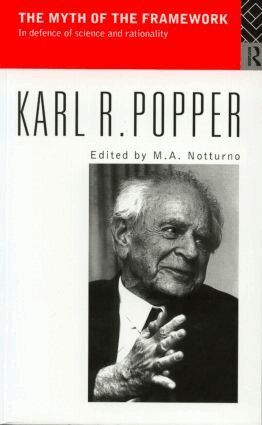
In a career spanning sixty years, Sir Karl Popper has made some of the most important contributions to the twentieth century discussion of science and rationality. The Myth of the Framework is a new collection of some of Popper's most important material on this subject.Sir Karl discusses such issues as the aims of science, the role that it plays in our civilization, the moral responsibility of the scientist, the structure of history, and the perennial choice between reason and revolution. In doing so, he attacks intellectual fashions (like positivism) that exagerrate what science and rationality have done, as well as intellectual fashions (like relativism) that denigrate what science and rationality can do. Scientific knowledge, according to Popper, is one of the most rational and creative of human achievements, but it is also inherently fallible and subject to revision.In place of intellectual fashions, Popper offers his own critical rationalism - a view that he regards both as a theory of knowlege and as an attitude towards human life, human morals and democracy.Published in cooperation with the Central European University.
630 kr
Skickas inom 10-15 vardagar
Based upon the Kenan Lectures that Karl Popper delivered at Emory University in 1969, Knowledge and the Body-Mind Problem raises problems connected with human freedom, creativity, rationality, and the relationship between human beings and their actions. These are what Popper calls big issues - too big for easy answers, but too important to be ignored. In these lectures, and in the discussions that follow them, Sir Karl develops a theory of body-mind interaction. This theory involves evolutionary emergence, human language, and that realm of autonomous products of the human mind which Popper calls World 3. According to Popper, consciousness emerged in the course of evolution as a kind of control system for the body, like a driver is a control system for a car. Objective knowledge - the kind of knowledge that is found in books and libraries - then emerged in the course of evolution as a higher level control system for the mind. Simply put, objective knowledge is the mind's control system for critical problem solving. In this way, full consciousness - the kind of consciousness that humans can have - is anchored in World 3 and is closely linked to human language, problems, theories, and criticism. And it is mainly through this use of objective knowledge as a control system for critical problem solving that we are able to exercise our freedom, creativity, and rationality - first by making contributions, like science books and works of art, to World 3; and then by using these contributions to bring about changes in Worlds 1 and 2. The Kenan Lectures were well-attended and provoked lively discussions. This book is published in the same informal language in which they were originally delivered and so can be easily understood by a general audience.
2 088 kr
Skickas inom 10-15 vardagar
In a career spanning sixty years, Sir Karl Popper has made some of the most important contributions to the twentieth century discussion of science and rationality. The Myth of the Framework is a new collection of some of Popper's most important material on this subject.Sir Karl discusses such issues as the aims of science, the role that it plays in our civilization, the moral responsibility of the scientist, the structure of history, and the perennial choice between reason and revolution. In doing so, he attacks intellectual fashions (like positivism) that exagerrate what science and rationality have done, as well as intellectual fashions (like relativism) that denigrate what science and rationality can do. Scientific knowledge, according to Popper, is one of the most rational and creative of human achievements, but it is also inherently fallible and subject to revision.In place of intellectual fashions, Popper offers his own critical rationalism - a view that he regards both as a theory of knowlege and as an attitude towards human life, human morals and democracy.Published in cooperation with the Central European University.