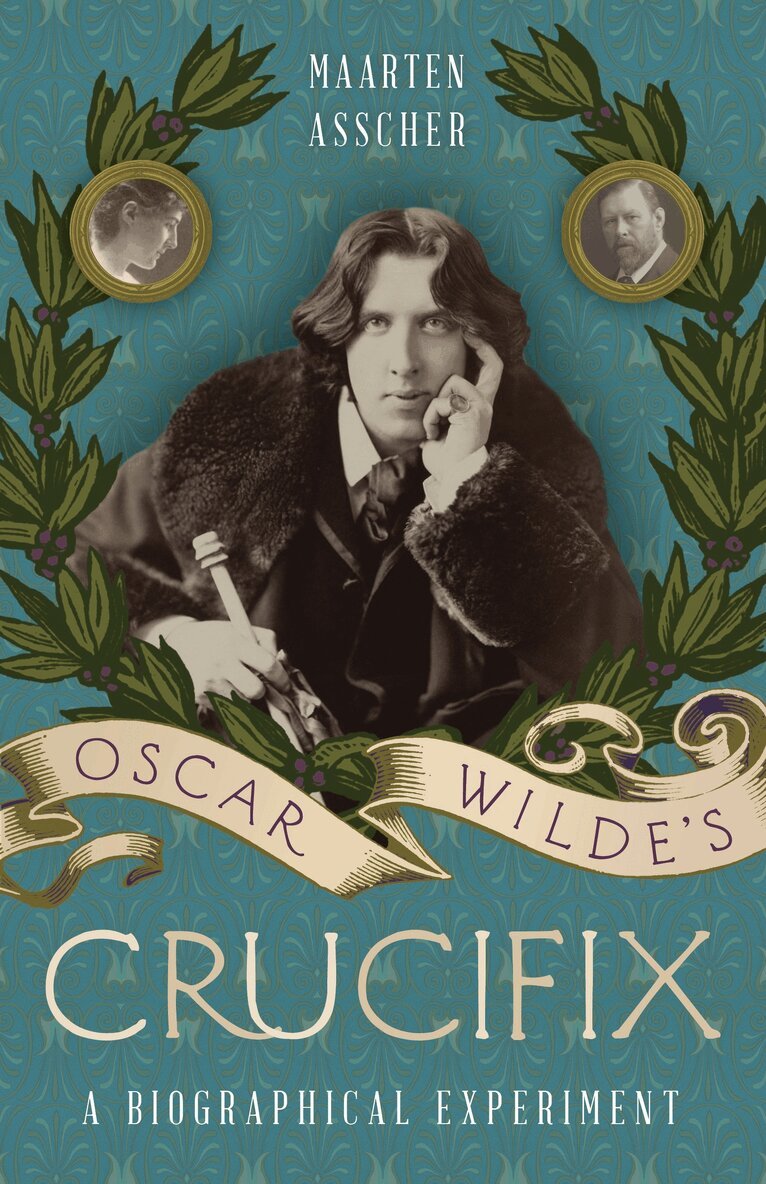
While a student at Oxford, Oscar Wilde was courting a beautiful Dublin girl, Florence Balcombe, and on Christmas Day 1876 he presented her with a love gift of a golden crucifix. Two years later, Florence surprised Oscar by suddenly marrying another young writer from Dublin, Bram Stoker, the future author of Dracula.Dutch writer Maarten Asscher uses that crucifix as a fulcrum to examine Wilde’s early development as an artist, from a seminal trip to Greece to his whirlwind tour of America and beyond, including real-life encounters with Walt Whitman and Arthur Conan Doyle. Asscher draws on the complete panoply of Wilde scholarship to supplement historical fact with imaginative reconstruction, including a myth-busting account of Wilde’s deathbed in Paris, and a fictional solution to the mystery of the crucifix delivered by none other than Sherlock Holmes. The result is a convincing and original interpretation of Victorian history, and a literary tour de force.
What does it mean when people say "You can't compare apples and oranges"? Are comparisons across genres inherently invalid, or can they be insightful and illuminating? In this brilliant and provocative collection of essays, Dutch author Maarten Asscher maintains that comparisons can be the highest form of argument. Asscher makes his case with examples drawn from classical to contemporary history, art, and literature: Hamlet in Ithaca and Telemachus in Elsinore, the Mediterranean and the North Sea, writing from a prison cell and writing from a room at home, the "suicide" of Primo Levi and Japanese Kamikaze pilots, and so on. With graceful erudition and idiosyncratic wit, Asscher demonstrates how the comparative method can provide insight not only into two subjects simultaneously, but also into fundamental issues they may have in common.
While a student at Oxford, Oscar Wilde was courting a beautiful Dublin girl, Florence Balcombe, and on Christmas Day 1876 he presented her with a love gift of a golden crucifix. Two years later, Florence surprised Oscar by suddenly marrying another young writer from Dublin, Bram Stoker, the future author of Dracula.Dutch writer Maarten Asscher uses that crucifix as a fulcrum to examine Wilde’s early development as an artist, from a seminal trip to Greece to his whirlwind tour of America and beyond, including real-life encounters with Walt Whitman and Arthur Conan Doyle. Asscher draws on the complete panoply of Wilde scholarship to supplement historical fact with imaginative reconstruction, including a myth-busting account of Wilde’s deathbed in Paris, and a fictional solution to the mystery of the crucifix delivered by none other than Sherlock Holmes. The result is a convincing and original interpretation of Victorian history, and a literary tour de force.
What does it mean when people say "You can't compare apples and oranges"? Are comparisons across genres inherently invalid, or can they be insightful and illuminating? In this brilliant and provocative collection of essays, Dutch author Maarten Asscher maintains that comparisons can be the highest form of argument. Asscher makes his case with examples drawn from classical to contemporary history, art, and literature: Hamlet in Ithaca and Telemachus in Elsinore, the Mediterranean and the North Sea, writing from a prison cell and writing from a room at home, the "suicide" of Primo Levi and Japanese Kamikaze pilots, and so on. With graceful erudition and idiosyncratic wit, Asscher demonstrates how the comparative method can provide insight not only into two subjects simultaneously, but also into fundamental issues they may have in common.