Madhabi Chatterji – författare
Visar alla böcker från författaren Madhabi Chatterji. Handla med fri frakt och snabb leverans.
4 produkter
4 produkter
Häftad, Engelska, 2027
996 kr
Kommande
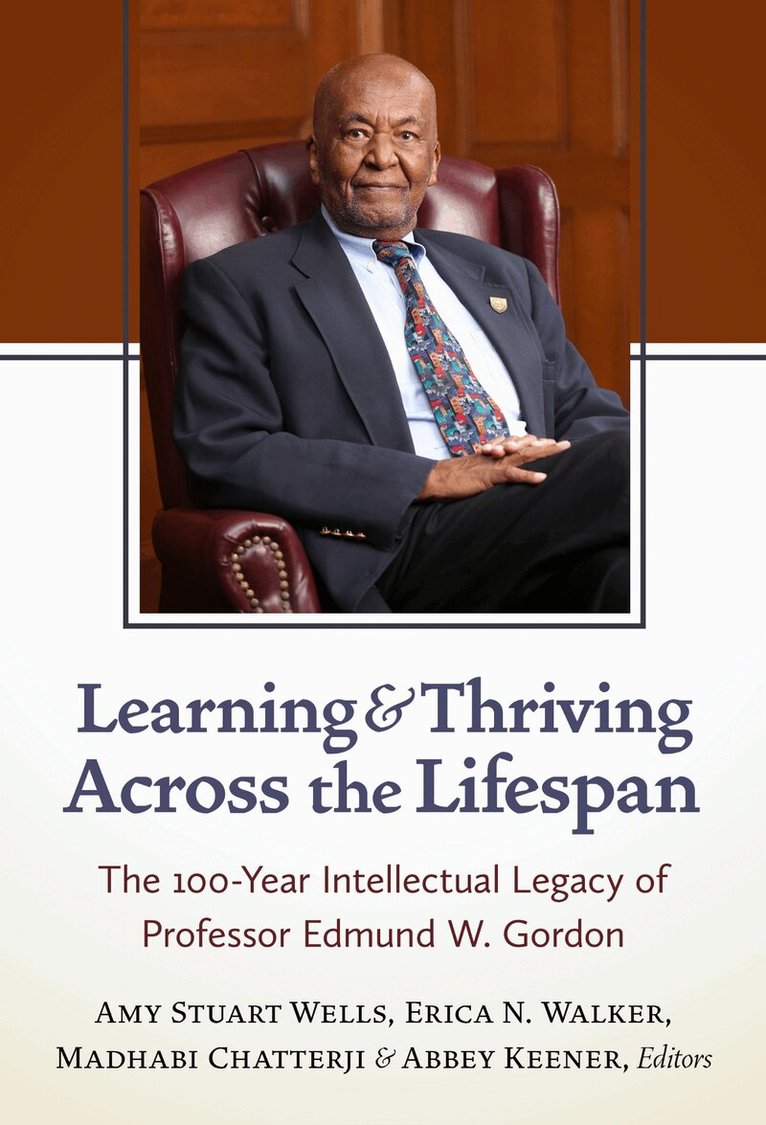
This timely and much-needed volume pays tribute to the long life and intellectual legacy of Dr. Edmund W. Gordon, a prolific scholar, mentor, and icon in the fields of psychology and education. The central aim of this collection, drawn from a major conference celebrating Gordon's 100th birthday, is to highlight Gordon's scholarship and its saliency to the most critical issues in the field of education today, especially educational assessment and inequalities in learning opportunities related to class, culture, and race. With topics ranging from rethinking how we approach education for the least advantaged students, to early childhood education, to affirmative pedagogies that uplift all students, to assessment in the service of learning, the chapters of this volume explore Gordon's influence in shaping the field through collaborative thinking across generations of scholars. The transdisciplinary research in this volume reflects Gordon's complex understanding of humanistic traditions and its connections to principles of social justice. The result is an accessible and vital roadmap for supporting all human beings across their life spans while addressing pervasive inequities in educational opportunities and outcomes for minoritized and low-income students. Book Features:A comprehensive look at the life and intellectual legacy of Dr. Edmund W. Gordon.Chapter authors examine Dr. Gordon's contributions across four areas—educational measurement, learning theory and development, human development, and human rights.Research that shows the importance of race, class, and culture in the interplay of education and student outcomes. The concept of affirmative development and how it helps us understand the emancipatory potential of education as a field.This book is made available as an open-access electronic publication that can be downloaded from the TC Press website.
Inbunden, Engelska, 2027
1 915 kr
Kommande
This timely and much-needed volume pays tribute to the long life and intellectual legacy of Dr. Edmund W. Gordon, a prolific scholar, mentor, and icon in the fields of psychology and education. The central aim of this collection, drawn from a major conference celebrating Gordon's 100th birthday, is to highlight Gordon's scholarship and its saliency to the most critical issues in the field of education today, especially educational assessment and inequalities in learning opportunities related to class, culture, and race. With topics ranging from rethinking how we approach education for the least advantaged students, to early childhood education, to affirmative pedagogies that uplift all students, to assessment in the service of learning, the chapters of this volume explore Gordon's influence in shaping the field through collaborative thinking across generations of scholars. The transdisciplinary research in this volume reflects Gordon's complex understanding of humanistic traditions and its connections to principles of social justice. The result is an accessible and vital roadmap for supporting all human beings across their life spans while addressing pervasive inequities in educational opportunities and outcomes for minoritized and low-income students. Book Features:A comprehensive look at the life and intellectual legacy of Dr. Edmund W. Gordon.Chapter authors examine Dr. Gordon's contributions across four areas—educational measurement, learning theory and development, human development, and human rights.Research that shows the importance of race, class, and culture in the interplay of education and student outcomes. The concept of affirmative development and how it helps us understand the emancipatory potential of education as a field.This book is made available as an open-access electronic publication that can be downloaded from the TC Press website.
Inbunden, Engelska, 2025
1 008 kr
Skickas inom 10-15 vardagar
How can assessment instruments be designed or selected to best serve the needs of intended users, taking into account their interests, capacities, and limitations? Informed by a socioecological perspective, this timely, state-of-the-art reference and text presents an integrated, user-centered process model for developing assessments guided by user contexts. Madhabi Chatterji provides foundational principles and procedures for designing multi-item tests; behavior-based, product-based, and portfolio-based assessments; and self-report instruments. She demonstrates how to integrate qualitative and quantitative methods to devise tools that meet the quality criteria of usefulness and usability alongside validity and reliability. The book features case study discussions; worked-through examples with diverse, global populations; and sample instruments from a variety of disciplines (education, psychology, health care, and others). Chapter overviews and objectives are tied to within-chapter Recaps and Reflection Breaks to further understanding and class discussion.
Inbunden, Engelska, 2013
1 277 kr
Skickas inom 5-8 vardagar
This volume questions the validity issues surrounding educational assessment programs and their appropriate uses in applied contexts. The authors break new ground in terms of validity theory and practice, offering recommendations, frameworks and assessment solutions that are broadly applicable in different regions. Chapters discuss the social consequences of validity oversights in high stakes testing, evaluation and accountability contexts. Questions addressed include: Do validity issues arise due to the technical complexities in assessment programs today, or a lack of awareness and inattention to technical limitations of assessment instruments by users? Is there a communication divide between educational policy-makers and measurement professionals that is obstructing more valid use of educational assessments and other forms of data? The prominent authors, representing voices of educational policy-makers, leaders, and recognized experts in educational measurement and evaluation from around the world, describe assessment programs in their regions, and appraise the conditions and factors that could enhance valid, equitable or fair assessment practices.