Magdy A. Bayoumi - Böcker
Visar alla böcker från författaren Magdy A. Bayoumi. Handla med fri frakt och snabb leverans.
10 produkter
10 produkter
1 064 kr
Skickas inom 10-15 vardagar
Interconnect has become the dominating factor in determining system performance in nanometer technologies. Dedicated to this subject, Interconnect Noise Optimization in Nanometer Technologies provides insight and intuition into layout analysis and optimization for interconnect in high speed, high complexity integrated circuits.The authors bring together a wealth of information presenting a range of CAD algorithms and techniques for synthesizing and optimizing interconnect. Practical aspects of the algorithms and the models are explained with sufficient details. The book investigates the most effective parameters in layout optimization. Different post-layout optimization techniques with complexity analysis and benchmarks tests are provided. The impact crosstalk noise and coupling on the wire delay is analyzed. Parameters that affect signal integrity are also considered.
1 578 kr
Skickas inom 10-15 vardagar
This publication combines models of adaptive information processing in the brain with advances in microelectronics technology and circuit design. The premise is to construct integrated systems not only loaded with sufficient computational power to handle demanding signal processing tasks in sensory perception and pattern recognition, but also capable of operating autonomously and robustly in unpredictable environments through mechanisms of adaptation and learning. This edited volume covers the spectrum of learning on silicon in five parts: adaptive sensory systems, neuromorphic learning, learning architectures, learning dynamics, and learning systems. The 18 chapters are documented with examples of fabricated systems, experimental results from silicon, and integrated applications ranging from adaptive optics to biomedical instrumentation. It serves as a reference for beginners and experienced researchers alike. It provides material for an advanced course, and a source of inspiration for continued research towards building intelligent adaptive machines.
Del 149 - Springer International Series in Engineering and Computer Science
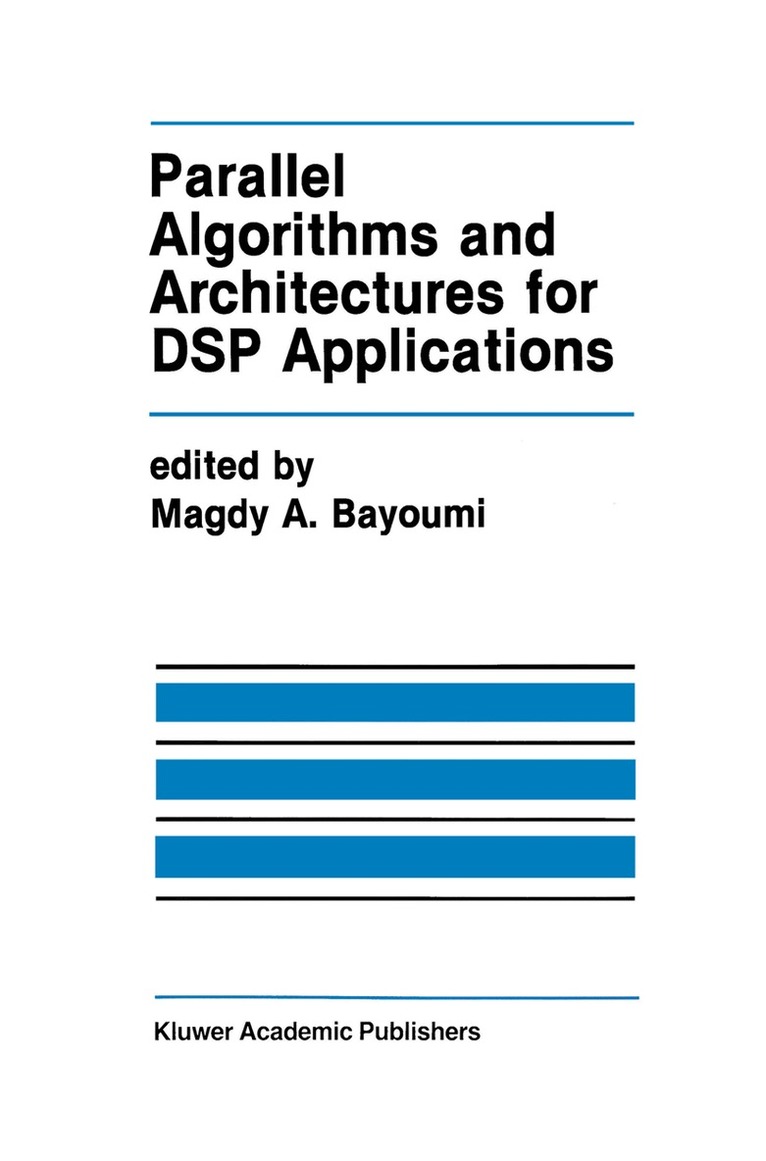
Parallel Algorithms and Architectures for DSP Applications
Inbunden, Engelska, 1991
1 064 kr
Skickas inom 10-15 vardagar
Over the past few years, the demand for high speed Digital Signal Proces sing (DSP) has increased dramatically. New applications in real-time image processing, satellite communications, radar signal processing, pattern recogni tion, and real-time signal detection and estimation require major improvements at several levels; algorithmic, architectural, and implementation. These perfor mance requirements can be achieved by employing parallel processing at all levels. Very Large Scale Integration (VLSI) technology supports and provides a good avenue for parallelism. Parallelism offers efficient sohitions to several problems which can arise in VLSI DSP architectures such as: 1. Intermediate data communication and routing: several DSP algorithms, such as FFT, involve excessive data routing and reordering. Parallelism is an efficient mechanism to minimize the silicon cost and speed up the pro cessing time of the intermediate middle stages. 2. Complex DSP applications: the required computation is almost doubled. Parallelism will allow two similar channels processing at the same time. The communication between the two channels has to be minimized. 3. Applicatilm specific systems: this emerging approach should achieve real-time performance in a cost-effective way. 4. Testability and fault tolerance: reliability has become a required feature in most of DSP systems. To achieve such property, the involved time overhead is significant. Parallelism may be the solution to maintain ac ceptable speed performance.
2 101 kr
Skickas inom 10-15 vardagar
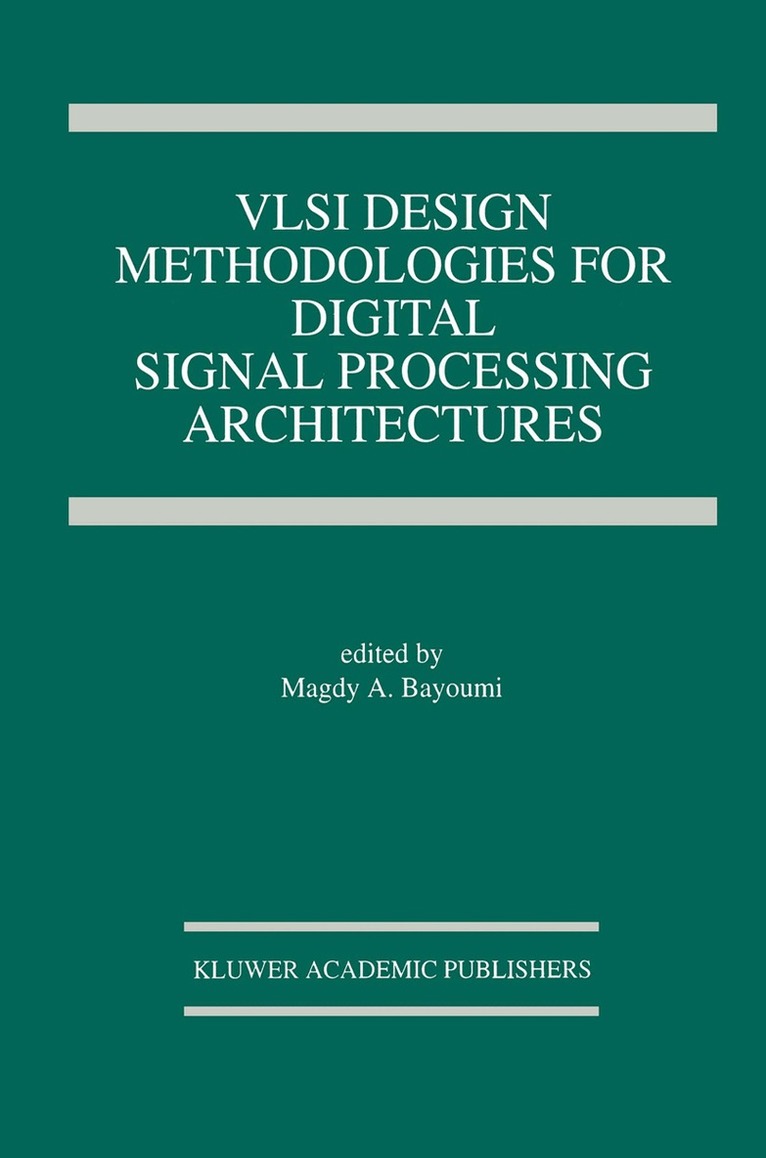
This book is centered around a number of emerging issues in the area of VLSI design methodologies, including system integration, optimization, algorithm transformation, impact of applications, memory management and algorithm prototyping. The text aims to provide the reader with the knowledge to participate in the rapidly evolving field of application specific design methodology for DSP architectures. "VLSI Design Methodologies for Digital Signal Processing Architectures" should be a useful reference for researchers in both academia and industry. It may also be used as a text for advanced courses in application specific design, VLSI design methods, and silicon compilers.
1 064 kr
Skickas inom 10-15 vardagar
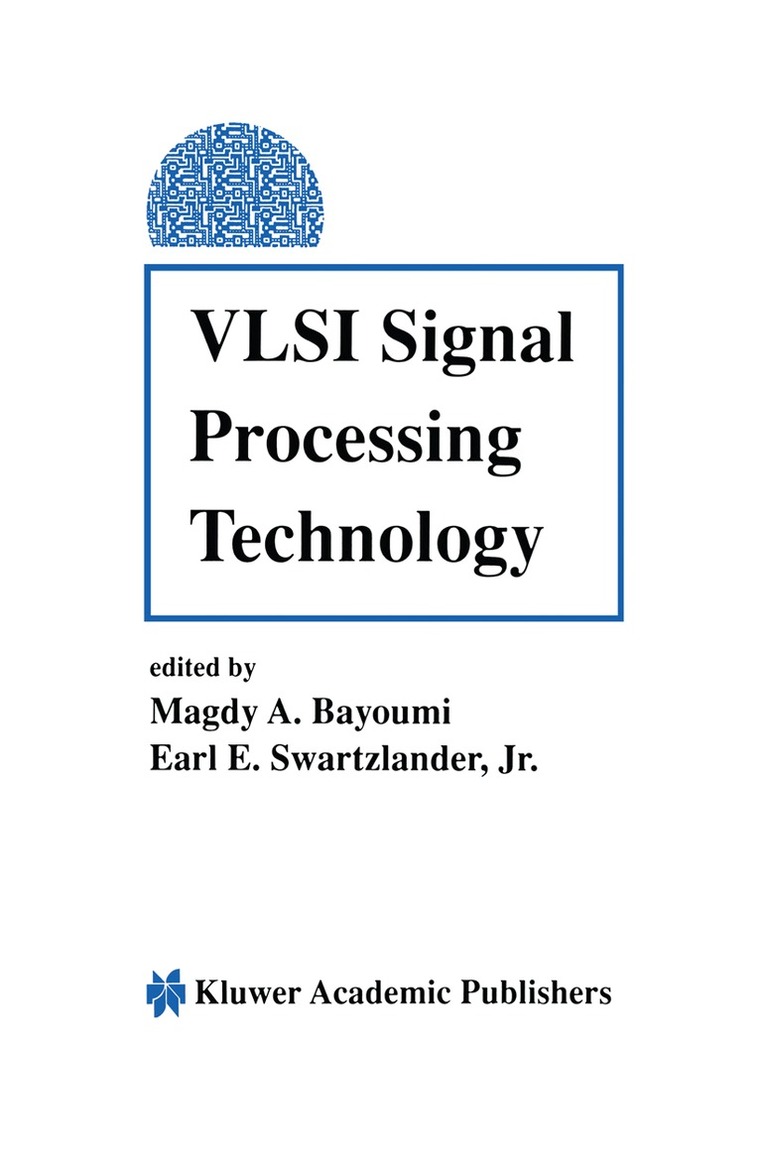
This text introduces readers to the main features of VLSI signal processing, and describes ongoing developments in the area. The comprehensive coverage includes: current developments in digital signal-processing processors and architectures; features and requirements of image and video signal-processing architectures; new market areas for signal processing; impact of arithmetic circuitry on the performance of DSP processors; pipelining; parallelism; systolic arrays; and analog signal processing. In addition, Chapter 8 presents a case study of application specific analog architecture for speech recognition. This book can be used for research courses in VLSI design and VLSI signal processing, as well as for graduate courses in signal processing and VLSI architecture. Individual chapters may be used as the basis for tutorials and short courses.
1 064 kr
Skickas inom 10-15 vardagar
Interconnect has become the dominating factor in determining system performance in nanometer technologies. Dedicated to this subject, Interconnect Noise Optimization in Nanometer Technologies provides insight and intuition into layout analysis and optimization for interconnect in high speed, high complexity integrated circuits.The authors bring together a wealth of information presenting a range of CAD algorithms and techniques for synthesizing and optimizing interconnect. Practical aspects of the algorithms and the models are explained with sufficient details. The book investigates the most effective parameters in layout optimization. Different post-layout optimization techniques with complexity analysis and benchmarks tests are provided. The impact crosstalk noise and coupling on the wire delay is analyzed. Parameters that affect signal integrity are also considered.
Del 257 - Springer International Series in Engineering and Computer Science
VLSI Design Methodologies for Digital Signal Processing Architectures
Häftad, Engelska, 2012
2 101 kr
Skickas inom 10-15 vardagar
Designing VLSI systems represents a challenging task. It is a transfonnation among different specifications corresponding to different levels of design: abstraction, behavioral, stntctural and physical. The behavioral level describes the functionality of the design. It consists of two components; static and dynamic. The static component describes operations, whereas the dynamic component describes sequencing and timing. The structural level contains infonnation about components, control and connectivity. The physical level describes the constraints that should be imposed on the floor plan, the placement of components, and the geometry of the design. Constraints of area, speed and power are also applied at this level. To implement such multilevel transfonnation, a design methodology should be devised, taking into consideration the constraints, limitations and properties of each level. The mapping process between any of these domains is non-isomorphic. A single behavioral component may be transfonned into more than one structural component. Design methodologies are the most recent evolution in the design automation era, which started off with the introduction and subsequent usage of module generation especially for regular structures such as PLA's and memories. A design methodology should offer an integrated design system rather than a set of separate unrelated routines and tools. A general outline of a desired integrated design system is as follows: * Decide on a certain unified framework for all design levels. * Derive a design method based on this framework. * Create a design environment to implement this design method.
1 064 kr
Skickas inom 10-15 vardagar
This book is the first in a set of forthcoming books focussed on state-of-the-art development in the VLSI Signal Processing area. It is a response to the tremendous research activities taking place in that field. These activities have been driven by two factors: the dramatic increase in demand for high speed signal processing, especially in consumer elec tronics, and the evolving microelectronic technologies. The available technology has always been one of the main factors in determining al gorithms, architectures, and design strategies to be followed. With every new technology, signal processing systems go through many changes in concepts, design methods, and implementation. The goal of this book is to introduce the reader to the main features of VLSI Signal Processing and the ongoing developments in this area. The focus of this book is on: • Current developments in Digital Signal Processing (DSP) pro cessors and architectures - several examples and case studies of existing DSP chips are discussed in Chapter 1. • Features and requirements of image and video signal processing architectures - both applications specific integrated circuits (ASICs) and programmable image processors are studied in Chapter 2. • New market areas for signal processing - especially in consumer electronics such as multimedia, teleconferencing, and movie on demand. • Impact of arithmetic circuitry on the performance of DSP pro cessors - several topics are discussed in Chapter 3 such as: number representation, arithmetic algorithms and circuits, and implementa tion.
Del 149 - Springer International Series in Engineering and Computer Science
Parallel Algorithms and Architectures for DSP Applications
Häftad, Engelska, 2012
1 064 kr
Skickas inom 10-15 vardagar
Over the past few years, the demand for high speed Digital Signal Proces sing (DSP) has increased dramatically. New applications in real-time image processing, satellite communications, radar signal processing, pattern recogni tion, and real-time signal detection and estimation require major improvements at several levels; algorithmic, architectural, and implementation. These perfor mance requirements can be achieved by employing parallel processing at all levels. Very Large Scale Integration (VLSI) technology supports and provides a good avenue for parallelism. Parallelism offers efficient sohitions to several problems which can arise in VLSI DSP architectures such as: 1. Intermediate data communication and routing: several DSP algorithms, such as FFT, involve excessive data routing and reordering. Parallelism is an efficient mechanism to minimize the silicon cost and speed up the pro cessing time of the intermediate middle stages. 2. Complex DSP applications: the required computation is almost doubled. Parallelism will allow two similar channels processing at the same time. The communication between the two channels has to be minimized. 3. Applicatilm specific systems: this emerging approach should achieve real-time performance in a cost-effective way. 4. Testability and fault tolerance: reliability has become a required feature in most of DSP systems. To achieve such property, the involved time overhead is significant. Parallelism may be the solution to maintain ac ceptable speed performance.
743 kr
Tillfälligt slut
Circuits and architectures have become more complex in terms of structure, interconnection topology, and data flow. Design correctness has become increasingly significant, as errors in design may result in strenuous debugging, or even in the repetition of a costly manufacturing process. Although circuit simulation has been used traditionally and widely as the technique for checking hardware and architectural designs, it does not guarantee the conformity of designs to specifications. Formal methods therefore become vital in guaranteeing the correctness of designs and have thus received a significant amount of attention in the CAD industry today.This book presents a formal method for specifying and verifying the correctness of systolic array designs. Such architectures are commonly found in the form of accelerators for digital signal, image, and video processing. These arrays can be quite complicated in topology and data flow. In the book, a formalism called STA is defined for these kinds of dynamic environments, with a survey of related techniques. A framework for specification and verification is established. Formal verification techniques to check the correctness of the systolic networks with respect to the algorithmic level specifications are explained. The book also presents a Prolog-based formal design verifier (named VSTA), developed to automate the verification process, as using a general purpose theorem prover is usually extremely time-consuming. Several application examples are included in the book to illustrate how formal techniques and the verifier can be used to automate proofs.