Magnus Enquist - Böcker
Visar alla böcker från författaren Magnus Enquist. Handla med fri frakt och snabb leverans.
5 produkter
5 produkter
Understanding Animal Intelligence
Practical Behavior Theory for Biology, Psychology, and Cognitive Science
Häftad, Engelska, 2025
1 452 kr
Kommande
Understanding Animal Intelligence: Practical Behavior Theory for Biology, Psychology, and Cognitive Science synthesizes theories and practice to comprehend animal cognition. Using the framework of reinforcement learning, this book combines current knowledge of animal intelligence, focusing on decision-making, memory retrieval, associative learning, training, and more. It evaluates how evolutionary and environmental factors influence cognition and behavior. Additionally, the book explores motivational states and how these fulfill different goals, such as seeking food and water. Moreover, this book is a valuable reference and essential reading for courses in animal behavior, animal physiology, and ethology.It provides a comprehensive analysis of animal intelligence by examining decision-making processes, memory retrieval, and associative learning. The book also delves into the interplay between evolutionary and environmental influences on cognition and behavior and demonstrates how learning can align with genetic predispositions.
738 kr
Skickas inom 7-10 vardagar
How can we make better sense of animal behavior by using what we know about the brain? This is the first book that attempts to answer this important question by applying neural network theory. Scientists create Artificial Neural Networks (ANNs) to make models of the brain. These networks mimic the architecture of a nervous system by connecting elementary neuron-like units into networks in which they stimulate or inhibit each other's activity in much the same way neurons do. This book shows how scientists can employ ANNs to analyze animal behavior, explore the general principles of the nervous systems, and test potential generalizations among species. The authors focus on simple neural networks to show how ANNs can be investigated by math and by computers. They demonstrate intuitive concepts that make the operation of neural networks more accessible to nonspecialists. The first chapter introduces various approaches to animal behavior and provides an informal introduction to neural networks, their history, and their potential advantages. The second chapter reviews artificial neural networks, including biological foundations, techniques, and applications.The following three chapters apply neural networks to such topics as learning and development, classical instrumental condition, and the role of genes in building brain networks. The book concludes by comparing neural networks to other approaches. It will appeal to students of animal behavior in many disciplines. It will also interest neurobiologists, cognitive scientists, and those from other fields who wish to learn more about animal behavior.
950 kr
Skickas inom 7-10 vardagar
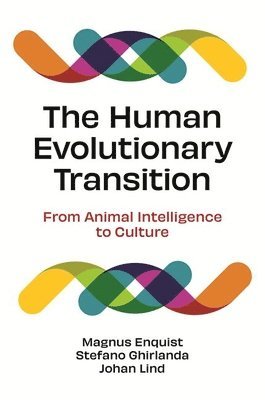
A major new theory of why human intelligence has not evolved in other speciesThe Human Evolutionary Transition offers a unified view of the evolution of intelligence, presenting a bold and provocative new account of how animals and humans have followed two powerful yet very different evolutionary paths to intelligence. This incisive book shows how animals rely on robust associative mechanisms that are guided by genetic information, which enable animals to sidestep complex problems in learning and decision making but ultimately limit what they can learn. Humans embody an evolutionary transition to a different kind of intelligence, one that relies on behavioral and mental flexibility. The book argues that flexibility is useless to most animals because they lack sufficient opportunities to learn new behavioral and mental skills. Humans find these opportunities in lengthy childhoods and through culture.Blending the latest findings in fields ranging from psychology to evolutionary anthropology, The Human Evolutionary Transition draws on computational analyses of the problems organisms face, extensive overviews of empirical data on animal and human learning, and mathematical modeling and computer simulations of hypotheses about intelligence. This compelling book demonstrates that animal and human intelligence evolved from similar selection pressures while identifying bottlenecks in evolution that may explain why human-like intelligence is so rare.
450 kr
Skickas inom 7-10 vardagar
A major new theory of why human intelligence has not evolved in other speciesThe Human Evolutionary Transition offers a unified view of the evolution of intelligence, presenting a bold and provocative new account of how animals and humans have followed two powerful yet very different evolutionary paths to intelligence. This incisive book shows how animals rely on robust associative mechanisms that are guided by genetic information, which enable animals to sidestep complex problems in learning and decision making but ultimately limit what they can learn. Humans embody an evolutionary transition to a different kind of intelligence, one that relies on behavioral and mental flexibility. The book argues that flexibility is useless to most animals because they lack sufficient opportunities to learn new behavioral and mental skills. Humans find these opportunities in lengthy childhoods and through culture.Blending the latest findings in fields ranging from psychology to evolutionary anthropology, The Human Evolutionary Transition draws on computational analyses of the problems organisms face, extensive overviews of empirical data on animal and human learning, and mathematical modeling and computer simulations of hypotheses about intelligence. This compelling book demonstrates that animal and human intelligence evolved from similar selection pressures while identifying bottlenecks in evolution that may explain why human-like intelligence is so rare.
227 kr
Tillfälligt slut
I denna volym presenteras delar av den aktuella forskning som ventilerades på Krapperups borg vid Gyllenstiernska Krapperupsstiftelsens symposium nr 6 år 2003, Arkeologi och naturvetenskap. Författarna har, under fyra teman - Samhälle, kriser och miljö, Det mentala landskapet, Människokroppens arkeologi och Människan och havet - hämtat sina exempel från när och fjärran i såväl tid som rum, men mest från Sverige och Danmark.