Mahmoud Nasrollahzadeh - Böcker
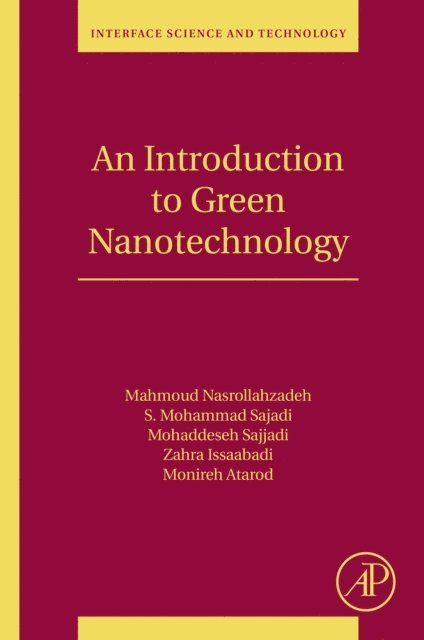
An Introduction to Green Nanotechnology
2 020 kr
Skickas inom 7-10 vardagar
An Introduction to Green Nanotechnology, Volume 28, provides students, scientists and chemical engineers with an overview of several types of nanostructures, discusses the synthesis and characterization of nanostructures, and provides applications of nanotechnology in daily life. The book offers a foundation to green nanotechnology by explaining why green nanotechnology is important. Covers biological sources in green nanotechnology, antioxidants, green nanostructures, mechanism, synthesis and characterization. The book ends with an evaluation of the risks of nanotechnology in human life and future perspectives.
Introduces novel sources of plants having a high potential to be used as bio media to synthesize nanostructures Provides phytochemical properties and antioxidant potential, and their effects on stability, morphology and size of green nanostructures Includes a medicinal and technological comparison of green synthesized nanostructures to nano-products from non-green methods Uses accessible language, avoiding complex concepts of mathematics, biology and chemistryBiopolymer-Based Metal Nanoparticle Chemistry for Sustainable Applications
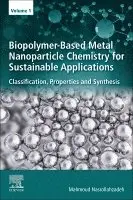
Volume 1: Classification, Properties and Synthesis
1 898 kr
Skickas inom 7-10 vardagar
Biopolymers are becoming an increasingly important area of research as traditional chemical feedstocks run low and concerns about environmental impacts increase. One area of particular interest is their use for more sustainable development of metal nanoparticles. Biopolymer-based Metal Nanoparticle Chemistry for Sustainability Applications, Volume 1 reviews key polymers found in nature, their characterization and modification, and processes for using them in the development of metal nanoparticles.
Beginning with an introduction to both green chemistry and biopolymers in Part 1, the book goes on to outline the classification of biopolymers in Part 2, with specific details on polysaccharides, proteins and polypeptides, lignin, and polylactic acid. Properties of biopolymers, including biodegradability and toxicity, are the focus of Part 3, before Part 4 goes on to discuss synthesis and characterization.
Reviews novel sources of polymers with high potential as green media for synthesizing nanostructures Provides technological details on the synthesis of natural polymer-based metal nanoparticles Highlights the use of natural polymer supports and the impact of their properties on stability, morphology and scale of nanostructuresBiopolymer-Based Metal Nanoparticle Chemistry for Sustainable Applications
Volume 2: Applications
1 898 kr
Skickas inom 7-10 vardagar
Biopolymers are becoming an increasingly important area of research as traditional chemical feedstocks run low and concerns about environmental impacts increase. One area of particular interest is their use for more sustainable development of metal nanoparticles. Biopolymer-Based Metal Nanoparticle Chemistry for Sustainability Applications, Volume 2 reviews key uses of biopolymers and biopolymer-based metal nanoparticles for a range of key sustainability-focused applications.
After providing contextual examples of applications across the fields of food science, biomedicine and biochemistry, the book goes on to explore further sustainability-focused applications of Biopolymer-Based Metal Nanoparticles in such important areas as catalysis, environmental science, biosensing, and energy.
Provides an overview of biopolymer-based metal nanoparticles for a wide range of applications Provides technological details on the synthesis of natural polymer-based metal nanoparticles Explores the role of biopolymer-based metal nanoparticles for more sustainable catalytic processesSolar Water Splitting
PV-Electrolysis, Photoelectrochemical, Photothermal, Photocatalyst, and Photobiological Methods
1 593 kr
Skickas inom 7-10 vardagar
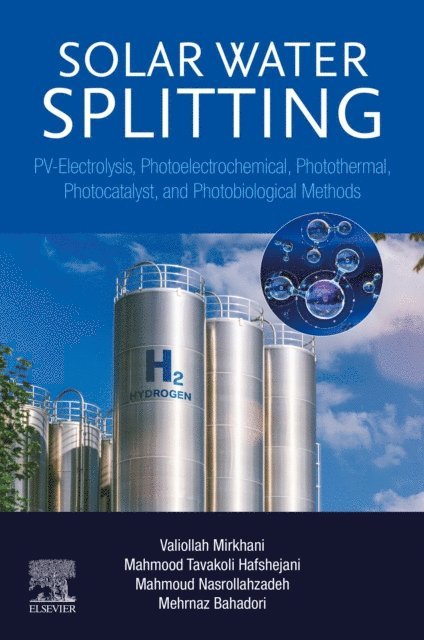
Solar Water Splitting: PV-Electrolysis, Photoelectrochemical, Photothermal, Photocatalyst, and Photobiological Methods is a fundamental resource offering detailed information on PV-electrolysis, photoelectrochemical, photothermal, photocatalyst, photobiological, and other innovative methods for the production of hydrogen gas, as well as presenting the theory, design, and materials involved. This is supported by application examples and recent developments in areas such as tandem cells, dye-sensitized photoelectrochemical cells, and perovskite cells for solar water splitting.This book will be of interest to researchers, scientists, and advanced students across solar energy, renewable energy, chemistry, chemical engineering, nanotechnology, and materials science, as well as engineers and industrial personnel with an interest in water splitting, solar cells, and hydrogen production.
Introduces the theory, design, and materials of solar water splittingProvides in-depth coverage of a range of processes and applicationsReviews current progress and considers future opportunities