Malay K. Kundu – författare
Visar alla böcker från författaren Malay K. Kundu. Handla med fri frakt och snabb leverans.
7 produkter
Pattern Recognition and Machine Intelligence
4th International Conference, PReMI 2011, Moscow, Russia, June 27 - July 1, 2011, Proceedings
Av Sergei O. Kuznetsov, Deba P. Mandal m. fl.
Häftad, 2011
566 kr
Lägg i varukorg
This book constitutes the refereed proceedings of the 4th International Conference on Pattern Recognition and Machine Intelligence, PReMI 2011, held in Moscow, Russia in June/July 2011. The 65 revised papers presented together with 5 invited talks were carefully reviewed and selected from 140 …
Pattern Recognition and Machine Intelligence
4th International Conference, PReMI 2011, Moscow, Russia, June 27 - July 1, 2011, Proceedings
Av Sankar Kumar Pal, Malay K. Kundu m. fl.
E-bok, 2011
755 kr
Lägg i varukorg
This book constitutes the refereed proceedings of the 4th International Conference on Pattern Recognition and Machine Intelligence, PReMI 2011, held in Moscow, Russia in June/July 2011. The 65 revised papers presented together with 5 invited talks were carefully reviewed and selected from 140 …
Perception and Machine Intelligence
First Indo-Japan Conference, PerMIn 2012, Kolkata, India, January 12-13, 2011, Proceedings
Av Malay K. Kundu, Sushmita Mitra m. fl.
Häftad, 2012
566 kr
Lägg i varukorg
This book constitutes the proceedings of the First Indo-Japanese conference on Perception and Machine Intelligence, PerMIn 2012, held in Kolkata, India, in January 2012. The 41 papers, presented together with 1 keynote paper and 3 plenary papers, were carefully reviewed and selected for inclusion …
Perception and Machine Intelligence
First Indo-Japan Conference, PerMIn 2012, Kolkata, India, January 12-13, 2011, Proceedings
Av Sankar K. Pal, Debasis Mazumdar m. fl.
E-bok, 2012
739 kr
Lägg i varukorg
This book constitutes the proceedings of the First Indo-Japanese conference on Perception and Machine Intelligence, PerMIn 2012, held in Kolkata, India, in January 2012. The 41 papers, presented together with 1 keynote paper and 3 plenary papers, were carefully reviewed and selected for inclusion …
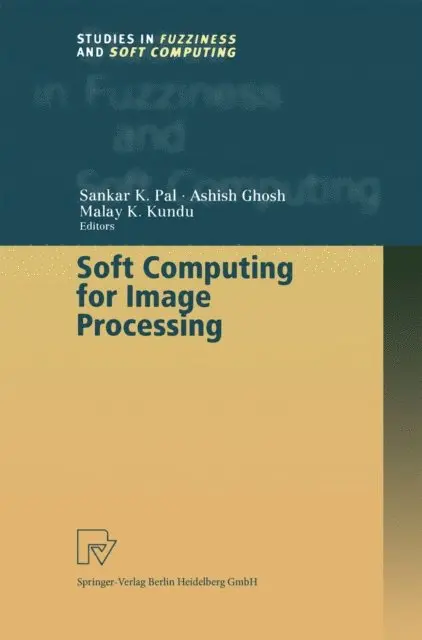
Soft Computing for Image Processing
Av Sankar K. Pal, Ashish Ghosh m. fl.
Inbunden, 2000
1636 kr
Lägg i varukorg
The volume provides a collection of 21 articles containing new material and describing, in a unified way with extensive real life applications, the merits and significance of performing different image processing/analysis tasks in soft computing paradigm. The articles, written by leading experts …
Soft Computing for Image Processing
Av Malay K. Kundu, Ashish Ghosh m. fl.
E-bok, 2013
2174 kr
Lägg i varukorg
Any task that involves decision-making can benefit from soft computing techniques which allow premature decisions to be deferred. The processing and analysis of images is no exception to this rule. In the classical image analysis paradigm, the first step is nearly always some sort of segmentation …
Soft Computing for Image Processing
Av Sankar K. Pal, Ashish Ghosh m. fl.
Häftad, 2010
1685 kr
Lägg i varukorg
Any task that involves decision-making can benefit from soft computing techniques which allow premature decisions to be deferred. The processing and analysis of images is no exception to this rule. In the classical image analysis paradigm, the first step is nearly always some sort of segmentation …