Malcolm W. Klein – författare
Visar alla böcker från författaren Malcolm W. Klein. Handla med fri frakt och snabb leverans.
11 produkter
11 produkter
E-bok
Engelska, 1997159 kr
Läs direkt efter köp
When the Soviet Union collapsed, the White House announced with great fanfare that 100 FBI counterintelligence agents would be reassigned. Their new target: street gangs. Americans--filled with fear of crack-dealing gangs--cheered the decision, as did many big-city police departments. But this highly publicized move could be an experience in futility, suggests Malcolm Klein: for one thing, most street gangs have little to do with the drug trade. The American Street Gang provides the finest portrait of this subject ever produced--a detailed accounting, through statistics, interviews, and personal experience, of what street gangs are, how they have changed, their involvement in drug sales, and why we have not been able to stop them. Klein has been studying street gangs for more than thirty years, and he brings a sophisticated understanding of the problem to bear in this often surprising book. In contrast to the image of rigid organization and military-style leadership we see in the press, he writes, street gangs are usually loose bodies of associates, with informal and multiple leadership. Street gangs, he makes clear, are quite distinct from drug gangs--though they may share individual members. In a drug-selling operation tight discipline is required--the members are more like employees--whereas street gangs are held together by affiliation and common rivalries, with far less discipline. With statistics and revealing anecdotes, Klein offers a strong critique of the approach of many law enforcement agencies, which have demonized street gangs while ignoring the fact that they are the worst possible bodies for running disciplined criminal operations--let alone colonizing other cities. On the other hand, he shows that street gangs do spur criminal activity, and he demonstrates the shocking rise in gang homicides and the proliferation of gangs across America. Ironically, he writes, the liberal approach to gangs advocated by many (assigning a social worker to a gang, organizing non-violent gang activities) can actually increase group cohesion, which leads to still more criminal activity. And programs to erode that cohesion, Klein tells us from personal experience, can work--but they require intensive, exhausting effort. Street gangs are a real and growing problem in America--but the media and many law enforcement officials continue to dispense misleading ideas about what they are and what they do. In The American Street Gang, Malcolm Klein challenges these assumptions with startling new evidence that must be understood if we are to come to grips with this perceived crisis.
Inbunden, Engelska, 1997
776 kr
Skickas inom 3-6 vardagar
This book provides an overview of the dominant philosophical approaches and practices in handling status offenders - the kinds of youth who habitually resist the control of their parents and schools, who run away from home, who drink and stay out after curfew. The three basic and competing social philosophies in responding to these troubled and troublesome youths are the treatment, deterrence, and normalization rationales. Local community services' response to status offenders in seven cities are investigated to determine whether local practices conform with the ideological thrusts embedded in state legislation.
Inbunden, Engelska, 2006
513 kr
Skickas inom 5-8 vardagar
Street Gang Patterns and Policies provides a crucial update and critical examination of knowledge about gangs and major gang control programs across the nation. Malcolm Klein and Cheryl Maxson here focus on gang proliferation, migration, and crime patterns, and highlight known risk factors that lead to youths joining gangs and to gang formation within communities. Dispelling long-standing assumptions that the public--and the media and law enforcement--have about street gangs, they present a comprehensive overview of how gangs are organized and structured. The authors assess the major gang programs across the nation, and argue that existing prevention, intervention and suppression methods, targeting individuals, groups, and communities, have been largely ineffective, when evaluated. Klein and Maxson close by offering policy guidelines for practitioners on how to intervene and control gangs more successfully. Filling an important gap in the literature on street gangs and social control, this book will be a must read for criminologists, social workers, policy makers, and criminal justice practitioners.
E-bok
PDF, Engelska, 1997283 kr
Läs direkt efter köp
This book provides an overview of the dominant philosophical approaches and practices in handling status offenders--those children who habitually resist the control of their parents and schools, who run away from home, who drink and stay out after curfew. The three basic and competing social philosophies in responding to these troubled and troublesome youths--discussed at length in this book--are known as the treatment, deterrence, and normalization rationales. In examining these philosophies, the authors consider the quality and quantity of response to and for status offenders at local community service outlets in seven different cities. In this way, Maxson and Klein are able to determine whether such response practices conform with the ideological thrusts embedded in state legislation. The results will surprise many legislative and youth service policy professionals. Agency characteristics, service-delivery patterns, and youth clients do indeed reflect the treatment, deterrence, and normalization rationales, but in ways that have little bearing on the dominant philosophies embodied by state legislation. Special chapters are devoted to those minors most likely to slip through the safety-net of youth service --chronic runaways and street kids. The authors discuss the implications of their findings for lawmakers and policy developers.
E-bok
PDF, Engelska, 2006270 kr
Läs direkt efter köp
In the past two decades, many prevention and suppression programs have been initiated on a national and local level to combat street gangs--but what do we really know about them? Why do youths join them? Why do they proliferate? Street Gang Patterns and Policies is a crucial update and critical examination of our understanding of gangs and major gang-control programs across the nation. Often perceived solely as an urban issue, street gangs are also a suburban and rural dilemma. Klein and Maxson focus on gang proliferation, migration, and crime patterns, and highlight known risk factors that lead to youths form and join gangs within communities. Dispelling the long-standing assumptions that the public, the media, and law enforcement have about street gangs, they present a comprehensive overview of how gangs are organized and structured. The authors assess the major gang programs across the nation and argue that existing prevention, intervention, and suppression methods targeting individuals, groups, and communities, have been largely ineffective. Klein and Maxson close by offering valuable policy guidelines for practitioners on how to intervene and control gangs more successfully. Filling an important gap in the literature on street gangs and social control, this book is a must-read for criminologists, social workers, policy makers, and criminal justice practitioners.
Häftad, Engelska, 2010
332 kr
Skickas inom 5-8 vardagar
In the past two decades, many prevention and suppression programs have been initiated on a national and local level to combat street gangs--but what do we really know about them? Why do youths join them? Why do they proliferate? Street Gang Patterns and Policies is a crucial update and critical examination of our understanding of gangs and major gang-control programs across the nation. Often perceived solely as an urban issue, street gangs are also a suburban and rural dilemma. Klein and Maxson focus on gang proliferation, migration, and crime patterns, and highlight known risk factors that lead to youths form and join gangs within communities. Dispelling the long-standing assumptions that the public, the media, and law enforcement have about street gangs, they present a comprehensive overview of how gangs are organized and structured. The authors assess the major gang programs across the nation and argue that existing prevention, intervention, and suppression methods targeting individuals, groups, and communities, have been largely ineffective. Klein and Maxson close by offering valuable policy guidelines for practitioners on how to intervene and control gangs more successfully. Filling an important gap in the literature on street gangs and social control, this book is a must-read for criminologists, social workers, policy makers, and criminal justice practitioners."This is an important book. Malcolm Klein and Cheryl Maxson here draw upon their own rich and pioneering research experience and that of others to provide the most comprehensive review of what is known and what needs to be known about gangs and their control in community contexts. I stand in awe of their accomplishment."-James F. Short, Jr., Past President of the American Sociological Association "The need to intervene successfully with street gangs is self-evident; unfortunately the way to do so is not. Klein and Maxson, based on a masterful review of the empirical literature on gangs and on gang intervention efforts, lay out a balanced and comprehensive strategy for confronting this problem head-on. Neither falsely optimistic nor unnecessarily gloomy, they provide a road map that, if followed, will yield substantial progress in our fight against gangs."-Terence P. Thornberry, Director, Research Program on Problem Behavior, University of Colorado
E-bok
Engelska, 2010270 kr
Läs direkt efter köp
In the past two decades, many prevention and suppression programs have been initiated on a national and local level to combat street gangs--but what do we really know about them? Why do youths join them? Why do they proliferate? Street Gang Patterns and Policies is a crucial update and critical examination of our understanding of gangs and major gang-control programs across the nation. Often perceived solely as an urban issue, street gangs are also a suburban and rural dilemma. Klein and Maxson focus on gang proliferation, migration, and crime patterns, and highlight known risk factors that lead to youths form and join gangs within communities. Dispelling the long-standing assumptions that the public, the media, and law enforcement have about street gangs, they present a comprehensive overview of how gangs are organized and structured. The authors assess the major gang programs across the nation and argue that existing prevention, intervention, and suppression methods targeting individuals, groups, and communities, have been largely ineffective. Klein and Maxson close by offering valuable policy guidelines for practitioners on how to intervene and control gangs more successfully. Filling an important gap in the literature on street gangs and social control, this book is a must-read for criminologists, social workers, policy makers, and criminal justice practitioners.
Del 1 - Violence Prevention and Policy
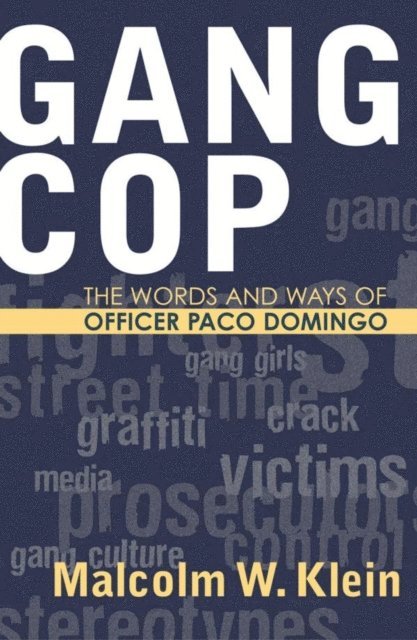
Gang Cop
The Words and Ways of Officer Paco Domingo
Häftad, Engelska, 2003
452 kr
Skickas inom 10-15 vardagar
Paco Domingo is a street cop, a gang cop, a composite figure derived from criminologist Malcolm Klein's real observations, actual incidents, and verbatim court testimony in over 40 years of police and gang research. Klein, well-known criminologist and police consultant, tells the story of Domingo, who is deeply engaged in battling his street gang opponents. The author points to the dangers in police elite units when a 'tough cop' begins to rationalize the use of police violence and corruption. For all of those concerned with dealing in practical ways with street gangs, the greatest impediment has been ignorance about their nature. Klein highlights the importance of the training of gang cops, often the first point of contact with gang members in the community. He points out the discrepancies between some of their views and assumptions of fact in law enforcement on the one hand, and what criminological research has discovered on the other. The author assesses the knowledge and skills of the gang cop, and current gaps in our knowledge of street gangs. This book will be valuable to law enforcement personnel, lawyers, criminologists, and community and governmental agencies concerned with the proliferation of gangs in America's towns.
E-bok
Engelska, 2004514 kr
Läs direkt efter köp
Paco Domingo is a street cop, a gang cop, a composite figure derived from criminologist Malcolm Klein''s real observations, actual incidents, and verbatim court testimony in over 40 years of police and gang research. Klein, well-known criminologist and police consultant, tells the story of Domingo, who is deeply engaged in battling his street gang opponents. The author points to the dangers in police elite units when a ''tough cop'' begins to rationalize the use of police violence and corruption. For all of those concerned with dealing in practical ways with street gangs, the greatest impediment has been ignorance about their nature. Klein highlights the importance of the training of gang cops, often the first point of contact with gang members in the community. He points out the discrepancies between some of their views and assumptions of fact in law enforcement on the one hand, and what criminological research has discovered on the other. The author assesses the knowledge and skills of the gang cop, and current gaps in our knowledge of street gangs. This book will be valuable to law enforcement personnel, lawyers, criminologists, and community and governmental agencies concerned with the proliferation of gangs in America''s towns.
Häftad, Engelska, 2000
1 084 kr
Skickas inom 10-15 vardagar
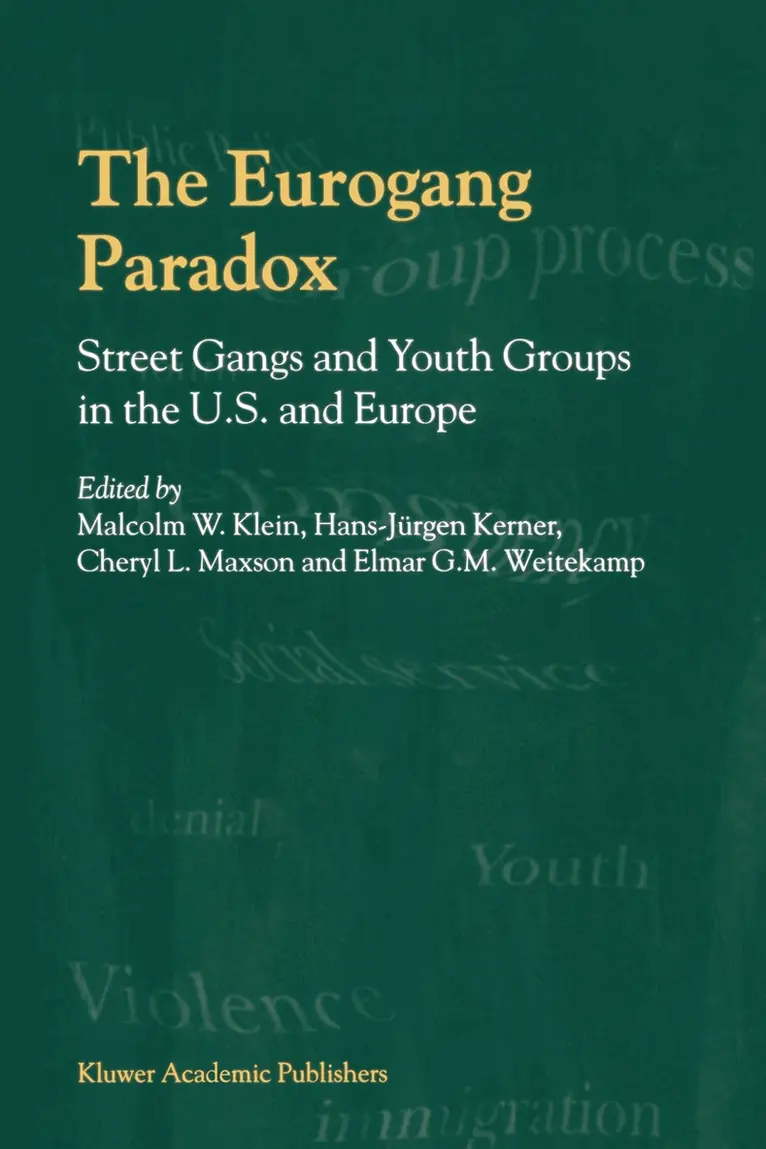
The Eurogang Paradox is the first comprehensive collection of original research reports on the status of street gangs and problematic youth groups in Europe, as well as a set of special, state-of-the-art reports on the current status of American street gang research and its implications for the European gang situation. Seven American papers are joined with reports from England, Norway, Sweden, Denmark, Germany, Russia, Holland, Belgium, France, and Slovenia. Summary chapters by the American and European editors provide overviews of the street gang picture: the associated issues and problems of definition, community context, comparative research procedures, and implications for prevention and intervention. Professionals and students will find these papers easy to comprehend yet fully informative on comparative street gang studies.
Häftad, Engelska, 2009
190 kr
Skickas inom 5-8 vardagar