Manfred Diehl - Böcker
Visar alla böcker från författaren Manfred Diehl. Handla med fri frakt och snabb leverans.
5 produkter
5 produkter
2 617 kr
Skickas inom 10-15 vardagar
Intraindividual variability (IIV) of human development and behavior across the entire life-span is explored in this new book. Leading researchers summarize recent findings on the extent, role, and function of IIV in human development with a focus on how, when, and why individuals change over time. The latest theoretical, methodological, and technological advances are reviewed. The book explores the historical and theoretical background and challenges of IIV research along with its role and function in childhood, adolescence, and adulthood. Edited to maximize consistency and accessibility, each chapter includes an introduction and a review of the research and most explore future directions, new theoretical developments, and conclusions and implications. Readers are shown that by focusing on the individual as a unit of analysis across different time scales, conditions, and situations, researchers can effectively demonstrate behavioral and developmental regularities at different points of the life-span. As such this book is a must have for anybody interested in IIV research. The book explores: -New designs and methods for the analysis of intensive repeated measures data. -The importance of real-time data for more time sensitive and ecologically valid measurements. -The role and function of intraindividual variability in behavior and development across the life-span -- from infancy to later life. -Numerous examples of how intraindividual variability research is conducted. -Topics and findings that are commonly treated in disparate bodies of literature from various disciplines.Part 1 provides a historical, conceptual, and methodological overview of the study of intraindividual variability (IIV). IIV during childhood and adolescence and its application in the investigation of development of language acquisition, infant-parent interactions, development of motor skills, cognitive development, mood regulation, and identity development are examined in Part 2. Part 3 focuses on IIV during adult development, including its use in neuropsychological functioning and attention and in personality development and mood regulation. IIV in the context of adults’ health behavior is also reviewed. Part 4 examines the key issues and challenges of IIV research in human development such as whether IIV in adult development is an indicator of vulnerability or resilience, the association between short-term IIV and long-term developmental change, and multiple time-scale design and analysis. The volume concludes with a look at the future of intraindividual variation analysis.Intended for advanced students and researchers in developmental psychology across the life-span, social, personality, and health psychology, as well as sociology, family studies, gerontology, education, and medicine, interested in intraindividual variability of behavior and its role in human development, this book also serves as a text for graduate courses on longitudinal analysis, multilevel modeling, and/or (advanced) data analysis offered in these departments. Knowledge in human development or life course sociology and graduate-level statistics is recommended.
2 030 kr
Skickas inom 10-15 vardagar
Intraindividual variability (IIV) of human development and behavior across the entire life-span is explored in this new book. Leading researchers summarize recent findings on the extent, role, and function of IIV in human development with a focus on how, when, and why individuals change over time. The latest theoretical, methodological, and technological advances are reviewed. The book explores the historical and theoretical background and challenges of IIV research along with its role and function in childhood, adolescence, and adulthood. Edited to maximize consistency and accessibility, each chapter includes an introduction and a review of the research and most explore future directions, new theoretical developments, and conclusions and implications. Readers are shown that by focusing on the individual as a unit of analysis across different time scales, conditions, and situations, researchers can effectively demonstrate behavioral and developmental regularities at different points of the life-span. As such this book is a must have for anybody interested in IIV research. The book explores: -New designs and methods for the analysis of intensive repeated measures data. -The importance of real-time data for more time sensitive and ecologically valid measurements. -The role and function of intraindividual variability in behavior and development across the life-span -- from infancy to later life. -Numerous examples of how intraindividual variability research is conducted. -Topics and findings that are commonly treated in disparate bodies of literature from various disciplines.Part 1 provides a historical, conceptual, and methodological overview of the study of intraindividual variability (IIV). IIV during childhood and adolescence and its application in the investigation of development of language acquisition, infant-parent interactions, development of motor skills, cognitive development, mood regulation, and identity development are examined in Part 2. Part 3 focuses on IIV during adult development, including its use in neuropsychological functioning and attention and in personality development and mood regulation. IIV in the context of adults’ health behavior is also reviewed. Part 4 examines the key issues and challenges of IIV research in human development such as whether IIV in adult development is an indicator of vulnerability or resilience, the association between short-term IIV and long-term developmental change, and multiple time-scale design and analysis. The volume concludes with a look at the future of intraindividual variation analysis.Intended for advanced students and researchers in developmental psychology across the life-span, social, personality, and health psychology, as well as sociology, family studies, gerontology, education, and medicine, interested in intraindividual variability of behavior and its role in human development, this book also serves as a text for graduate courses on longitudinal analysis, multilevel modeling, and/or (advanced) data analysis offered in these departments. Knowledge in human development or life course sociology and graduate-level statistics is recommended.
806 kr
Skickas inom 7-10 vardagar
Renowned experts in adult development and aging, Manfred Diehl and Hans‑Werner Wahl synthesize decades of psychological research into a comprehensive volume that considers later life in the context of lifespan development, social and physical environmental factors, and historical amp ndash cultural influences. In so doing, they review important research on cognitive functioning, behavioral processes, personality and identity development, and overall well‑being in middle to late adulthood. Diehl and Wahl amp rsquo s three-part framework helps readers better understand that the development process is influenced by multiple factors and can take many different trajectories. Through this contextualized perspective, they examine the influence that previous life experiences, beginning in early childhood, can have on the aging process in older adults. This includes social relations, technological advances, societal perspectives on aging, and education. The authors also examine the challenges and opportunities of aging, using a strength‑based approach to promote a diverse, nuanced understanding of successful, healthy aging. Chapters also conclude with dialogues from other experts in the field, offering multiple different perspectives on the research.
1 095 kr
Skickas inom 10-15 vardagar
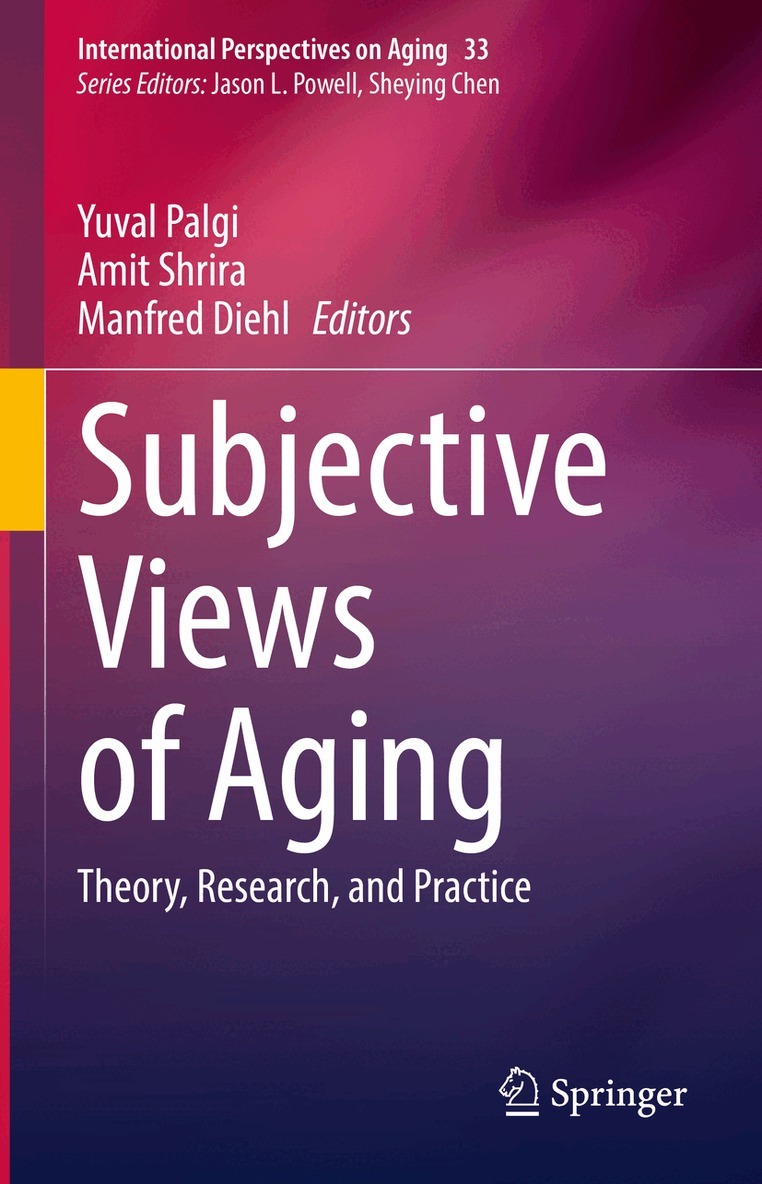
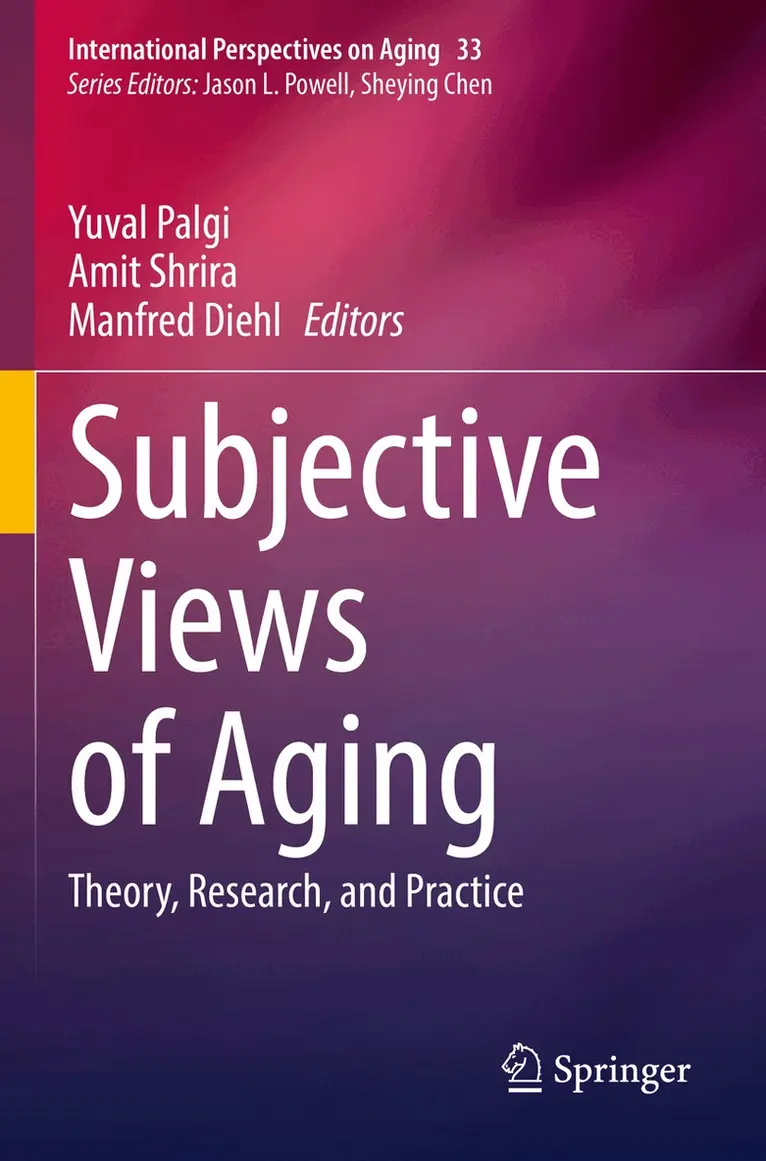
This book focuses on the concept of subjective views of aging. The theoretical section expands the framework of subjective views of aging with the inclusion of additional concepts, and further integrates these concepts by accounting for their synergistic effects.
1 095 kr
Skickas inom 10-15 vardagar
This book focuses on the concept of subjective views of aging. This concept refers to the way individuals conceptualize and perceive the aging process. Social and cultural perceptions regarding older adults are incorporated and internalized into views people hold regarding their own aging process. The book contains three parts which present theoretical, empirical, and translational perspectives about subjective views of aging. The theoretical section expands the framework of subjective views of aging with the inclusion of additional concepts, and further integrates these concepts by accounting for their synergistic effects. The empirical section presents recent developments in the field starting at the intra-individual level as assessed by ecological momentary assessments, going through the level of interpersonal relationships, and concluding at the social and cultural levels. Finally, the translational section presents recent endeavours to develop interventions aimed at advancing favourable views of aging. This cutting-edge edited book includes chapters written by internationally renowned scholars in the field and serves as an up-to-date resource for scholars in the field as well as a textbook for students in courses like social gerontology, lifespan psychology, and life course sociology.