Manuel Berenguel – författare
1 620 kr
Skickas inom 10-15 vardagar
2 049 kr
Läs direkt efter köp
1 416 kr
Läs direkt efter köp
1 082 kr
Skickas inom 10-15 vardagar
1 620 kr
Skickas inom 10-15 vardagar
1 082 kr
Skickas inom 10-15 vardagar
1 367 kr
Läs direkt efter köp
The aim of this book is to research comfort control inside buildings, and how this can be achieved through low energy consumption. It presents a comprehensive exploration of the design, development and implementation of several advanced control systems that maintain users'' comfort (thermal and indoor air quality) whilst minimizing energy consumption. The book includes a detailed account of the latest cutting edge developments in this area, and presents several control systems based on Model Predictive Control approaches. Real-life examples are provided, and the book is supplemented by illustrations, tables, all of which facilitate understanding of the text.
Energy consumption in buildings (residential and non-residential) represents almost the half of the total world energy consumption, and they are also responsible for approximately 35% of CO2 emissions. For these reasons, the reduction of energy consumption associated with the construction and use of buildings, and the increase of energy efficiency in their climatic refurbishment are frequently studied topics in academia and industry. As the productivity of users is directly related to their comfort, a middle ground needs to be found between comfort of users and energy efficiency. In order to achieve this, it is necessary to develop innovation and technology which can provide comfortable environments with minimum energy consumption. This book is intended for researchers interested in control engineering, energy and bioclimatic buildings, and for architects and process control engineers. It is also accessible to postgraduate students embarking on a career in this area, particularly those studying architecture.
1 082 kr
Skickas inom 10-15 vardagar
1 190 kr
Skickas inom 10-15 vardagar
1 108 kr
Läs direkt efter köp
Automatic Control with Interactive Tools is a textbook for undergraduate study of automatic control. Providing a clear course structure, and covering concepts taught in engineering degrees, this book is an ideal companion to those studying or teaching automatic control. The authors have used this text successfully to teach their students.
By providing unique interactive tools, which have been designed to illustrate the most important automatic control concepts, Automatic Control with Interactive Tools helps students overcome the potential barriers presented by the significant mathematical content of automatic control courses. Even when they have previously had only the benefit of an introductory control course, the software tools presented will help readers to get to grips with the use of such techniques as differential equations, linear algebra, and differential geometry.
This textbook covers the breadth of automatic control topics, including time responses of dynamic systems, the Nyquist criterion and PID control. It switches smoothly between analytical and practical approaches. Automatic Control with Interactive Tools offers a clear introduction to automatic control, ideal for undergraduate students, instructors and anyone wishing to familiarize themselves with the fundamentals of the subject
867 kr
Skickas inom 10-15 vardagar
1 512 kr
Skickas inom 10-15 vardagar
1 891 kr
Läs direkt efter köp
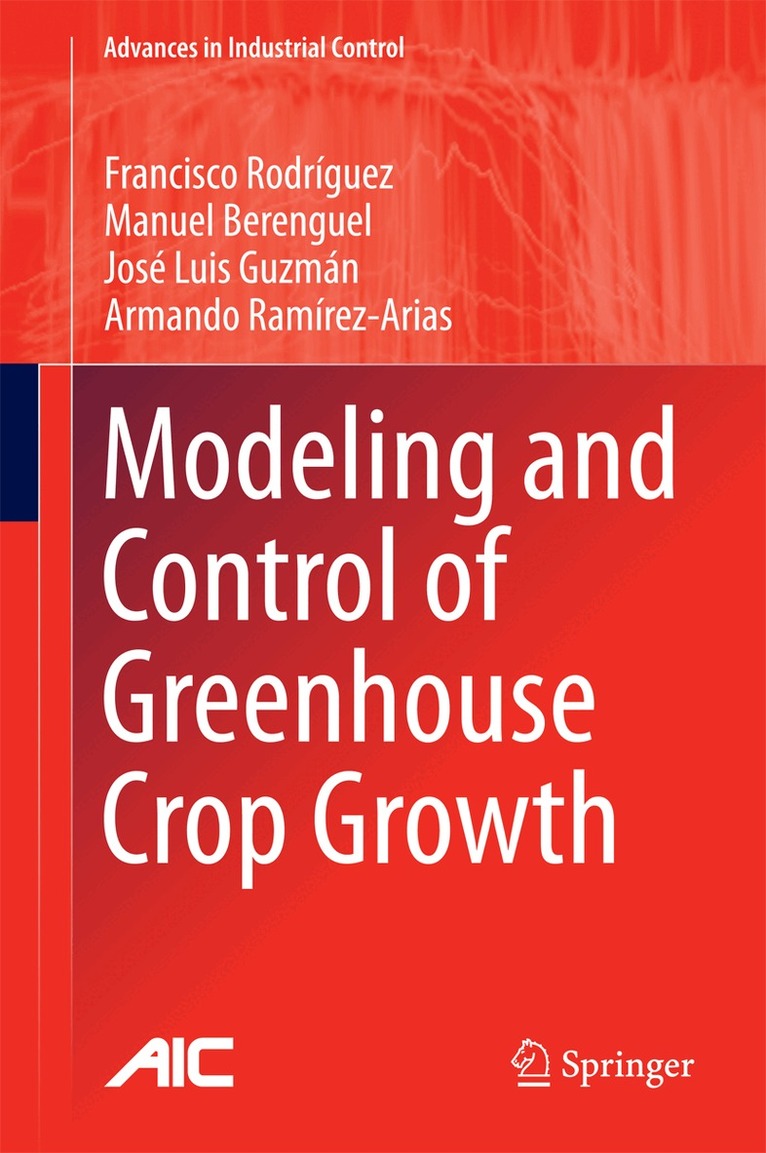
A discussion of challenges related to the modeling and control of greenhouse crop growth, this book presents state-of-the-art answers to those challenges. The authors model the subsystems involved in successful greenhouse control using different techniques and show how the models obtained can be exploited for simulation or control design; they suggest ideas for the development of physical and/or black-box models for this purpose.
Strategies for the control of climate- and irrigation-related variables are brought forward. The uses of PID control and feedforward compensators, both widely used in commercial tools, are summarized. The benefits of advanced control techniques—event-based, robust, and predictive control, for example—are used to improve on the performance of those basic methods.
A hierarchical control architecture is developed governed by a high-level multiobjective optimization approach rather than traditional constrained optimization and artificial intelligence techniques. Reference trajectories are found for diurnal and nocturnal temperatures (climate-related setpoints) and electrical conductivity (fertirrigation-related setpoints). The objectives are to maximize profit, fruit quality, and water-use efficiency, these being encouraged by current international rules. Illustrative practical results selected from those obtained in an industrial greenhouse during the last eight years are shown and described. The text of the book is complemented by the use of illustrations, tables and real examples which are helpful in understanding the material.
Modeling and Control of Greenhouse Crop Growth will be of interest to industrial engineers, academic researchers and graduates from agricultural, chemical, and process-control backgrounds.
1 512 kr
Skickas inom 10-15 vardagar